
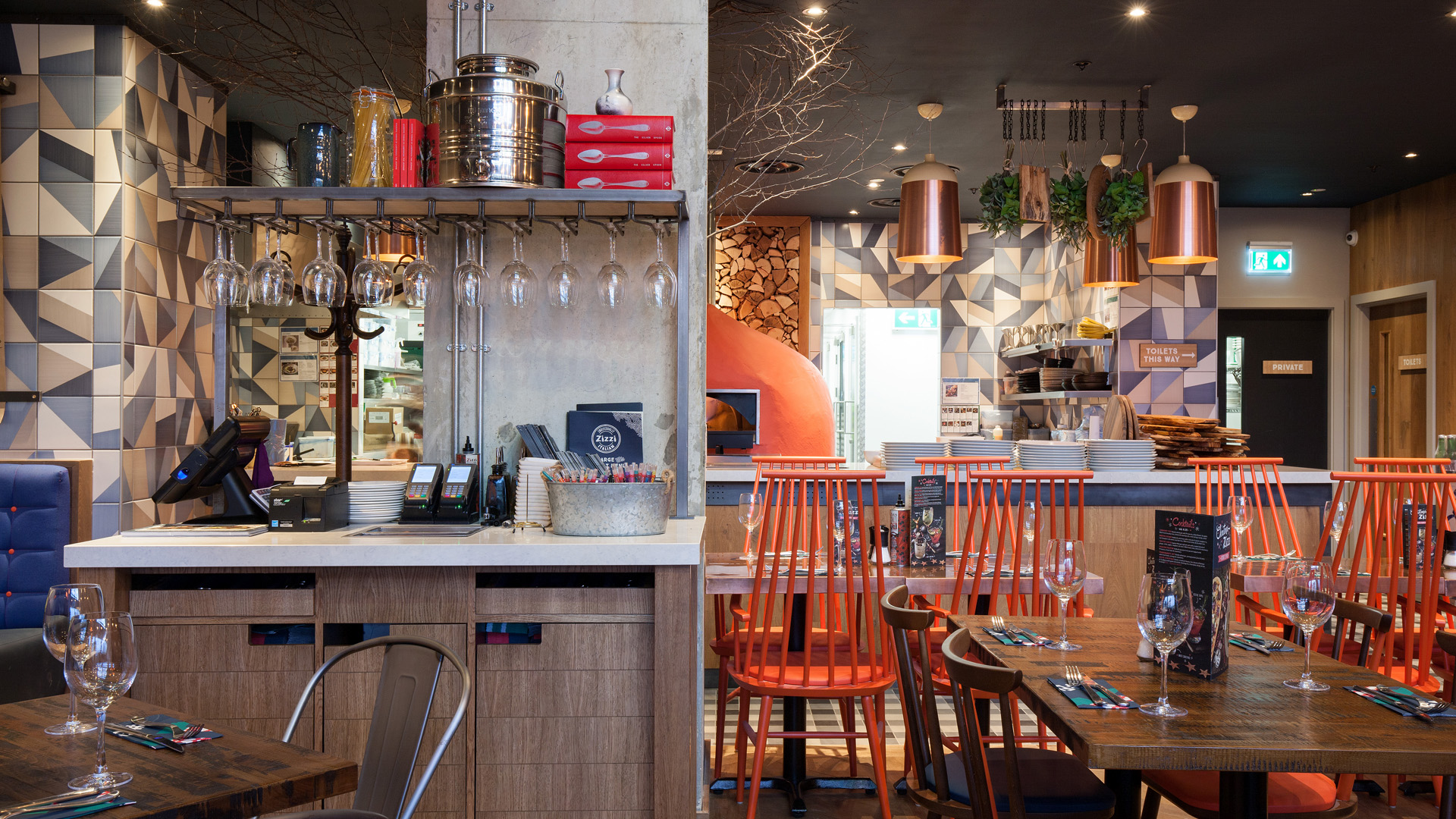
Working in collaboration with concept designer Candy Murray of Blockwork Design Ltd, Fuse handed over the 132 cover restaurant in December 2016. Based on the Concept of ‘A point of departure’, the 285 sqm restaurant boasts a variety of finishes from parquet flooring to exposed concrete elements complimented by a subtle industrial references.
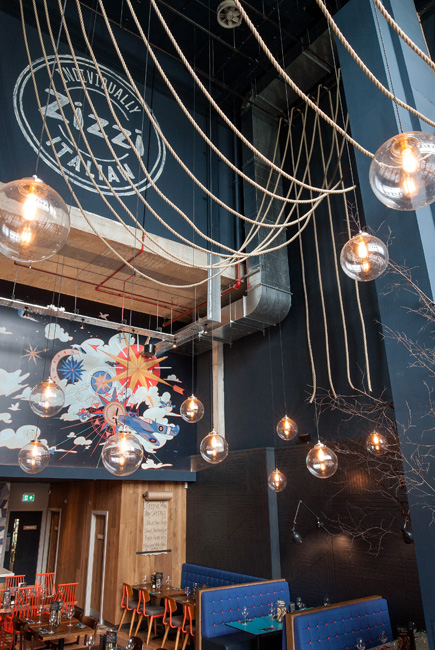
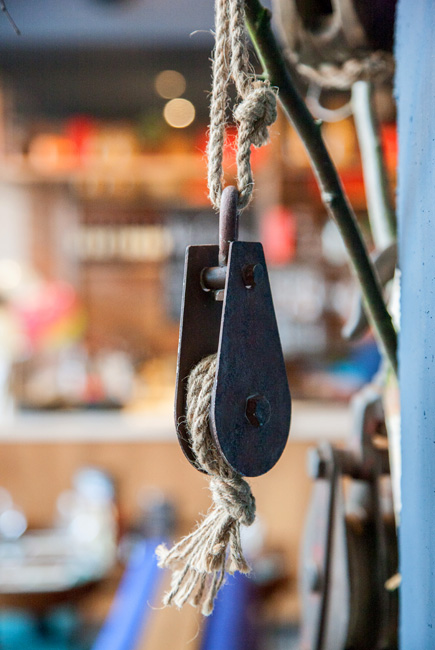
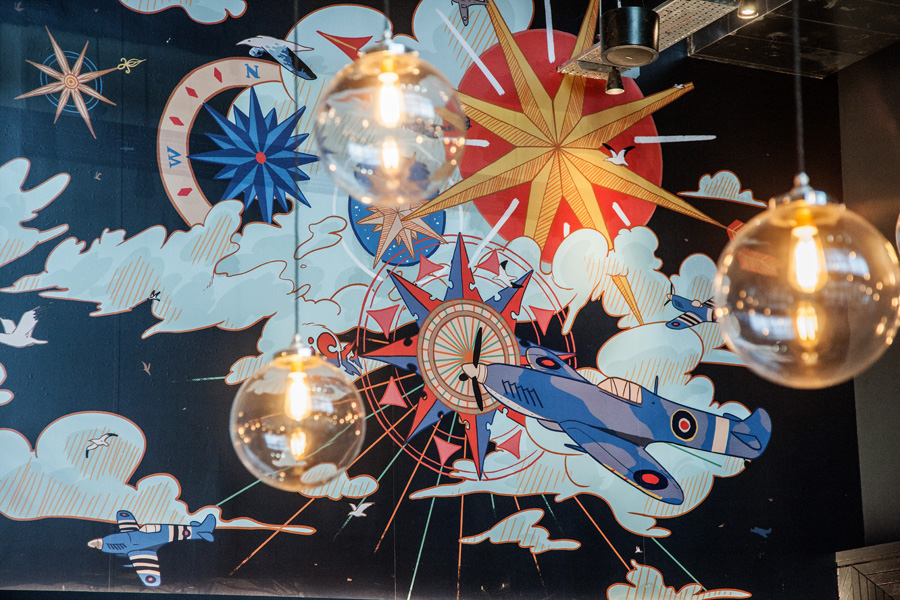
Visible from the sea walls of Southampton, the triple height restaurant’s main feature is a full height installation of ropes and pulleys inspired by the local docklands. The ropes are deliberately positioned not only to lower the perceived ceiling heights for the diners below but also to frame the large Zizzi roundel positioned at high level within the space. As with all Zizzi restaurants, the regular brand features of an open pizza oven, comfy seating, signature birch trees and illustrated mural inspired by the local area are all included.
The unit is located on level 2 in WestQuay Watermark Shopping Centre. A brand new leisure–led hub with over 20 restaurants, cinema and bowling alley. Located in the heart of Southampton city centre, the watermark centre is actually built on land that was once open water so the unit enjoys enviable views over towards the seawalls of Southampton.
Project interior designer for Fuse was Rick Cartwright with assistance from Emma Howson and Mandy Wright. Director in charge was Scott Ryalls.
The main contractor was Gary Bluff Projects Ltd of Chesterfield, Derbyshire. Catering design and installation was by Intracat Ltd of Cambridge; Mechanical Design & Installation was Chapman Ventilation and the electrical design and install was in the hands of Amdon Electrical.


Fuse began its work on the Victoria Gate Casino as long ago as 2012 when Global Gaming Ventures (GGV) approached us to assist them in putting together a credible bid for the coveted 2005 Gambling Act license in Leeds – one of only eight ‘large’ casino licenses in the UK. At the time, GGV didn’t have a site or a development partner. We reacted quickly and put together a shortlist of potential sites. To cut a long story short, GGV won the license competition just a few weeks later with a Fuse design for the new venue and a partnership with Hammerson plc to provide a home for the casino within their spectacular Victoria Gate retail development.
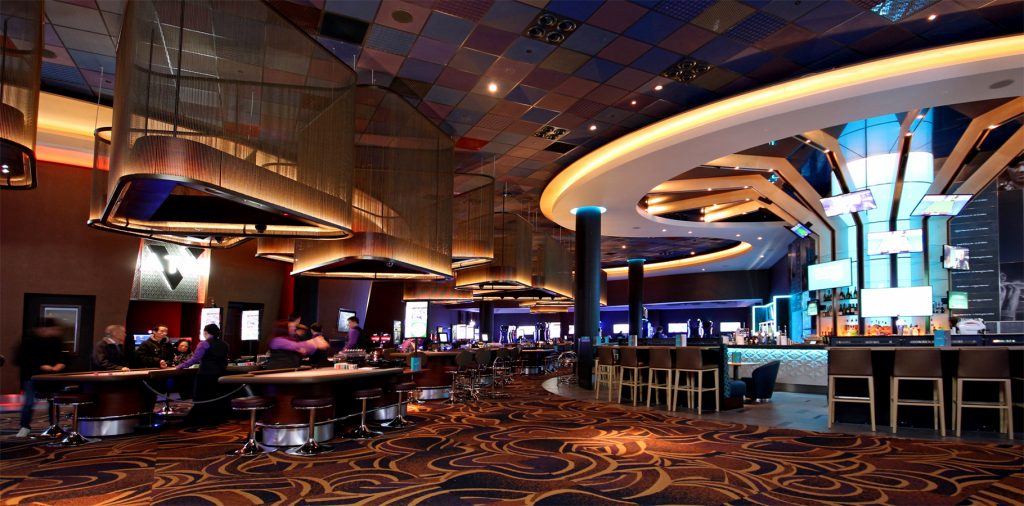
Nearly 5 years, over 300 Fuse drawings and over 25,000 emails later, the new venue was unveiled to the public in January 2017. Staying with the statistics, the casino which is the size of 18 tennis courts cost £30m to turn into a reality and the casino has created more than 200 jobs in the Leeds City Region. It boasts 24 gaming tables, 140 slots, 80 electronic gaming terminals and a 100 seat dedicated poker area – plus two spectacular bars and a restaurant. 432,000 bronze beads were used in the canopies over the gaming pits and 1.9km of carpet cover most of the floor (that’s around 8 tonnes) with about 50km of data cable concealed beneath it. There are 102 TV screens, of which 21 make up a huge video wall to show major sporting events.
The casino sits at second floor over the retail arcades below and is actually arranged over three levels. This posed a huge challenge for the design team as casinos generally consist of a single flat floor. The philosophy was therefore to turn this disadvantage into a virtue and use the levels to create smaller, intimate zones such that the very large venue never feels very large to the customers using it. Another issue with gaming floors is that the slots and tables (and the customers) tend to block low level views so new visitors can struggle to understand the layout of the space. Here, the ceilings have been used to provide clues (a device known as ‘cognitive mapping’). The gaming floor ceilings therefore have a curvaceous edge which tells the visitor where the space continues around the corner – encouraging exploration and distribution of people around the casino.
This edge detail, which became known as ‘the blade’, is made up of a layer of birch plywood, illuminated from below by a concealed warm white LED light. Above it is the accessible ceiling, made up of a dozen or more different ceiling tiles, painted in a dozen different shades of blue and interspersed with steel and aluminium mesh tiles which allow the ceiling void to be used as a return air plenum.
Another significant challenge was the height of the space. We wanted to maintain as much height as possible to make the casino as dramatic as it could be but we also had to deal with the need to provide lighting and cameras at low level over the gaming tables. The solution was the innovative pit canopies – hardwood-clad triangles that ‘float’ over the gaming tables with interchangeable panels on the underside containing speakers, lights and cameras. To reduce the impression of their weight, curtains of illuminated bronze beads encase them and extend upwards towards the ceiling, making them appear more delicate and at the same time creating a sense of intimacy at the tables below – despite the considerable true height of the room.
By contrast, the two bars (right and below) make maximum use of the height. ‘Live’, the venue’s sports bar, is wrapped around an illuminated column of steel mesh framed with enormous plywood blades that support an array of flat screen televisions showing sports events whereas ‘curve’, the more luxurious cocktail bar, boasts a huge display of whiskies and champagnes as its backdrop.
The Live bar front is clad in geometric Kaza concrete tiles, topped with a Corian counter top. The walls are clad in natural slates which are decorated with the names of famous sporting winners of the past. At Curve, the bar front is of herringbone, quarter-cut oak with a bar top of stunning, figured granite. The walls are of polished hardwood.
The bars are very deliberately designed to appeal to different audiences – or to the same audience at different times. Groups of friends might gravitate to Live whereas couples might be more inclined to spend time at Curve. Live is situated close to the entrance and provides a convenient refuge for the first-time casino visitor.



In terms of gaming content, the venue is divided into two main areas (with a third area at mezzanine level due to be opened in 2018). The upper gaming floor (top left) contains the largest of the gaming table pits and two distinct slot zones. This area is closest to the entrance and so is busy throughout the week and around the clock. The lower gaming floor pit (bottom left) is slightly smaller and is overlooked by the V Restaurant, a 50-cover, up-market dining experience. At one end of the lower floor is the Poker area, currently home to ten tables. The lower floor comes in to its own on Fridays and Saturdays when well over 2,000 customers pass through the doors each day.


The Fuse team was led by Director, David Matthews. Associate David Eastwood and interior designer Paul Henning lived and breathed the project for several years and both deserve medals. Tracy Heywood led on the FF&E and made an enormously important contribution on design – not least in her work on the Curve bar. Technical support came from Iain McDonald, Mandy Wright and and Professor Revit, Rob Moules. The project would never have been built without Sami Lee’s constant support on the project administration and constant, hot running caffeine. Just about all of the Fusiliers got involved at some point.
The venue wouldn’t look half as good without the inspired work by our regular partners in crime – lighting designers extraordinaire, Technical Arts, under the leadership of Chris Filippidis. The complex mechanical and electrical design was by BSE3d from down South under the watchful eye of Phil Todd and Graham Bowes respectively. Project management and contract adminstration was provided by the hugely experienced Bob Turley of the Emeny Turley Partnership from Birmingham who indulged us often and still kept the project within budget.
Cost consultancy and valuation was by Currie & Brown in the person of Geoff Cairns. Structural matters were under the stewardship of our local pals Mark Brady and Steve Bell at Roscoe; acoustic design was by Jason Clouston at Scotch Partners, John Hutchinson at Currie & Brown provided health and safety advice to Fuse in our role as principal designer. Craig Matthews (no relation) of Momentum Wayfinding helped us out with the signage.
On site, the main contractor was Phelan Construction led by Darren McQuire and Danny McGowan back at the mothership and by a site team led by Chris Field with vital roles played by Shaun Carter, Rory Wilson, Paul Gardner, Craig Bennett, Paul Jones and Kathryn Wheatley. Mechanical installations were untangled by Hensall Mechanical Services under the leadership of Mark Levenston and Mark Robinson. Andrew Austin of DPS Electrical and his team laid more miles of cable than you can shake a stick at. Audio-visual installations were by the Willow team led by Chris Hampson, data installations were by IT Backbone under Jason Chaplin and security and CCTV was by Amberstone led by Andy Foster. Signage was by Spectrum Signs, furniture was supplied by Angus MacRae Interiors and the carpets came from Shaw Contract in the USA. Lifts and escalators were supplied (eventually!) by Kone and Schindler respectively.
Our very sincere thanks go to our remarkable client, Global Gaming Ventures, notably Tony Wollenberg, Andrew Herd, Paul Sculpher and Deborah Roil. These four stalwarts were GGV in the early days and they placed an unparalleled degree of trust in the Fuse team to design a venue without all the usual client departments to dictate how things should be done. In the later stages, the addition of Patrick Noakes (Venue Director), Duncan Bachelor (Finance), John Davies (Food and Beverage) and Leanne McKenna (Marketing) allowed the loose ends to be tied off just in time!
Thank you all.

Istanbul is one of the most amazing cities on earth. Home to a staggering 15 million people, it is where ancient meets modern, Europe meets Asia and it is a veritable maelstrom of cultures. The Fuse-designed Hard Rock Cafe in the heart of this remarkable metropolis opened its doors in the summer of 2014 and it had to be special. Here is the story behind its design and construction.
First, the location. Our client, Retail Platform, a successful Turkish retail and restaurant operator which also has a number of Carluccio’s restaurants across the city, had been looking for a suitable site for a couple of years when it found the ideal location just off Istiklal Cadessi (Istiklal Street) which is the very long pedestrianised street leading from the historic Galata Tower area at the western end to the world-famous Taksim Square at the East. It is reputed to have a footfall of over a million people every day.
The building itself, comprising a basement, ground and five further floors, once housed Istanbul’s very first cinema but at the time we first saw it, it was derelict and crumbling with daylight visible through the walls and roofs. In fact, it was originally at least four separate buildings that had been remodeled many times over the centuries such that few original features remained internally. Even so, a major restoration was required before the building could be transformed into a Hard Rock Cafe.
Internally, there was only one staircase at the centre of the building which could not be used for servicing or for fire escape so the first job was to introduce a new stair core and elevator linking all the levels and provide safe escape and delivery access to the rear of the building. Externally, the front facade required careful restoration, from the ornate window surrounds of the upper floors to the marble storefront surround at the street level.

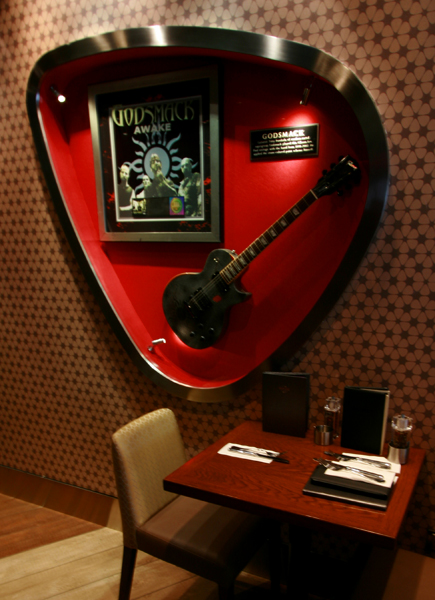
The unit is accessed via a relatively narrow space opening onto the main street and this could only be occupied by the new Rock Shop (below left, centre and right). Here is the first use of the plectrum (or guitar pick as they say in the USA) motif which is a recurring theme of the design – chosen because this shape can be repeated geometrically to create patterns reminiscent of those used in traditional Turkish and Ottoman ceramics and fabrics. The Rock Shop walls are of 3mm powder-coated aluminium sheet fret cut with the guitar pick pattern and back-lit with red LED. Both the retail fixtures and the memorabilia cabinets also exploit the motif.
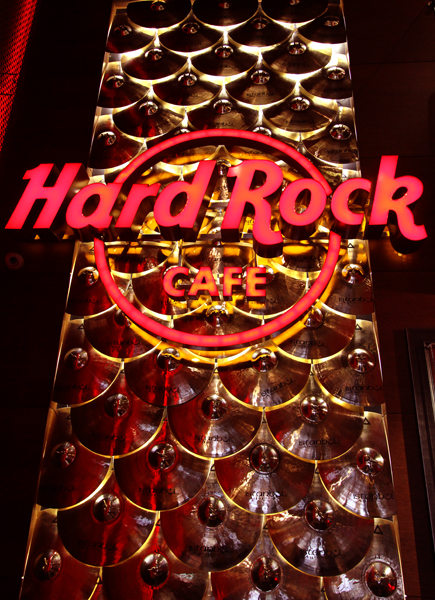
At the back of the Rock Shop is the cymbal wall, included because Istanbul is where most of the world’s cymbals are manufactured and where, it is said, the percussion instrument originated.
Beyond the Rock Shop, the venue opens out into a larger area which contains the main bar. Here the ceilings were relatively low and the floors were constructed of contemporary concrete so the decision was taken to open up the floor and create a double height backdrop to the bar. In addition, reflective Barrisol membrane panels were used on the ceiling to introduce some reflectivity. The floor throughout the Rock Shop and bar areas is a collage of traditional Turkish tiles mixed with more contemporary, larger format tiles through which a ‘yellow brick road’ of pale tile strips indicates the customer route deeper into the building.
Beside the bar, the stage doubles as a lounge area when not in use for live performance and is home to an eclectic mix of unusual but comfortable furiniture.
Beyond the Rock Shop, the venue opens out into a larger area which contains the main bar. Here the ceilings were relatively low and the floors were constructed of contemporary concrete so the decision was taken to open up the floor and create a double height backdrop to the bar. In addition, reflective Barrisol membrane panels were used on the ceiling to introduce some reflectivity.
The floor throughout the Rock Shop and bar areas is a collage of traditional Turkish tiles mixed with more contemporary, larger format tiles through which a ‘yellow brick road’ of pale tile strips indicates the customer route deeper into the building.
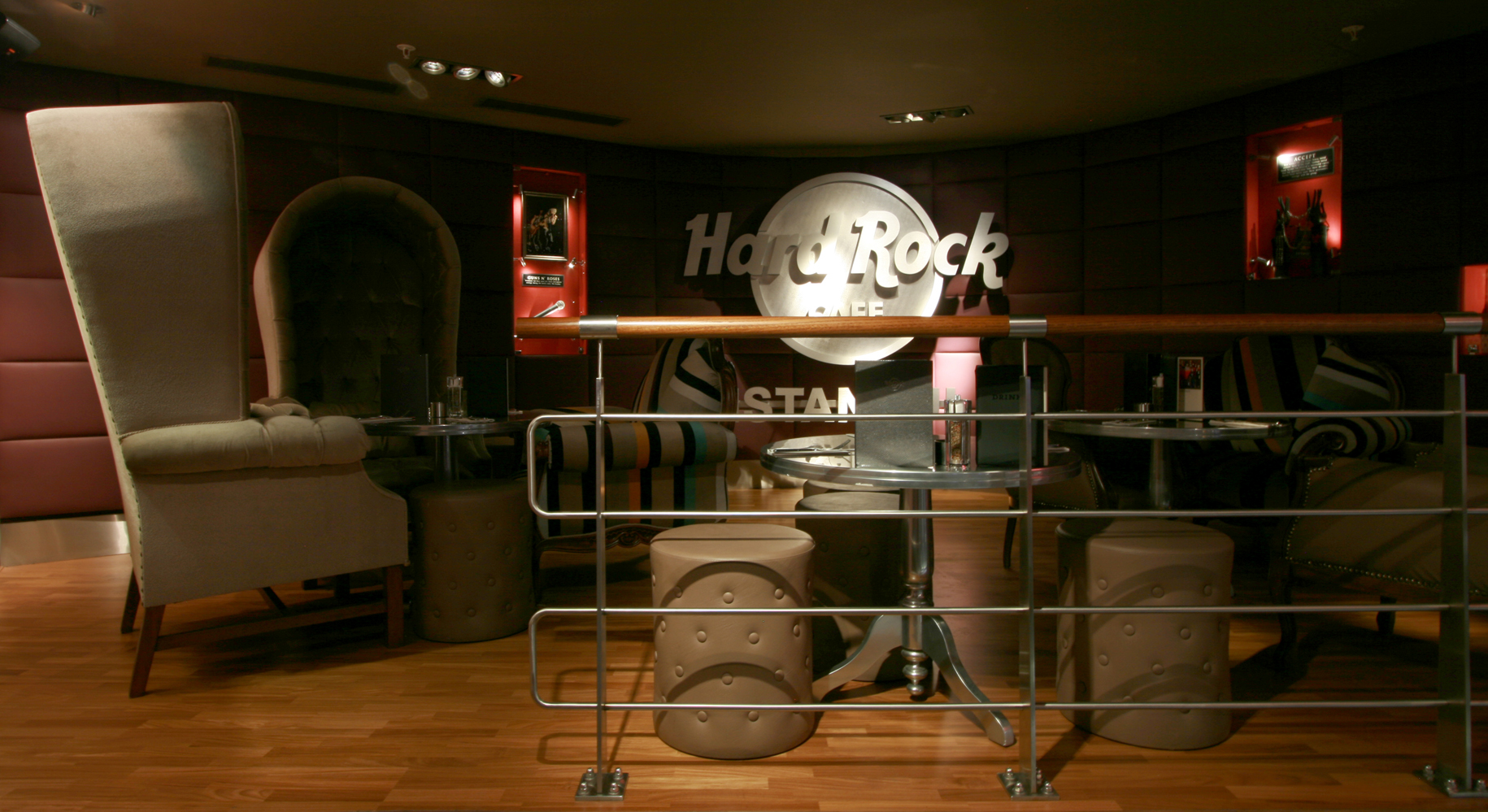
Beside the bar, the stage doubles as a lounge area when not in use for live performance and is home to an eclectic mix of unusual but comfortable furniture.


The upper floors are reached via either the very cool staircase or the even cooler lift.
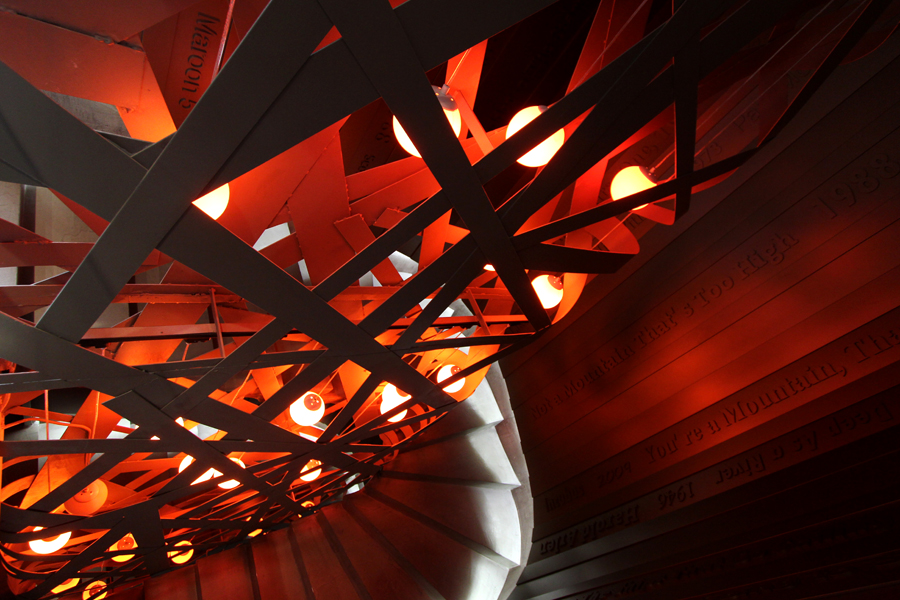
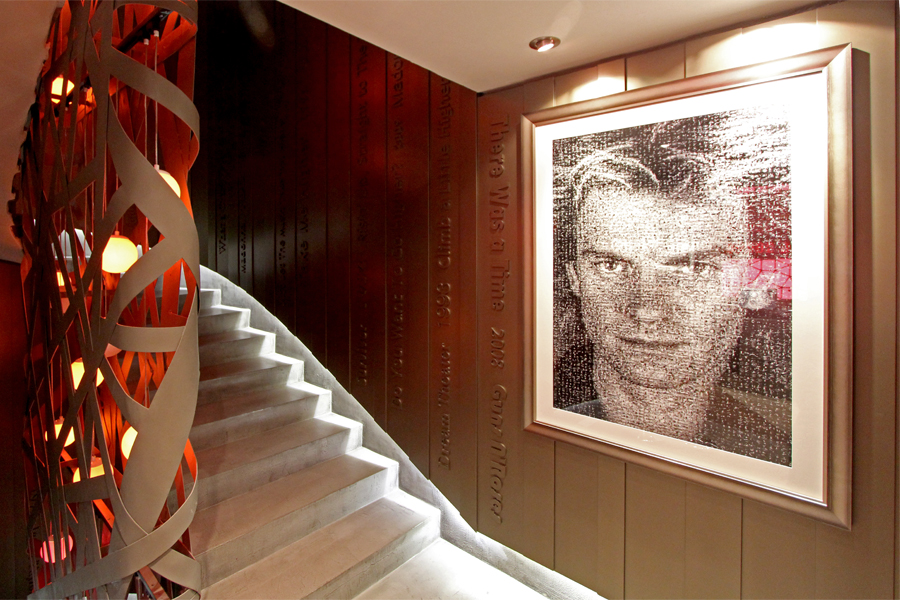
The stairwell (below) has been lined with planks into which song lyrics (such as”She’s climbing a Stairway to Heaven”) have been carved. The centre of the stair is now home to a ‘cage’ of welded steel ribbons (extending all the way from ground floor to roof level) containing pendant lights which fill the space with warm light and throw shadows on the lyric walls.
The elevator (above, extreme right) was a design idea which we never really expected to survive all the way to implementation but our Turkish partners were not that easily defeated. The back wall of the lift car appears to be a memorabilia cabinet but in fact is just a sheet of frameless glass. The memorabilia you can see in the photograph is not in the lift, but actually in the lift shaft beyond. As they travel between floors therefore, the lift passengers see different pieces of memorabilia at every level.
At first floor is the main dining area, much of which overlooks the Bar or Rock Shop below (see right and below).The balustrades to the openings to the ground floor below are of frameless laminated glass to allow uninterrupted views.
At this level, the floor is a herringbone pattern of wood effect ceramics in two shades to key into the timber and upholstery of the loose furniture.
The perimeter of the main area is lined with booths of aubergine (another Turkish favourite) leather cubes which not only offer a comfortable alternative to the loose furniture but also perform an important role in improving the acoustics of the space.
The guitar pick theme is continued here with halo-lit picks of Barrisol membrane breaking up the ceiling and introducing more reflections to combat the low ceiling height. The pick also appears in the wallcoverings and memorabilia cabinets of the smaller first floor area overlooking the street.

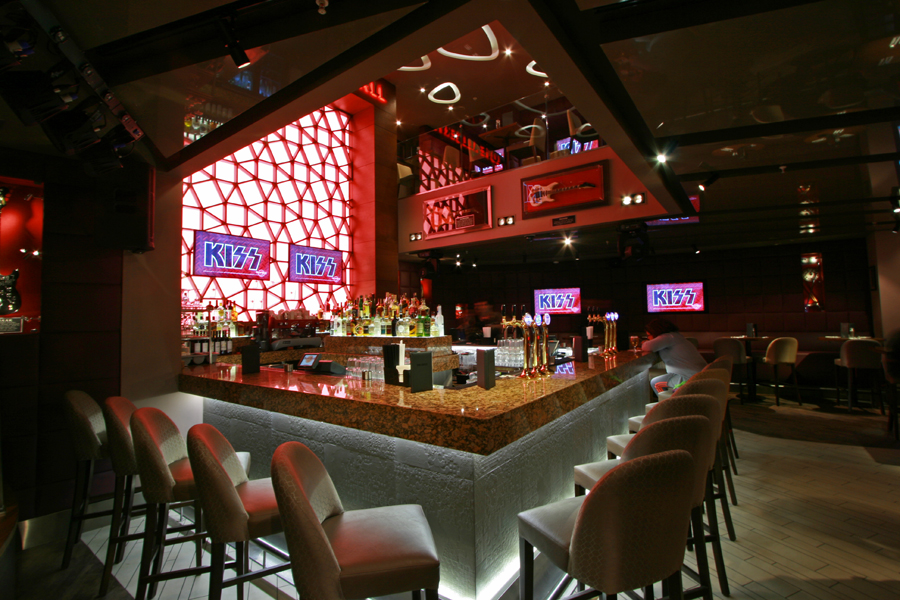
The second floor (left and below) which was the location of the ancient cinema, now houses a second kitchen – the venue is so large that one kitchen simply couldn’t cope – and two further dining areas which lend themselves to use as private function areas but can be added to general dining at peak periods.
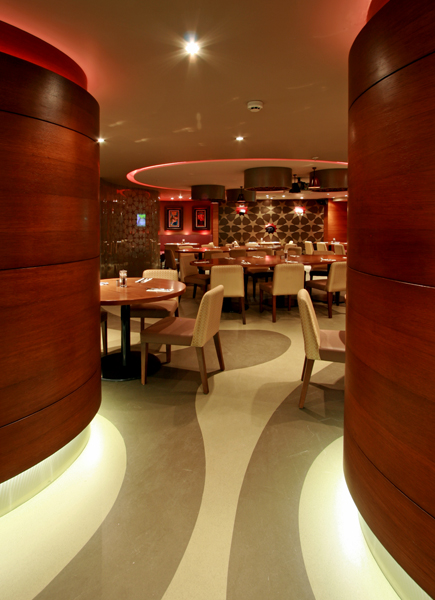
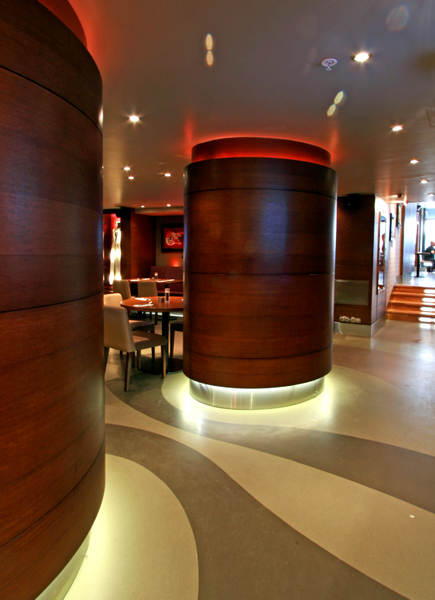
The emphasis here is on group dining which is enormously popular in Turkey. There are several large ‘family’ tables and plenty of two seater tables which can be joined together for large parties. The space has a slightly different feel with a number of devices used to hide the rectilinear frame of the building. A curvaceous resin floor and hardwood elliptical column casings and ceiling rafts eliminate most of the straight lines.
There are a number subtle cultural references. The drum lights over the large tables are specially made and are lined with Turkish carpet. The wall patterns are based on traditional Turkish ceramics but are formed once again from the guitar pick motif. They are machined out of MDF and then finished in durable, metallic automotive paint and lacquer.
There is a second bar here too so that private functions can be self-sufficient and the space can be used in conjunction with the spectacular roof terrace at the level above. The terrace has yet more dining, a very cool cocktail lounge area and a further, rather amazing bar. There are still one or two finishing touches to add up there so we’re keeping the terrace under wraps for a while longer.
The Fuse team was David Matthews, Louise James, Tracy Heywood, David Eastwood and Rick Cartwright with additional contributions from James Smith and Paul Henning.
Huge thanks are owed to our Turkish architectural partners Atabek TPA for their fantastic contribution to the success of the project. Haluk Atabek (principal), Efsun Aydin (project architect) and their Istanbul-based team did a magnificent job and were a constant source of wise advice. Their attention to detail was second to none and their office espresso machine got as lot of use during the very enjoyable (and very long) design workshops in Istanbul!
The stunning lighting design was courtesy of our regular co-conspirators, Technical Arts. Chris Filippidis and Andy Pound did an amazing job. Clients for F&B Plaform, Bilgehan Karakuy and Oguz Bektas couldn’t have been more of a pleasure to work with. Their hospitality and support was beyond compare and they will now forever refer to 6.00pm as beer o’clock after our Mr. Matthews led them astray on numerous occasions.
Finally, thanks to Andreas Buergelt. Andreas is probably the biggest Hard Rock fan in the world and travels all over the planet from his home in Germany to see the latest Hard Rock venues. He loaned his wide angle lens to our Mr. Matthews so he could take these photographs after David’s camera equipment was stolen en route to Istanbul. The exterior photograph is actually one of Andreas’s too.

The Hard Rock Cafe at Max Euweplein, near the Rijksmuseum in central Amsterdam first opened in March 1999 and has been packed with visitors seven days a week ever since. It was a challenge then when we were asked to extend and comprehensively refit the unit – whilst keeping it trading throughout!
In 2014, a unique opportunity arose for the Cafe to take over the adjacent Comedy Club property to add a new bar and enlarge the extraordinarily busy but very small Rock Shop. Needless to say, it wasn’t that straightforward.
Amsterdam has strict rules about the size of ‘Horeca’ venues. So, “What is Horeca?”, we hear you say. Well, it is a Dutch term actually derived from the English phrase HOtels and REstaurants CAtegory so it actually means ‘food and beverage’ venues. The Cafe was already at its maximum size so it would be necessary to continue to differentiate the extra area rather than simply add it to the existing restaurant. The decision was taken to therefore to create a separate bar area with its own personality which would double as a venue in its own right but also act as a feeder bar and waiting area for the busy restaurant.
The space for the bar was complicated – arranged over 4 split levels with very low ceilings. At the main floor (entered from the Max Euplein courtyard) it was decided to install a bar that completely filled the space (above and left) providing seating areas instead at the small mezzanine which overlooked it (below). The remaining new area at ground floor was given over to double the size of the struggling Rock Shop. At the lower levels alongside the canal, a new prep kitchen was built from scratch, allowing the existing prep kitchen to be refitted as an extension to the main kitchen, incorporating a second cookline to cope with the increased numbers at busy times.
The palette for the bar was a mixture of largely reclaimed materials. Old brickwork, unfinished steel, reclaimed timber sat over a floor of timber effect porcelain plank tiles intermixed with traditional Dutch patterned tiles. In front of the bar, song lyrics (all relating to drinking) were sandblasted into the concrete-effect tiles.

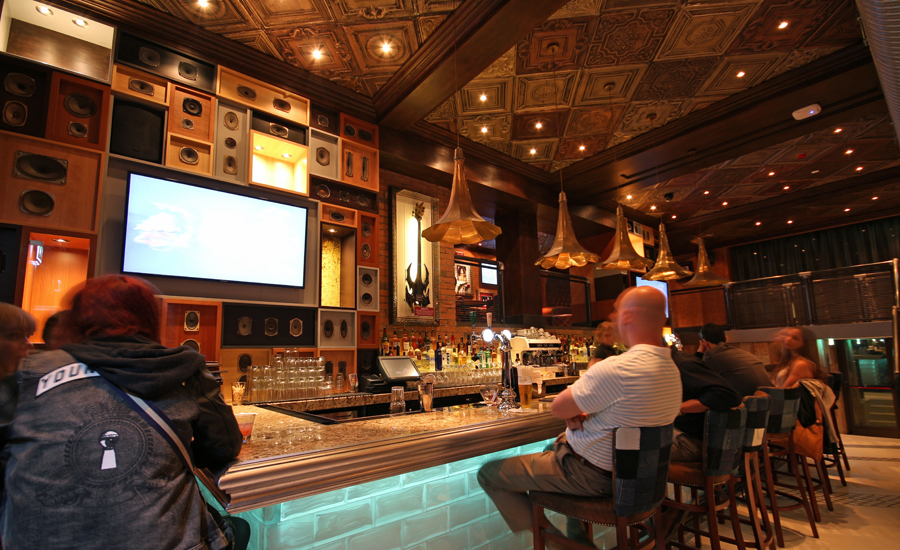
The bar backfitting was made up of speakers – both working and false – which also conceal some of the new ventilation system. The lights over the bar are inspired by old gramophone horns but were in fact made specially for the project by Technical Arts. The bar front is of glass bricks, back-lit through a diffuser with RGB LED lighting.
Concealing extensive acoustic improvements above, the ceilings were of nail-up pressed steel tiles – not one but a collection of completely different tiles, sprayed copper and aged.
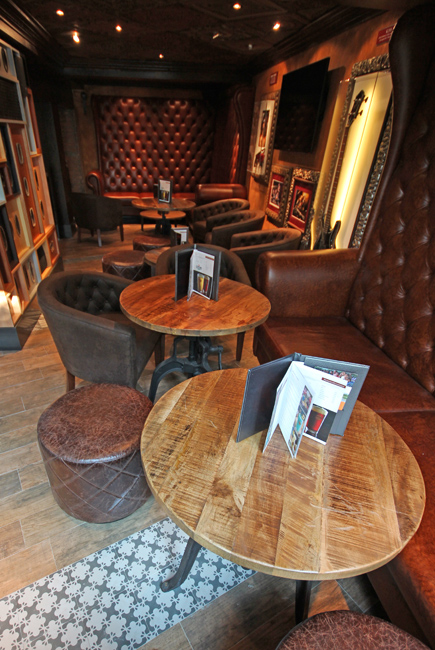
Furniture, including some incredibly high-backed settles made specially for the venue, was upholstered in assorted old leathers and the table bases are recycled old cast iron machine parts.
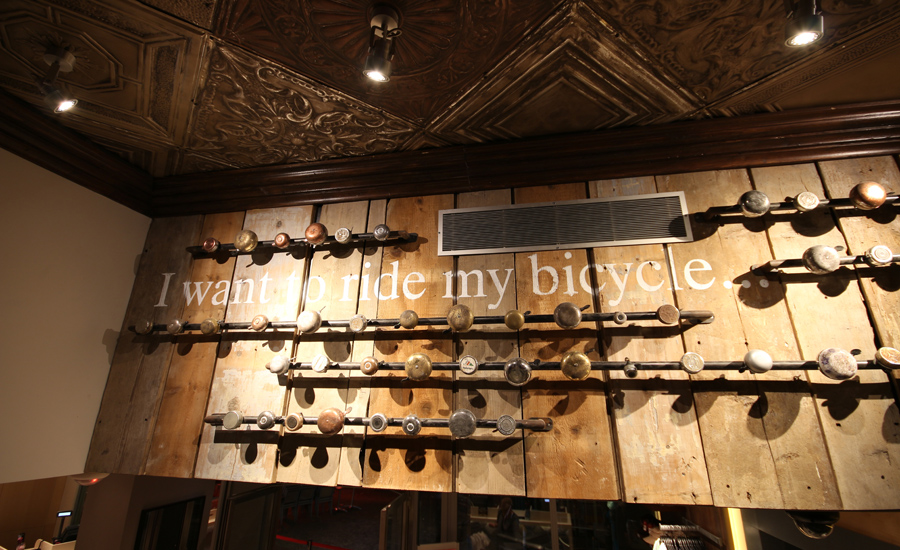
Accessed from the bar mezzanine is a further drinking and grazing area (pictured above) which overlooks the enlarged Rock Shop below. The reclaimed materials are continued here – including a collection of old bicycle bells (below) which pays homage first to rock legends Queen and their track ‘Bicycle Race’ and secondly, to the hundreds of thousands of bicycles which swarm across Amsterdam at all hours of the day and night.
Back in the original part of the venue, bicycles feature once again in the cog chandelier which adorns the ceiling just inside the main entrance. Originally intended to be a full sphere, we were unable to divert the mechanical services in the ceiling void above so we ended up installing a hemispherical fitting mounted on mirror. The bicycle cog shadows that it generates across the lobby area still werk perfectly however (see right).
These extend across the ‘Photo Opp’ – which here features a couple of cowhide-upholstered armchairs with a backdrop of the city name made of old Dutch gilders (the former currency of the Netherlands before the Euro). The wall behind has been removed so that the canalside below can be seen from the lobby area. The floor is again of concrete effect porcelain tiles with sand-blasted lyrics, interspersed with stripes of traditional patterned tiles.
All of this work, including a complete refurbishment of the existing restaurant areas, was undertaken with the cafe fully open for business. This entailed replacement of mechanical, electrical, audio-visual and data systems whilst keeping part of the existing systems live at all times. The kitchen was enlarged and replaced entirely and yet served great food 7 days a week throughout the works. It really was a Mission Impossible, but we made it.

Thanks are due to the very large team that made this happen against all odds. It really shouldn’t have been possible:
First, at Fuse, project designer was Paul ‘Bubbles’ Henning with hugely important contributions from interior designers Tracy Heywood, Andrew Thurman, David Riall and David Eastwood. Director in charge was David Matthews. They worked as closely as ever with Chris Filippidis and Andy Pound from our favorite lighting designers, Technical Arts. In Holland, our architectural partners at Valtos Architects in Rotterdam – principal Kenny McDonald (yes, he is Scottish) and project architect Ko van Wijngaarden (who isn’t even slightly Scottish) ably assisted by Liesbeth Oskam (whio isn’t Scottish either); Jos Meiier of Dutch M&E consultants,WHR who did a great job of untangling the spaghetti above the ceilings; Ken Schwartz and Joe Mora at SSA Foodservice design in Tampa FL for doing the impossible with the catering design; Kristin Hill and team at Technomedia in Orlando for the AV design and install; John Moss and the KFP team for the data installations; Hermoine Geeves and Angus MacRae at AMI furniture for meeting our demands for some very unusual furniture.
Kudos to our favorite Italian main contractor Exa – Jacopo Teoni, Letizia Parigi Bini, Alessio Bianchi, Simione Sassoli and their joinery sub-contractor Garbo and M&E contractor, Dejong. Thanks too to Guido Pelagallo of Open Resources srl: We first worked with Guido on our very first Hard Rock project in Florence and it was great to see him again.
At Hard Rock International, general manager in Amsterdam the remarkably resilient Dale Swift and his amazing team (with a special mention for the always-helpful Jorrit Ahrends); the equally resilient and talented roving Italian-English project manager from Copenhagen, Mr. Stephen Abbiati. Area VP of Operations, David Pellow and in Orlando FL, the project development team including Joe Emanuele, Rick Sconyers Maria Carillo and Maneesa Kelley-Fagen – not forgetting the IT, memorabilia, retail and merchandise teams who provide us with endless support. Thanks to all.
Finally, this project is dedicated to the memory of Ruud Wolfs of M&E sub-contractor, Dejong, who passed away whilst we were on site with this project. God bless.

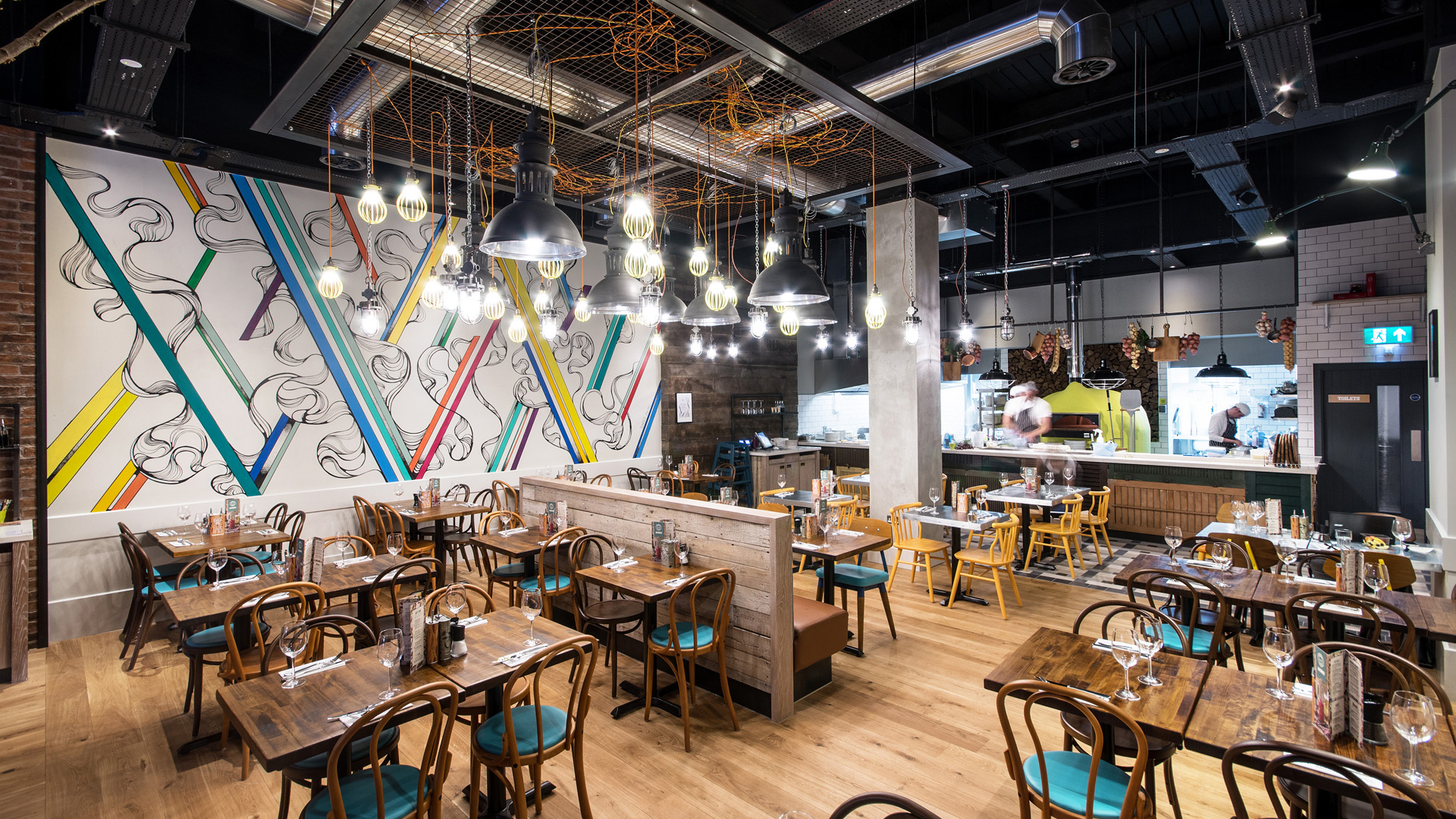
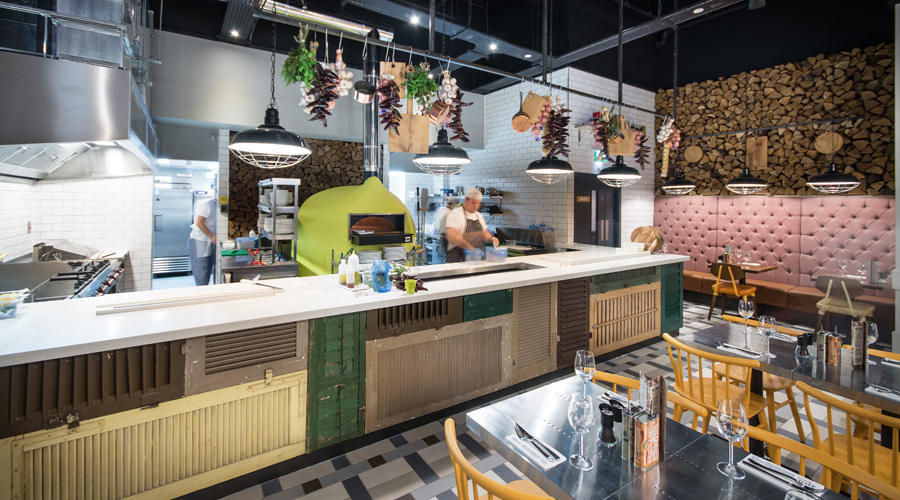
The first Zizzi restaurant to be designed by the Fuse team opened its doors in Derby in August 2015. Delivered by Dover Design to a concept by Fuse, the 120 cover restaurant is the newest addition to the Intu Derby Shopping Centre.
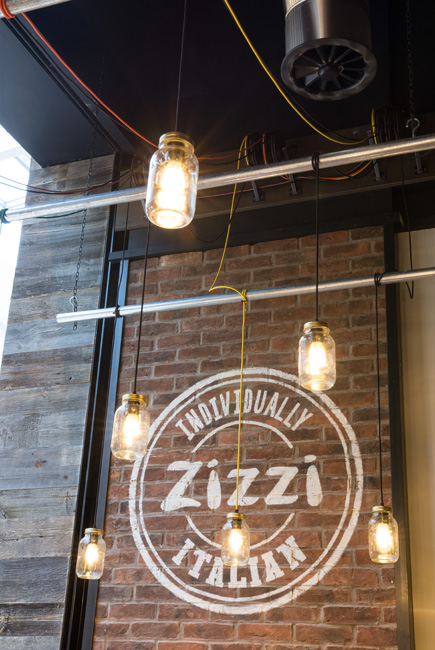
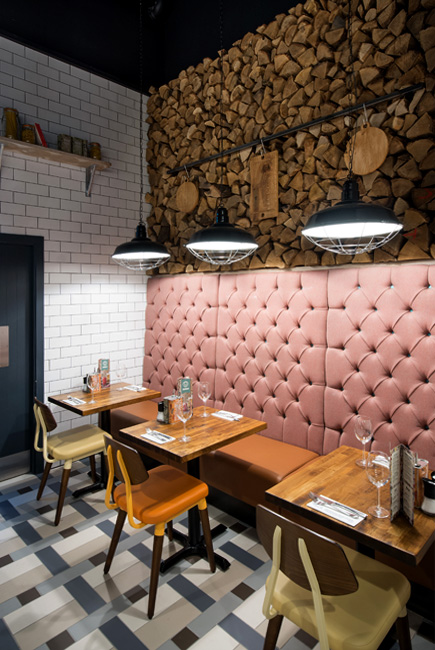
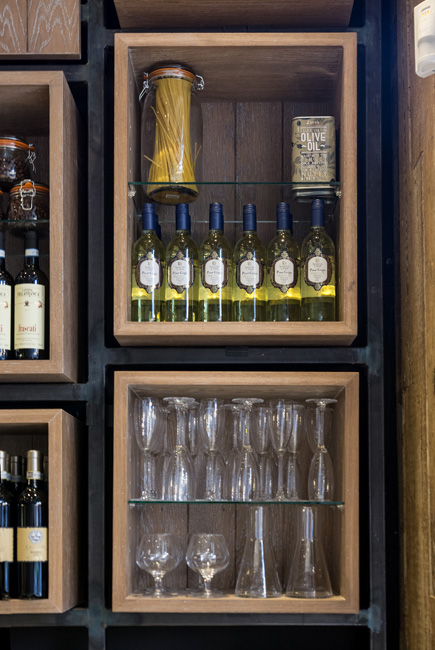
The venue uses an eclectic mix of reclaimed materials, assorted pendant lighting and furniture to create a relaxed but fun environment. The kitchen is open to the restaurant and features a pizza oven finished in a very familiar bright green colour! Inspiration for the interior design is drawn from the local surroundings & history of Derby being the birthplace of the industrial revolution & silk mills (Derby had the world’s first mill designed for spinning silk).
Talented & upcoming artist Saroj Patel (click here to discover more of Saroj’s work) has illustrated a mural on two of the walls, playing on these local features with an colourful design of interesting shapes, repeated patterns & graphical lines.
Zizzi Derby Intu is the first of a series of Zizzi venues to be designed by Fuse. Look out for further openings in the coming weeks and months.
Project interior designer was Fusilier Rick ‘Drummer Boy’ Cartwright. Director in charge was Scott ‘Scoot’ Ryalls. Good work boys!
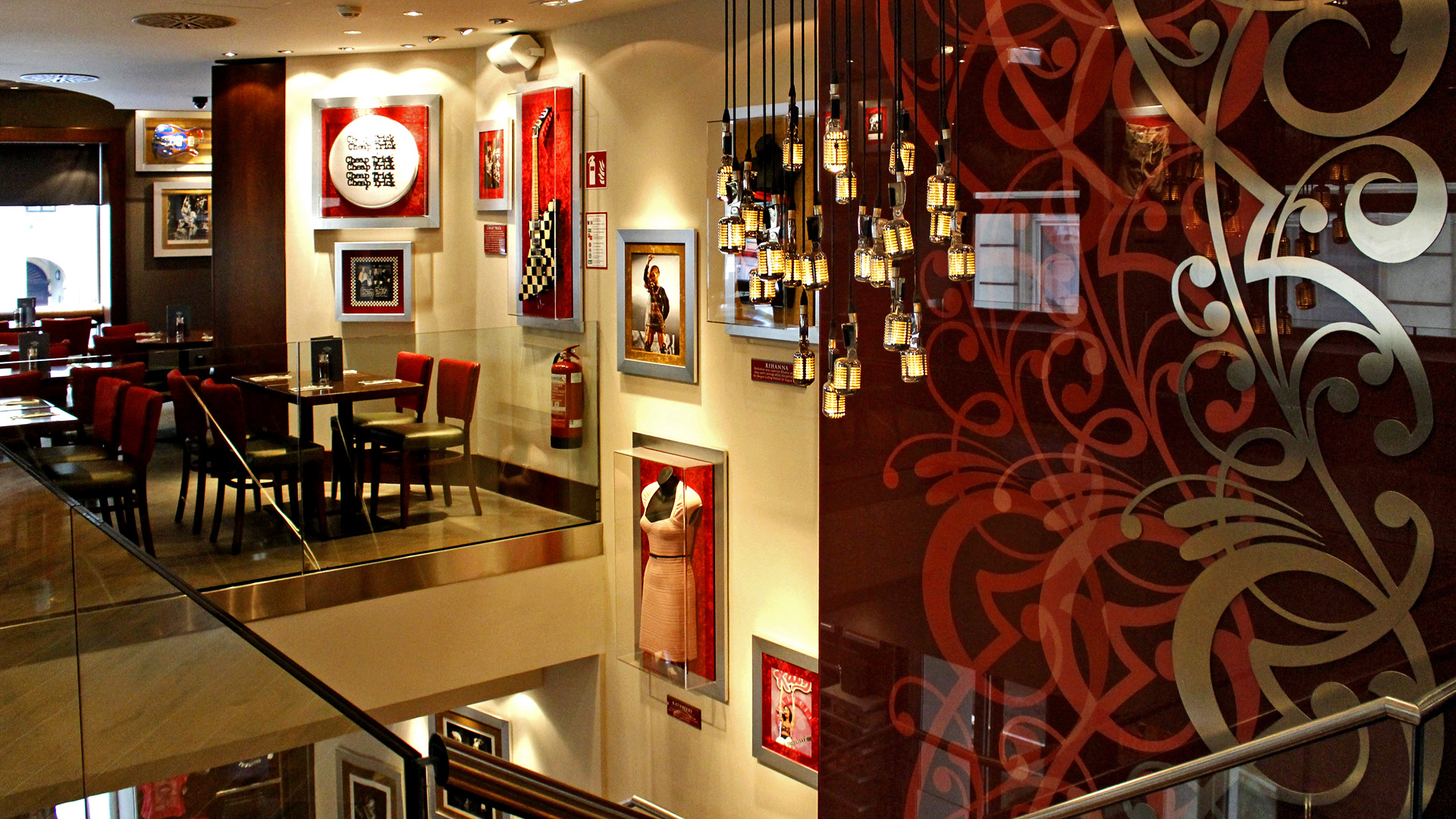
October 2014 saw the official Grand Opening of the Hard Rock Cafe in Vienna, Austria. Situated in a prime location on Rotenturmstrasse, just down the road from the tourist magnet of St. Stephen’s Cathedral, it extends over three floors, with two bars and provides over 300 dining covers.
Fuse began work in Vienna as long ago as 2011 and we looked seriously at three other sites on Rotenturmstrasse before the current location was finally selected. The unit was already a restaurant but required major alterations, a new electricity sub-station, a total replacement of electrical and mechanical systems and completely new kitchens as well as the Hard Rock fit out itself. Space planning the venue was extremely challenging as the space available for kitchens was severely limited. The back of house spaces therefore split between all three levels with the food prep and wash up at first floor, the main line kitchen at ground and the storage and staff areas utilising the basement.
In common with all the Hard Rock Cafes, the design is a response to the host city and so is unlike any other Hard Rock venue. Unusually, the cafe utilises just one main colour – red -inspired by the plush opera houses of the city of music – once home to Beethoven, Brahms, Mozart, Schubert and Strauss. The colour is introduced through one predominant material – glass. Mixed with hardwoods and stainless steel, this produces a contemporary look but with subtle classical references throughout.
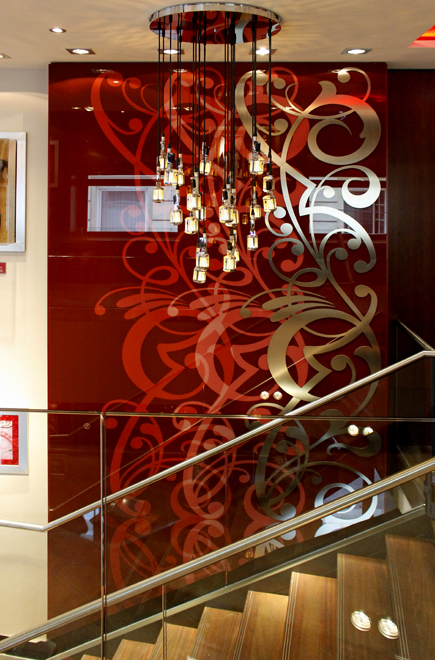
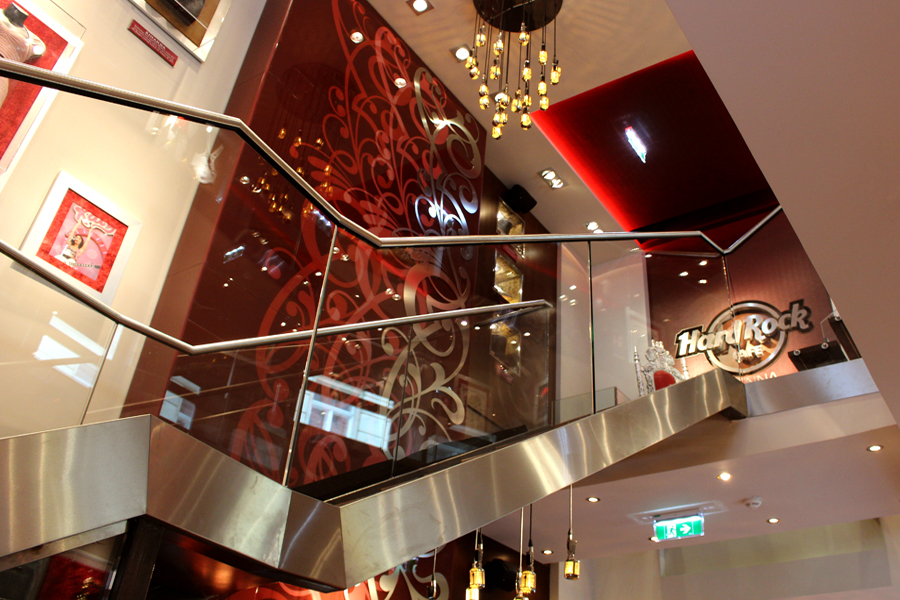
The front of house staircase (above) linking the ground and first floors had to be replaced late in the project when the City of Vienna decided that it no longer met the requirements of current legislation. The replacement had to take place in an almost completed cafe so there were a lot of crossed fingers when the old stair was finally removed without damaging either the finishes or the priceless memorabilia both of which were already in place by this stage. Behind the stair, an enormous feature glass wall rises through both main floors of the venue. Constructed of red glass (on a steel frame – this is a heavy wall!) it is decorated with a motif developed for the project. This is applied to the front of the glass in 3mm brushed stainless steel. the two ‘echoes of the motif were screen printed onto the rear face of the glass before the red enameling was applied.
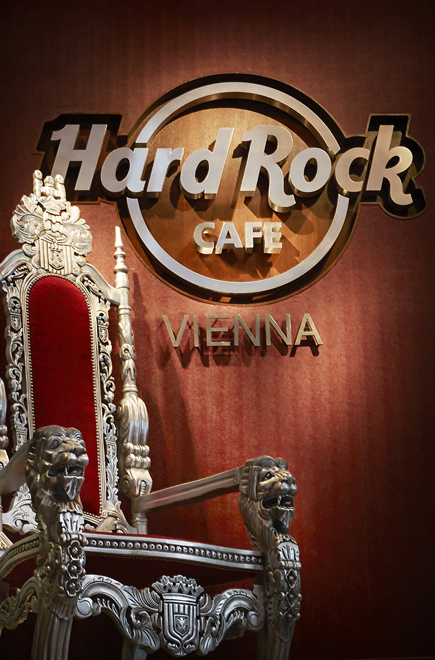
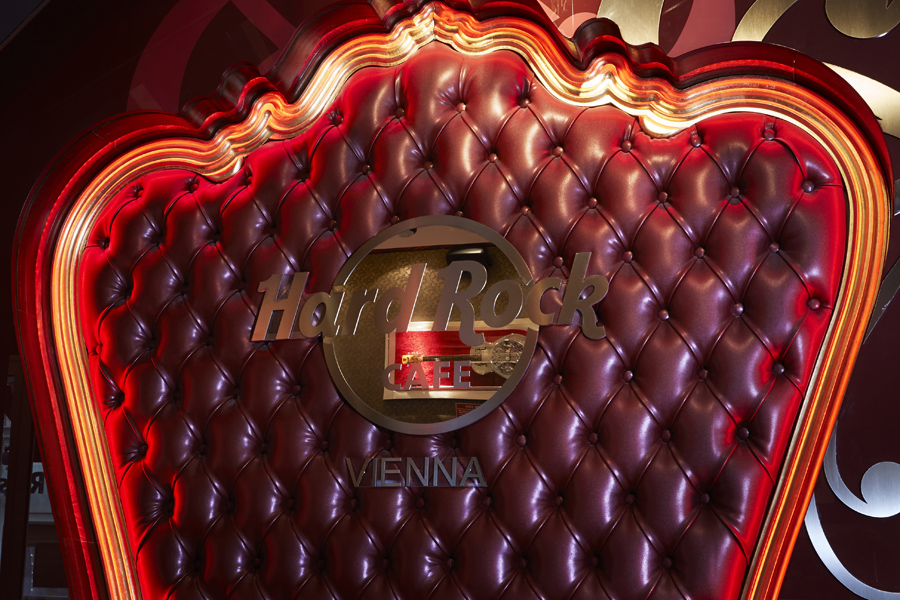
All Hard Rock Cafes have a ‘photo opportunity’ – a place where visitors naturally gravitate to have their photograph taken. Whatever form it takes, it includes the famous Hard Rock ‘badge’ logo and the name os the host city.Vienna is no exception and here we used the space beneath the stairs to create a giant feature throne – some 2.7m (9’0″) tall, the back is recessed into the red glass wall and edge lit with LED lighting.
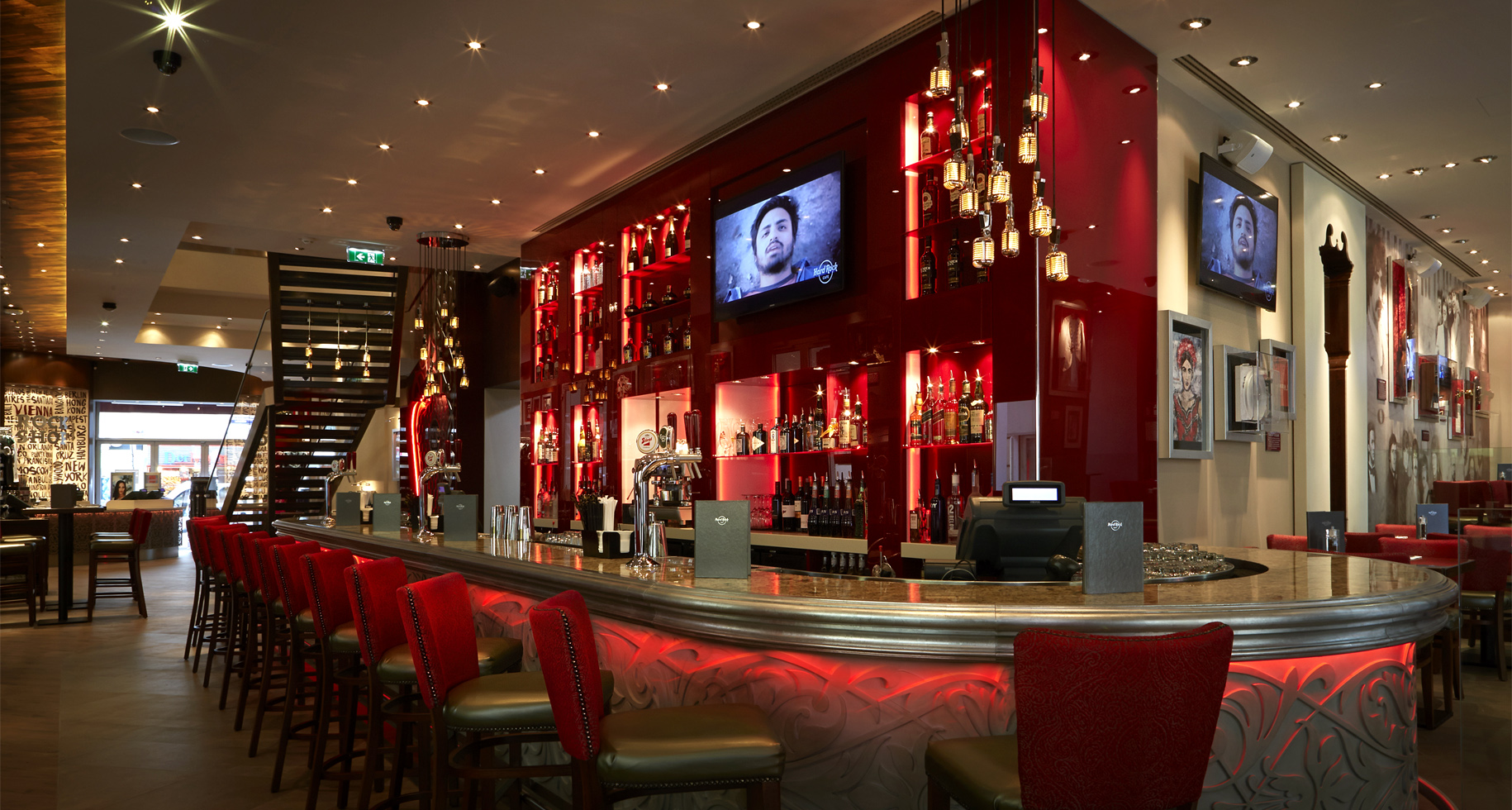
The ground floor bar is at the rear of the building, close to a secondary entrance which connects the cafe to the ‘Bermuda Triangle’ area of Vienna – the late night entertainment district of the city. The ‘concrete’ bar front uses Viennese patterns in relief to contrast with the smooth red glass of the backfitting (which conceals all the main service risers between the floors) and both bar front and backitting are illuminated with programmable RGB LED lighting which slowly changes the colour of the lighting throughout the day from a warm white for lunchtime through to a deep red late at night.
The new suspended ceiling which conceals all the new mechanical and acoustic installations is pulled away from the external walls of the building to allow the existing high windows to be retained. The higher ceiling is finished in timber plank (actually not timber at all but a digitally printed wall-covering to minimise the weight and cost). The inner ceiling is a lighter paint finish. The step in the ceiling is repeated in a change in floor finish following exactly the same line. The external walls are finished in darker colours and the inner walls use a lighter ivory colour.
The first floor can be sold separately for functions or act as an extension to the main cafe area at busy times. Two dumb waiters connect the area to the kitchen below and finding a location where the dumb waiters could serve all three floors was one of the biggest challenges we faced when initially space planning the venue. In the end, we used the path of the old kitchen extract duct and installed the new extract elsewhere.
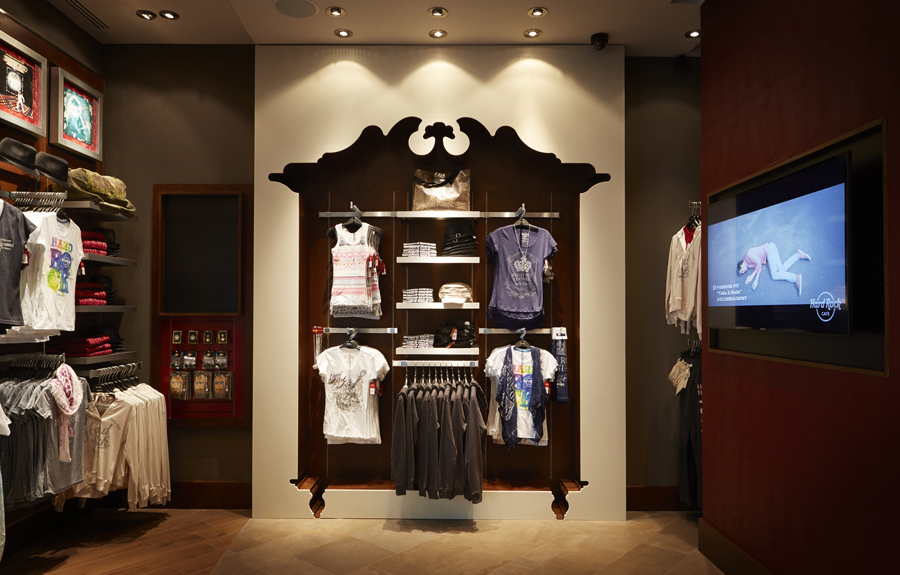
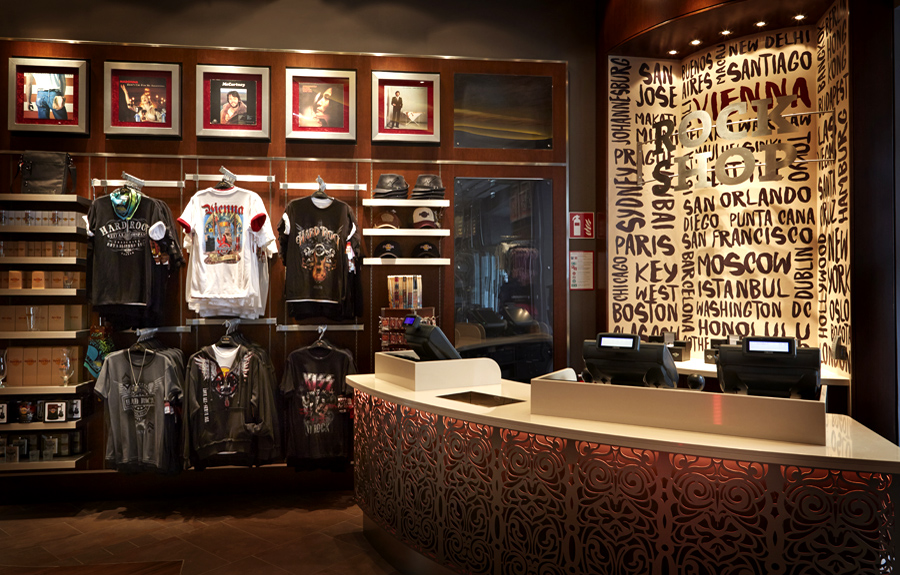
The Rock Shop (below) occupies its usual spot at the front of the property and manages to pack a lot of retail into a very small space. It includes items of ‘ghost’ furniture – impressions made by furniture that isn’t actually there at all – such as the wardrobe below. There is a lot of dark hardwood to create a slightly more opulent feel than usual and the POS counter is picked out with fret-cut metal back-lit with coloured LED lighting
The store smashed all records for merchandise sales and staff had to be flown in from other locations to help the unit cope with the volume of trade.
Congratulations to project interior designer, Fusilier Paul ‘Bubbles’ Henning and thanks for all those who had vital supporting roles in the studio including Tracy Heywood, David Eastwood and Andrew Thurman. As ever, our thanks go to the huge, international team that worked with Fuse so collaboratively to make this happen within an ambitious budget and a near-impossible timescale:
At Hard Rock, thanks go to Stephen Abbiati (Italy, Denmark and everywhere in between) Rick Sconyers, Maneesa Kelly-Fagen and Maria Carrillo (USA) our lighting design partners Chris Filippidis and Andy Pound at Technical Arts (UK).
Thanks too to the local Austrian team ably led by our local architect of record Thomas Hrabal and his team at Hrabal Architektur; Gregor Szerencsi, Christian Janisch and the team at mechanical and electrical designers BPS Engineering; structural engineer Hans Pfeil; acoustician Jörg Felgitsch of Vatter and Partners (all in Austria) and last but by no means least, the irrepressible Marco Noli along with Simone Sassoli and Alessio Bianchi of miracle-working main contractors EXA (Italy once again).
Food services design was by Ken Schwartz and his team at SSA (USA), audio visual design and installation by Jon Micelli and the team at Technomedia (USA) and data and low voltage was John Moss and the guys from KFP (UK).
Another amazing team. It was a privilege to work with you all.
Selected images Stephen Abbiati and Ben Leitner. Copyright www.benleitner.co

Many would have considered it rather vulgar – a Hard Rock Café in Florence, birthplace of the Renaissance, home of Brunelleschi, Donatello and Michelangelo. However, when 20,000 people gathered in July 2011 to mark the opening of the latest Hard Rock venue in the corner of the Piazza della Repubblica, that initial concern had changed to relief and indeed celebration that a beloved building in the ancient city had been preserved, enhanced and afforded a vibrant new lease of life. As one local visitor put it: “A sleeping beauty has been awakened”.
Indeed, the arrival of Hard Rock Café was greeted with considerable enthusiasm by the Commune di Firenze, the city council. Florence Mayor Matteo Renzi (later to be President of Italy) and his team were keen to see a catalyst for a modern renaissance in the Florentine late night economy which had been in serious decline for over a decade. For Hard Rock too, Italy was at the very top of their target list. Of 2 million Hard Rock Facebook fans worldwide, no less than 800,000 of them are in Italy.
When the vacant Cinema Gambrinus building in the corner of the world-famous Piazza della Repubblica was identified in early 2010 as a potential location, Hard Rock moved quickly to secure the property. As an existing ‘Place of Entertainment’, city laws required that public entertainment continued. Hard Rock was therefore a perfect partner. The new Café would also be a live music venue.
Despite the poor structural repair and the fact that much of the basement was flooded at the time, a feasibility study showed that the building was a near-perfect match for Hard Rock’s requirements and a ‘Convenzione’ was signed between the building owners and the Commune di Firenze providing a guarantee that entertainment events would be staged not less than two nights per week. Hard Rock took a long leasehold on the premises and Fuse was instructed to begin detailed design work in September 2010.
The Brief
Although many of the early Hard Rock Cafés are rather similar, they are now designed individually and each is required to respond to its local context and in particular, the building which is its home. Creating a sense of place is central to the brief. Hard Rock International is also rapidly developing a global chain of luxury hotels and resorts and so there was a desire to see some convergence between the hotel and café brands in terms of the quality of interior design. This allowed Fuse some latitude in its interpretation of the Hard Rock brand standards. However, there were some problems to solve first.
The only place where an operationally efficient kitchen could be achieved was the basement but places of work at basement level are not permitted under city law. Fortunately, we discovered an old existing kitchen at basement level which had operated before the new legislation was enacted and we were able to argue that we could use the old consent. All we needed to do then was get rid of the water that was flowing through the area.
Once the kitchen location was agreed with the Commune, the layout of the front of house areas was all but self evident. The Rock Shop would occupy the front of the building in what used to be the Caffe Gambrinus – the lobby bar of the old cinema and once a highly popular venue held in great affection by many Florentines. The Restaurant would occupy the old cinema auditorium with a stage at the screen end and a large bar positioned centrally beneath the cinema balcony (which would be left in place for a potential future expansion of the restaurant).
The only problem with the old Caffe Gambrinus was that it was divided by a huge staircase providing a secondary access to the cinema balcony. This stair blocked all views into what would be the restaurant beyond and the decision was quickly taken to seek its removal. The Heritage Department at the Commune di Firenze agreed to the proposal following undertakings to re-use the stone steps and carved timber balustrade in other parts of the scheme. With that decision, the layout of the ground floor was settled (see below).
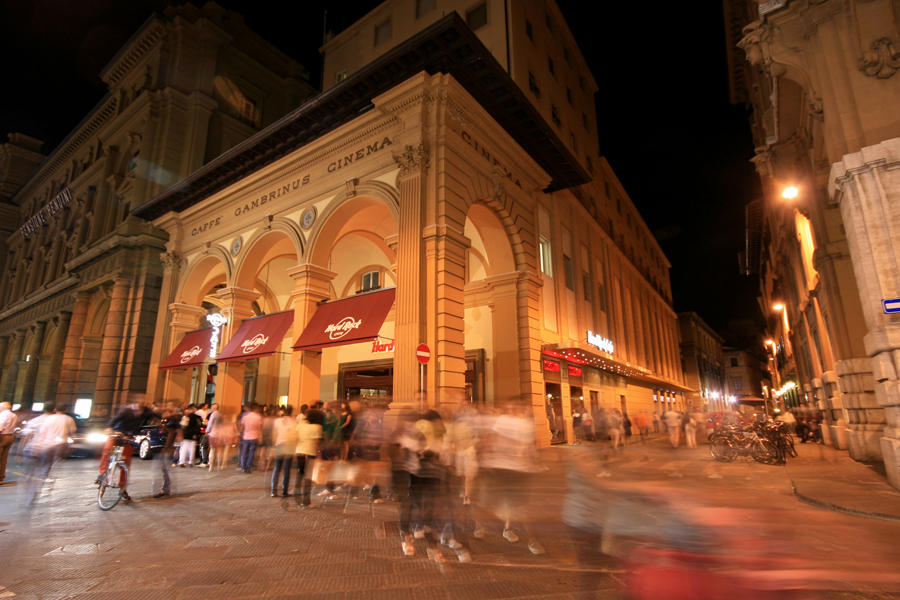


The Heritage Department was closely involved in every aspect of the scheme – not least the external presentation and signage. The enormous neon signage seen on many Hard Rock Cafes was clearly not appropriate at this location so Fuse proposed the addition of canvas awnings as a means of signposting the venue without detracting from the existing architecture.
A single-sided sign of off-white acrylic and bronze was added to the front of the arcade (following the signage convention used throughout the historic city – see below left) but with this exception, all new signage was a direct replacement for that which previously existed.
New storefront openings also had to be inserted along the Via Campidoglio elevation to satisfy the daylighting regulations for restaurants in the city. This entailed some major structural reframing of the external wall and the re-rouiting of existing drainage from the apartment levels above. Externally, the openings were exact matches for the pre-existing doorways and windows and so appear to have been there since the building was constructed.
One other problem was that there were very few locations where it would be possible to site air-cooled condensers for the air conditioning and kitchen refrigeration. There was also the question of noise nuisance to the adjacent residential property. Fortunately, the high water table (which had coused the flooding in the basement) came to our rescue. It was discovered that the building had a lapsed license to extract ground water and this was re-established such that the water could be used for cooling. Except at times of particularly high temperature, the water provides enough cooling to run both the kitchen refrigeration and the air conditioning systems – saving around 80% on cooling energy costs.
To avoid unnecessary energy wastage from transport costs, as many of the finishes as possible were sourced locally. The area is well known for its granite, leather and ceramics and the majority of these materials were purchased in Italy. In addition, as much as possible of the existing materials within the building were either preserved in situ, or removed and stored for re-use. Almost all the marble used within the scheme came from within the original building.
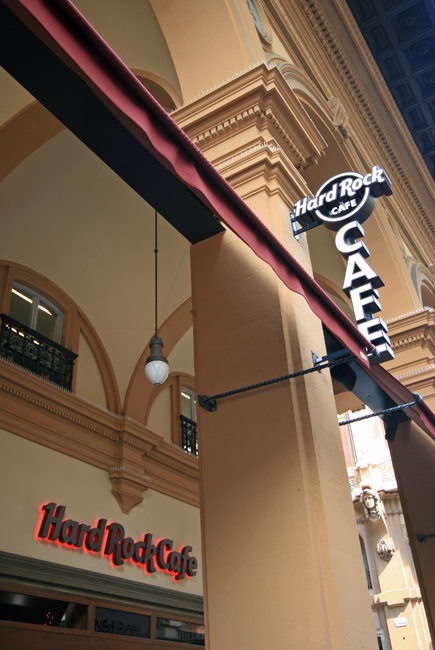
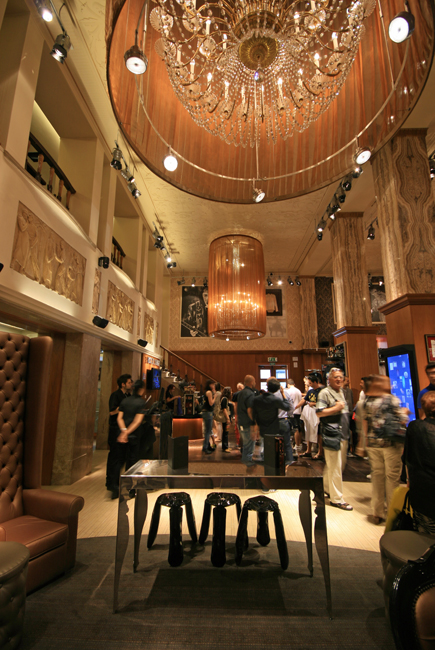
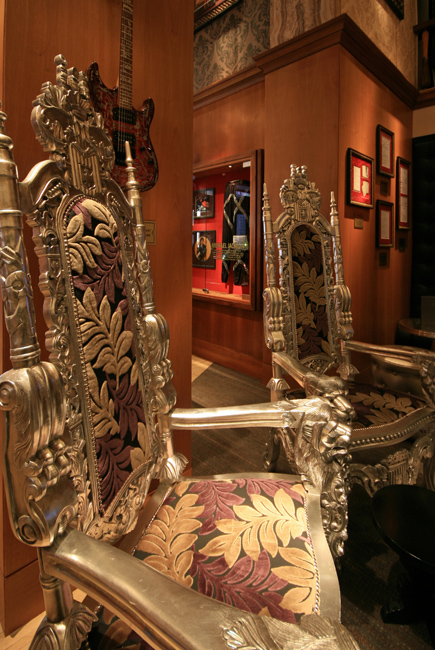
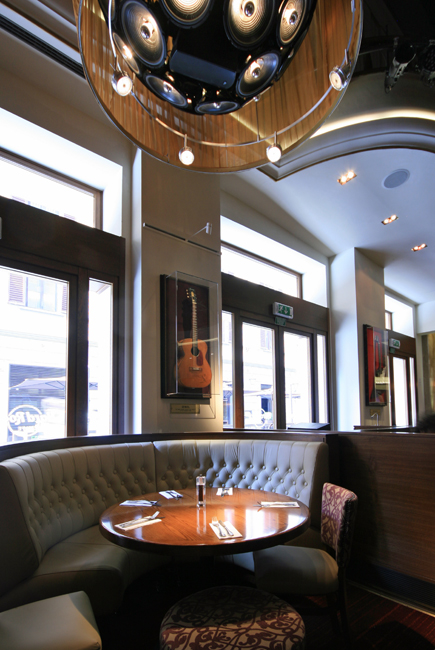
Work on site started in November 2010 with an enabling works package to strip out redundant services and carry out some initial demolitions. Tenders were invited in December for the main contract and work on site began in January. Substantial completion was achieved on May 23rd 2011 in time for training ahead of the opening to the public on June 14th – 40 years to the day after the original Hard Rock Cafe opened in London in 1971.
The official Grand Opening Celebration was held on July 4th, marked by a huge free concert in the Piazza della Repubblica headlined by Simple Minds.
The Team
The Fuse team was led by David Matthews and Scott Ryalls with Steve Bell, Rick Cartwright, Craig Russell and our much-missed, late dear friend, Kev Cummins.
Our thanks go to the client team from Hard Rock International in Orlando, Florida: Joe Emanuele, Mike Kneidinger, Rick Sconyers, Joemy Vega, Andrea Torgueman, Steve Jackson and Rob Conti and from Operations in London and Rome – Calum MacPherson and Stefano Pandin.
In the UK, we were supported by Project Managers and Cost Consultants – Arcadis, London: Mark O’Brien, Nick Jones; Lighting Designers – Isometrix, London: Colin Ball, and Franceso Secone; in the USA: Food Sevice Design – SSA Catering design, Tampa, Florida: Ken Schwartz, David Hensall; Audio Visual Design – Technomedia, Orlando, Florida: John Micelli, Matt Kent and John Stancil.
In Italy: Our friends and local Architect of Record – SAA Architects, Florence: Carlo Carbone, Gimmy Tranquillo, Marika Hansson, Barbara Sampoli and Grazia Salvi; local Project Managers – GSP Italia, Milan: Dario Francescetti, Stephen Abbiati (now with Hard Rock International); Mechanical Engineering Design – Spring, Florence: Manuele Petronelli; Electrical Design – Studio GM, Florence: Gianmario Magnifico; Structural Design – Sodi & Associati, Florence: Enrico Sodi and Michele Livani; Health & Safety Consultant – AbUs 127 Architetti: Alessandro Unali.
The work was expertly carried out on site by Main Contractor – CPF Construzioni, Florence: Alessandro Focardi, Fabio Ranieri and Guido Pelagallo with a hugekly important contribution by Joinery Sub Contractor – Polvanesi, Florence led by Barbara Polvanesi.
Thanks to all. It was a project we will never forget.
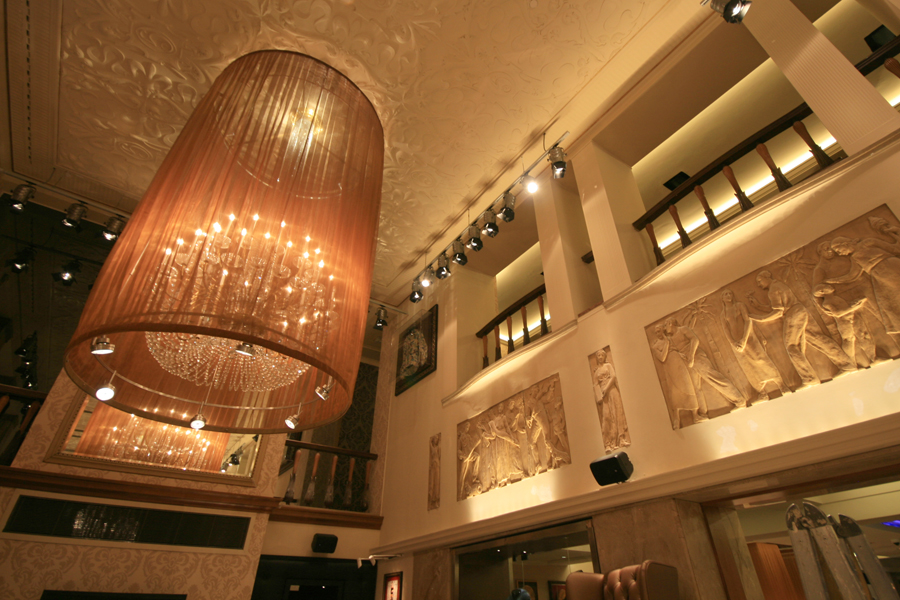
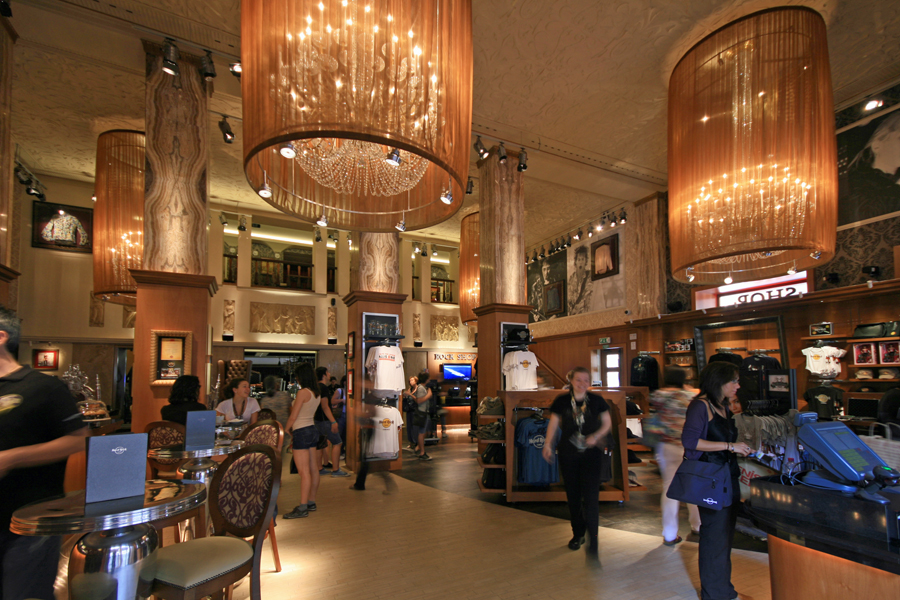

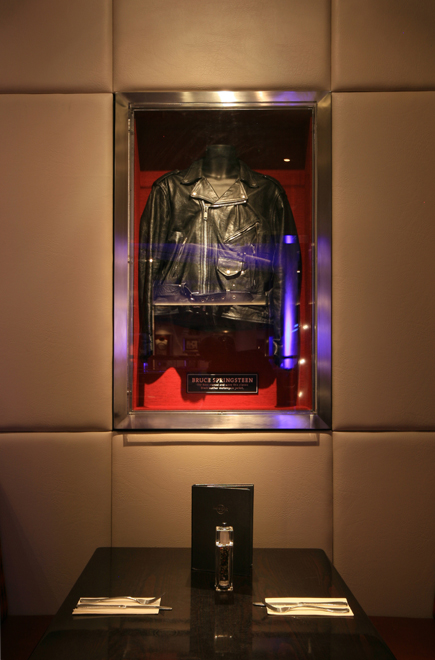
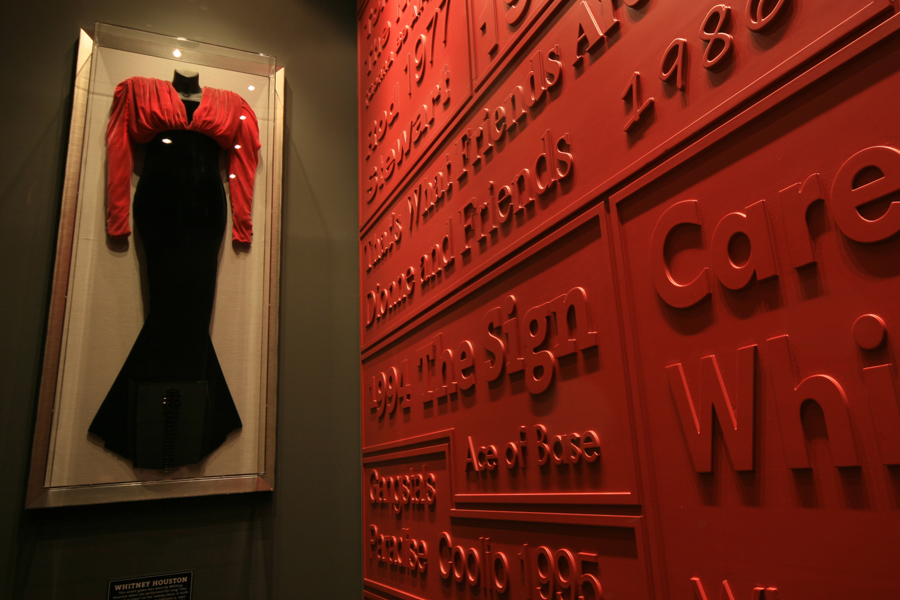
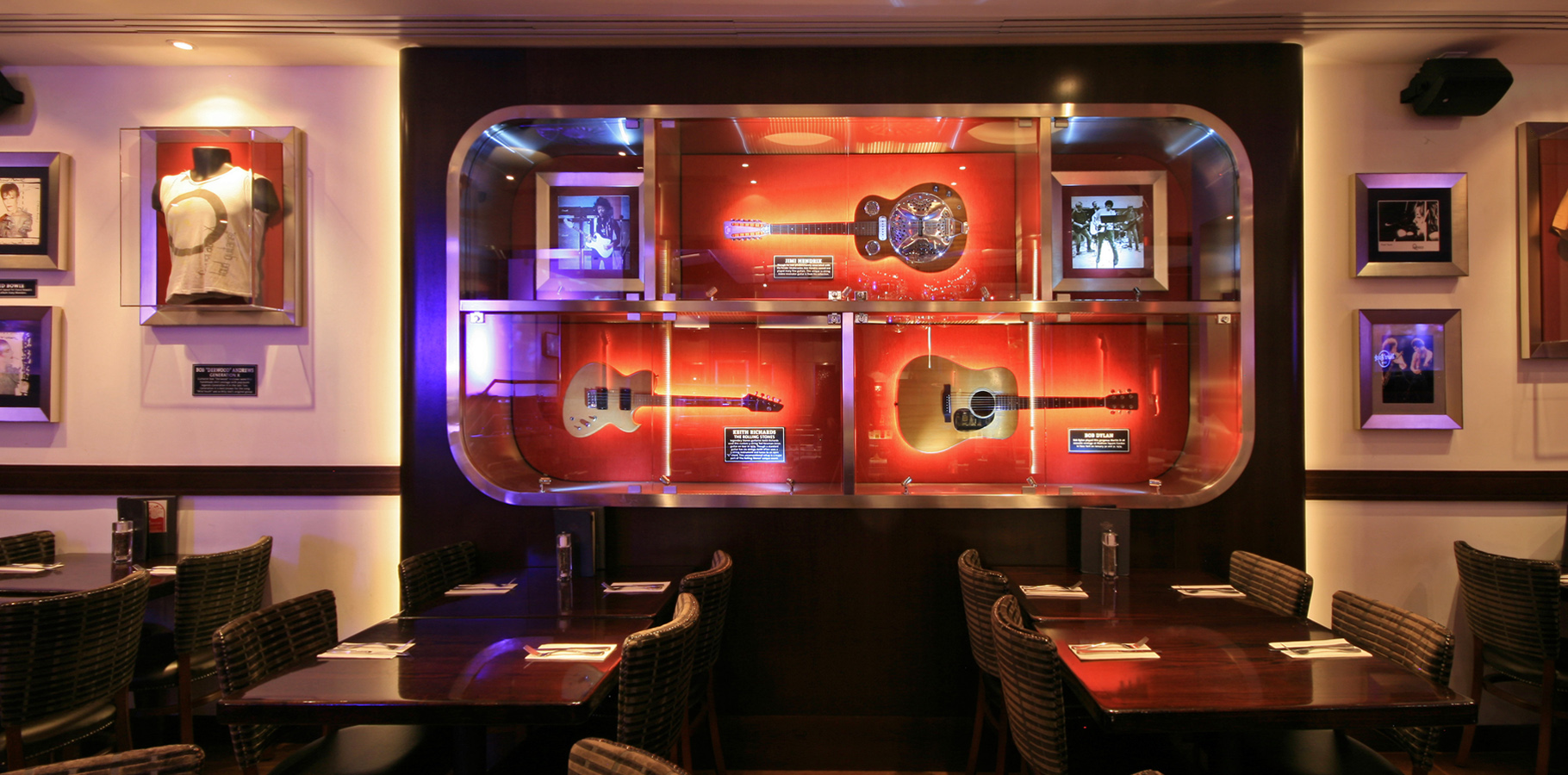
Gone is the flying Cadillac which once dominated the cafe and so is the old dark wood and brass interior which was once so typical of the early Hard Rock venues around the world. It has been replaced by a radically new and contemporary interpretation but it is still 100% Hard Rock from end to end. Memorabilia display has been transformed with built-in, museum standard cabinets throughout the venue. Memorabilia lighting by our design partners, Techical Arts, includes new LED tape lighting on the back of the guitar necks such that the priceless instruments apear to ‘float’ in their cases. In fact, the memorabilia is all new and now includes instruments and clothing from Michael Jackson, Bruce Springsteen, Keith Richards and Madonna to name but a few.
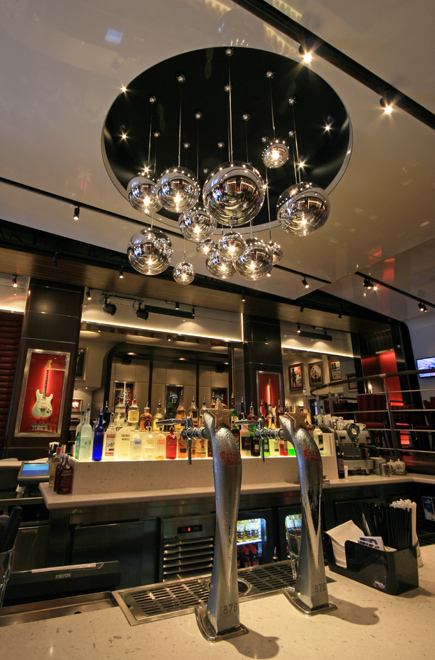
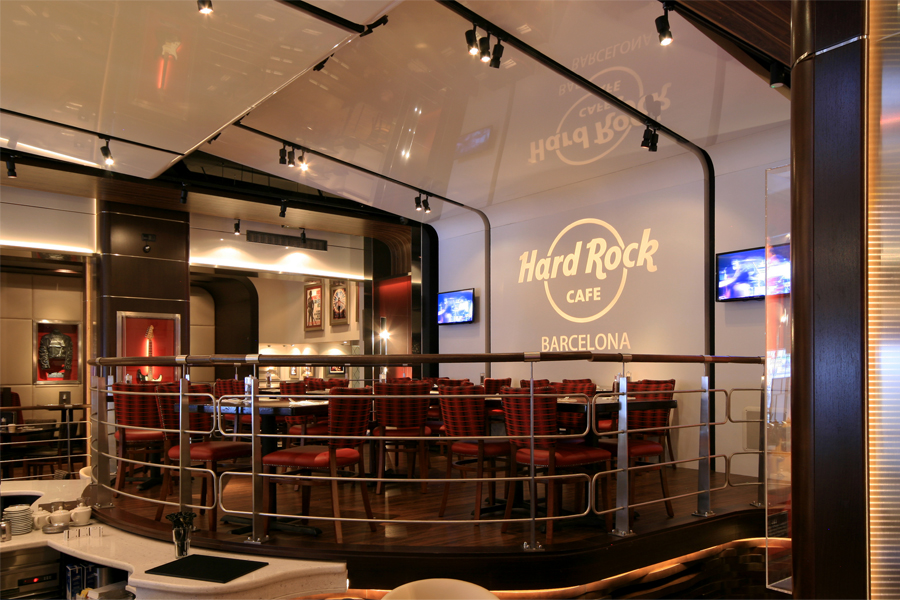
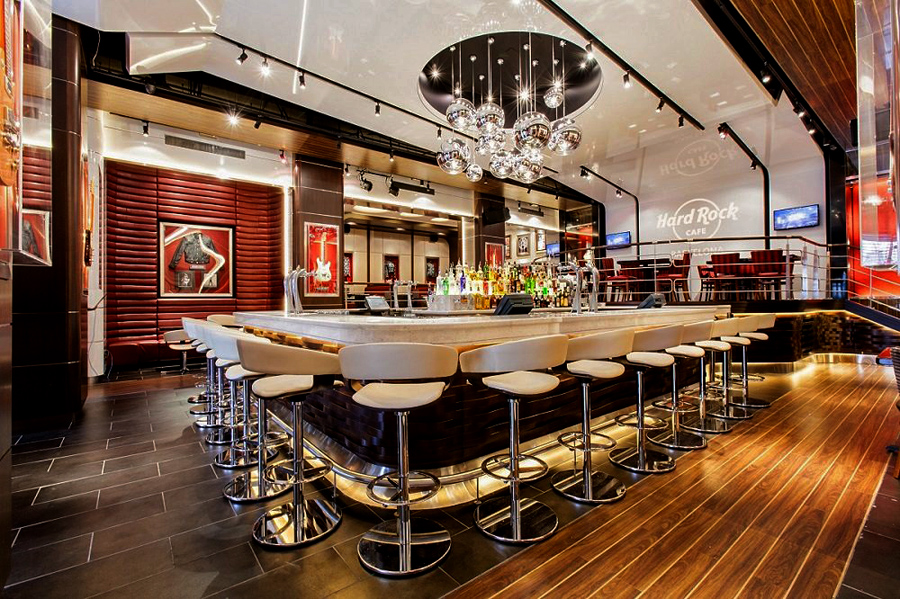
The stage (below) which was previously tucked away on one side of the cafe, has been moved to the centre of the venue directly behind the central island bar which remains the focal point of the space. One of the biggest changes is in the design of the ceiling. New ‘Barrisol’ ceiling rafts stretch from the back of the stage (where they form a projection screen showing music videos or as a backdrop to live performances) over the bar and to the entrance. These are flanked by timber rafts (actually of ‘Amtico’ planks) which continue down the walls and across the floor to signpost the main circulation routes into the restaurant. Over the bar, a lighting feature of ‘Tom Dixon Mirror Ball’ fittings mark the centre of the venue.
The clean lines of the interior were inspired by the superyachts which flock to the Catalunian Capital every summer. High gloss white surfaces (granites, Barrisol and high-build sprayed acrylic) contrast with dark hardwoods. Corners are softened with gentle curves. Stainless steel is used extensively to frame openings, for new balustrades, signage and memorabilia cabinets. Unusually, it was decided that in Barcelona, only one colour would be used – red. This is used throughout the leathers and fabrics chosen for the furniture and, for the first time, in all the memorabilia cabinets and frames. It is even carried into the restrooms where feature walls of red tiling incorporate some very unusual lighting.
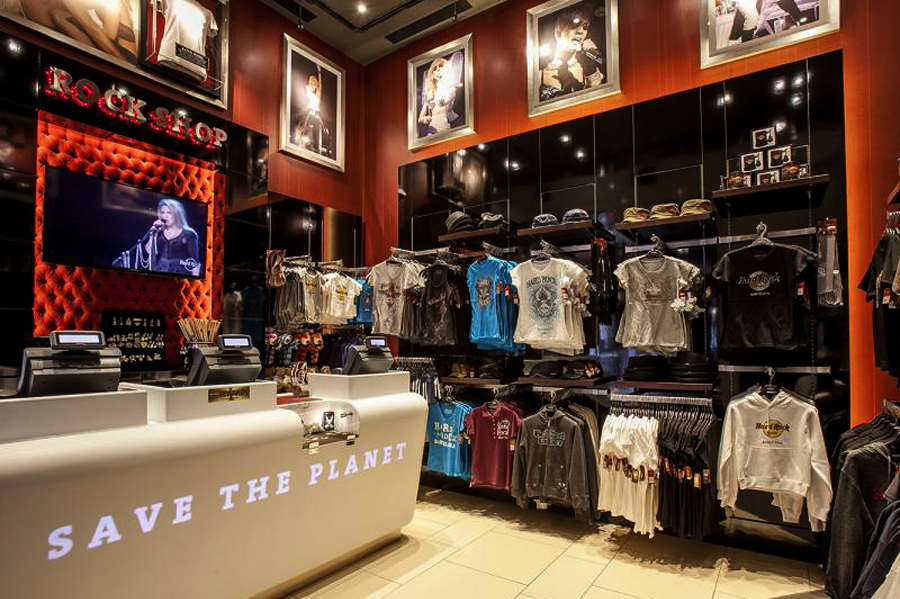
Red is also dominant in the two Rock Shops which frame the main entrance from the Placa Catalunya. These are amongst the busiest Rock Shops in the world and get extremely crowded in high season. Consequently, these have been completely remodeled to improve access to merchandise. New POS counters built entirely of white ‘Corian’ have been designed for the project which incorporate the Hard Rock ‘mantras’ – “Love All, Serve All” and “all is One”. The words are routed into the rear face of the counter-front Corian and then back-lit with warm white LED. When illuminated, the words appear on the counter fronts. When the lighting is off, the words completely disappear.
Externally, the old polished brass entrance screen has been replaced with a new stainless steel storefront incorporating three interlinked video screens which are visible from across the Placa Catalunya. The external granite facades have been restored to their original form having been much altered in recent decades and all external signage has also been replaced. A new side entrance linking to a large new external terrace was also introduced allowing the total capacity of the cafe to increase significantly during the busy summer months. The main cookline in the kitchen was also extended to cope with the extra capacity.
This project looks outstanding. This is the quality, effort, outcome and the level of detail I have been striving for. Great Job, Great Firm and Great People to work with.
Thank you !!”
Joseph Emanuele
SVP of Design and Development,
Hard Rock International
Fuse Studios Limited, info@fuse-studios.com