
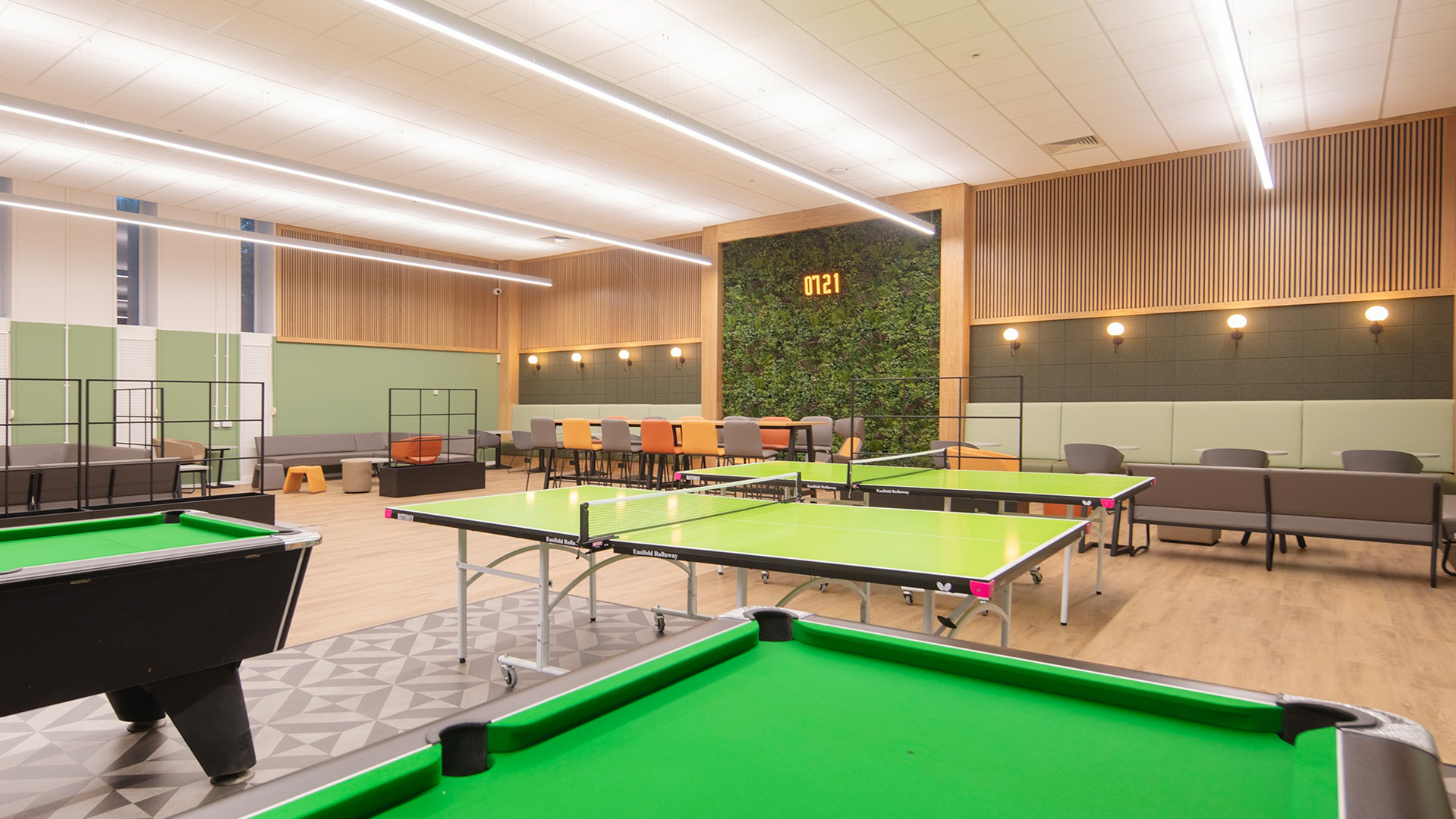
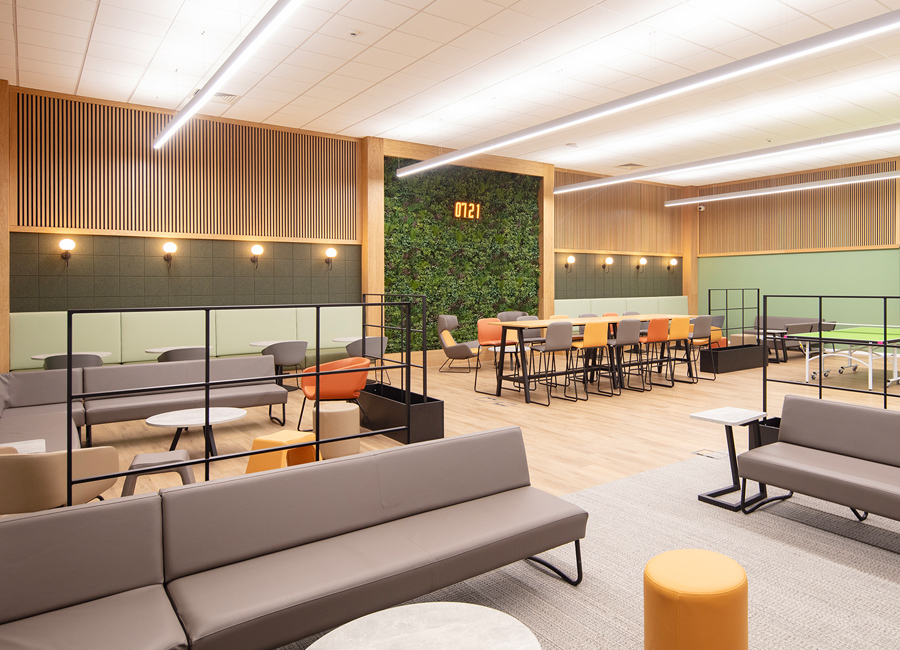
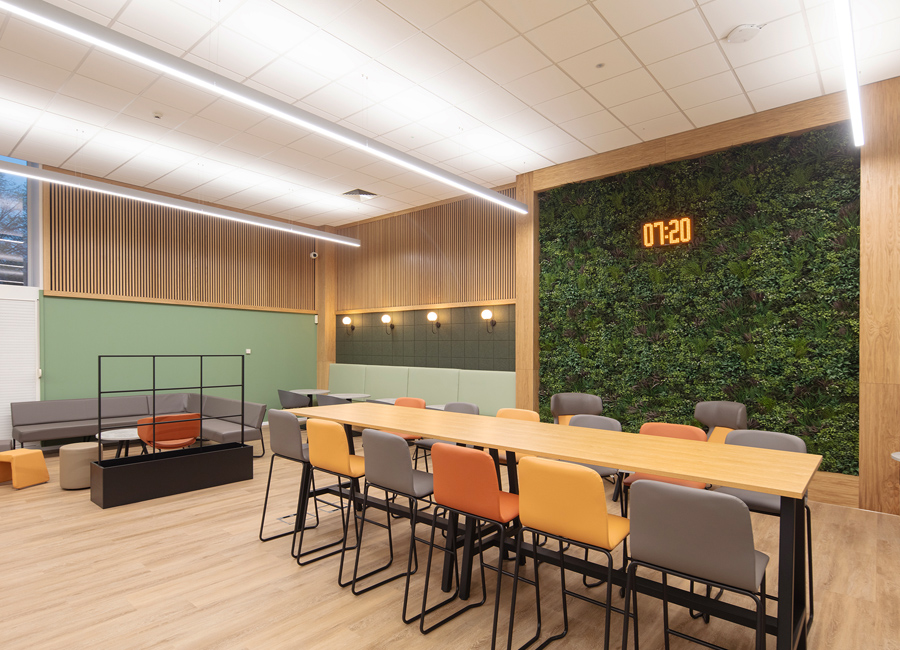
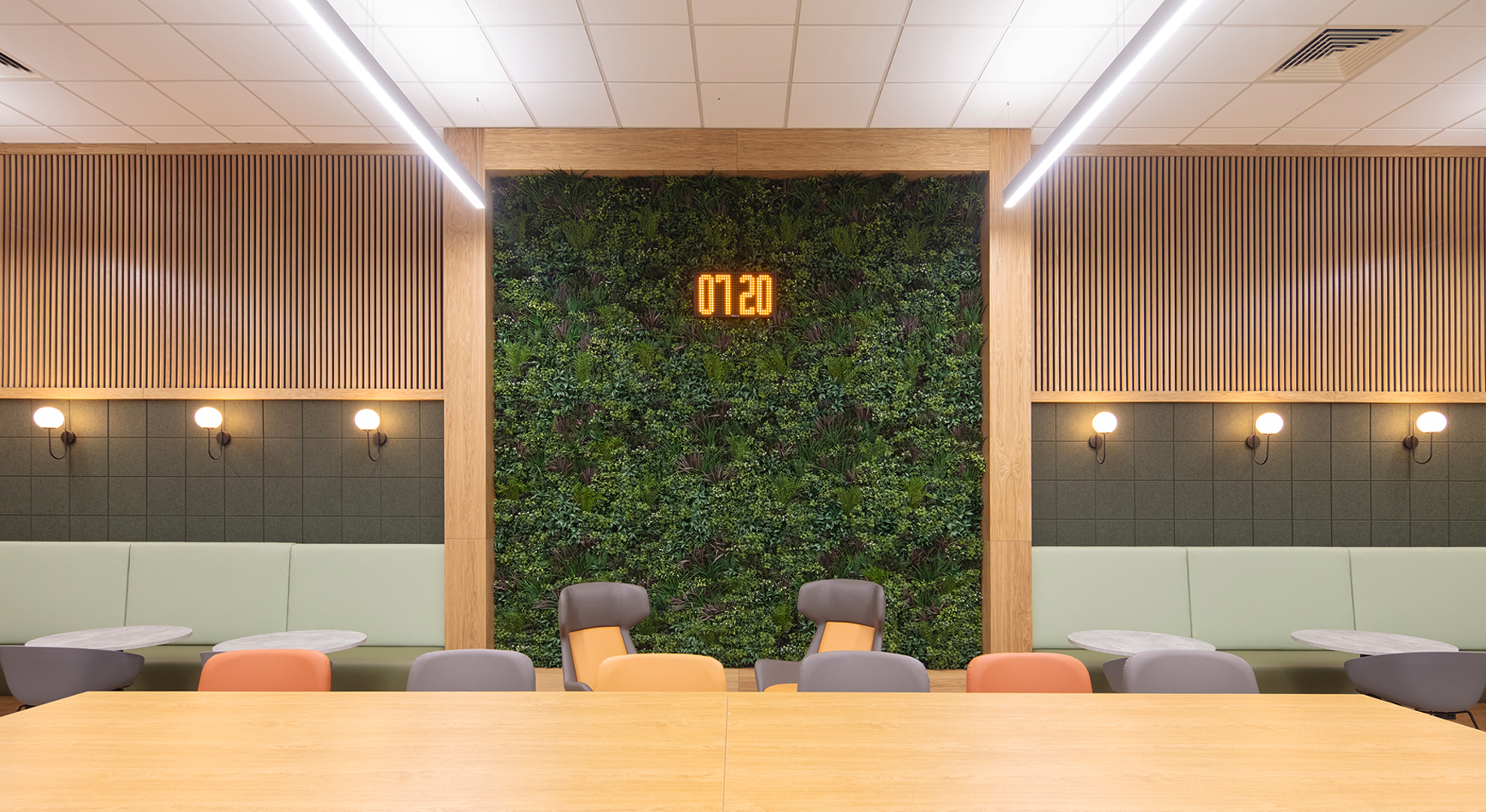
This refurbishment project has transformed the student experience at Leeds College of Building North Street Campus, following a recent renovation programme. Building work took place over four floors, incorporating the transformation of the former library into a light and airy student enrichment area. The large open-plan space includes a gaming area, TV lounge, meeting room, Student Services office, study areas and co-working spaces.
The ground floor work was part of the College’s broader strategy to boost accessibility. The enrichment area is now better located near the entrance and is designed to be an inclusive and safe space that is welcoming to all students. A flexible furniture arrangement means the area can be transformed into an exam space accommodating up to 80 desks.
The reception and cafe area were upgraded into a larger communal zone with fresh decoration, flooring, power, and IT. Corridors and staircases across floors were also refreshed with new wall graphics and energy-efficient LED lighting. The upper levels of the building were reconfigured to create a new learning resource centre, additional teaching spaces, teaching and support rooms, and a new staff training room in place of the old student common room.
Award-winning fit-out specialists, Lodestone Projects, managed the extensive summer works that rejuvenated the site and created contemporary and accessible facilities for construction students. Cost Consultancy and Project Management services were provided by Turner & Townsend.
Client: Leeds College of Building / Sector: Education / Status: Complete / Photography: John Kees Photography
Fuse led the development of the project brief with Leeds College of Building via a number of stakeholder meetings, this including valuable feedback sessions from the Phase One building. As a result, a strategy for creating spaces capable of delivering the best practice in teaching and education was quickly adopted.
The brief called for two very different types of learning environments – large workshops for the teaching of practical skills and more typical classrooms for academic study. As in the previous Phase One building, large workshop spaces are grouped together, as are the classrooms. As a building college teaching practical skills can be “A messy and noisy business,” so the cleaner/quieter classroom spaces are therefore deliberately positioned to be acoustically separated from the workshops.
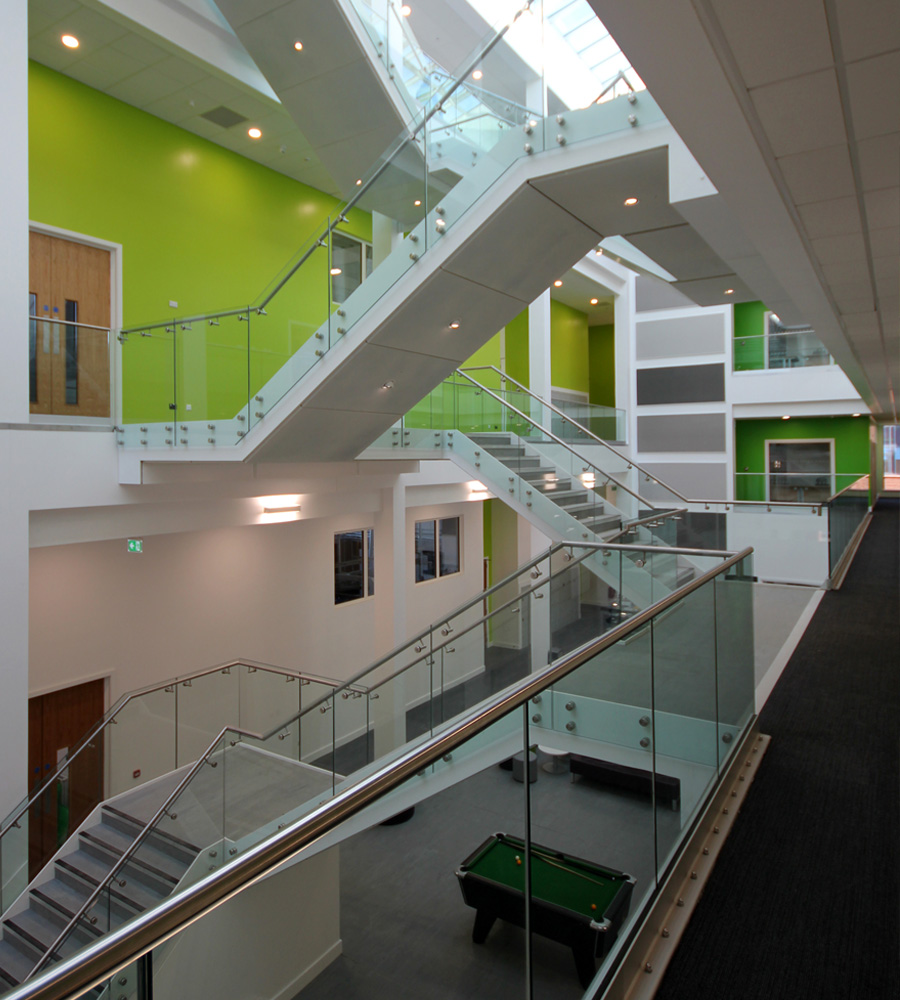
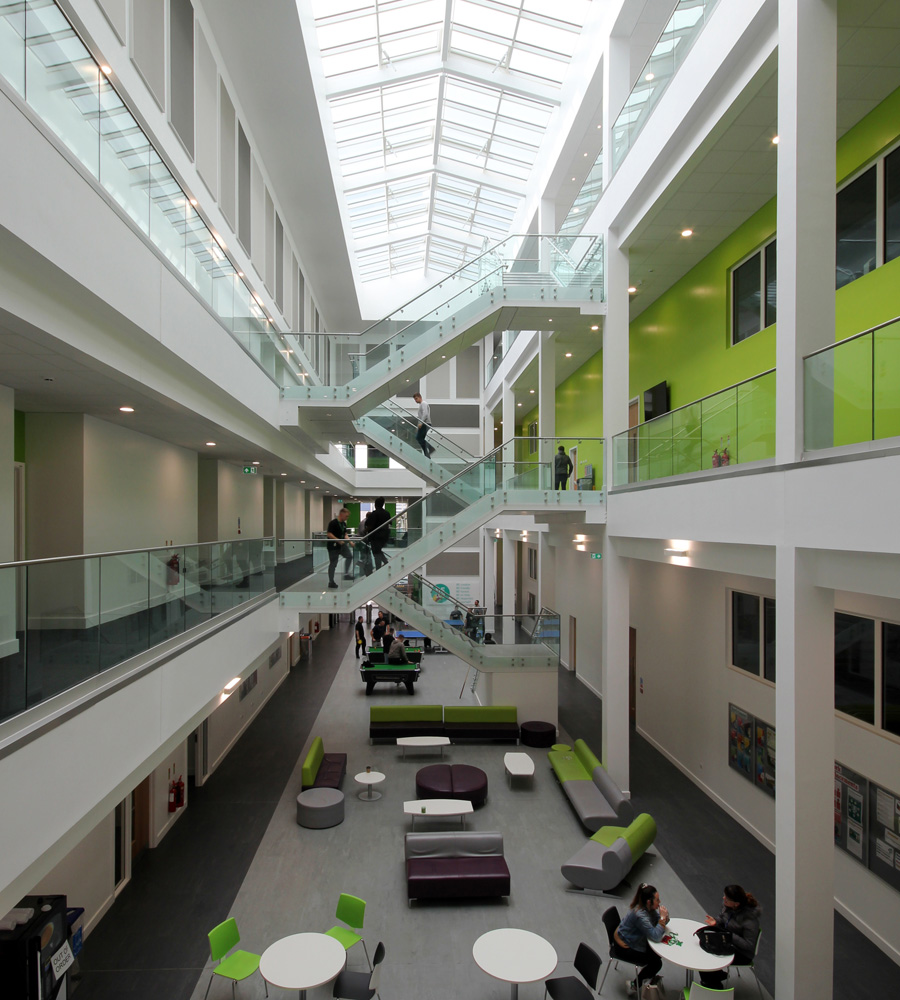
Teaching, administrative and social areas are arranged efficiently, with simple to understand circulation spaces. The workshop and classroom zones are linked by a central atrium, which also serves as the main communal space. Throughout both buildings, daylight permeates the relatively deep plans, provided through atria and the extensive use of rooflights over the common areas.
The seamless integration of architecture and interiors was fundamental to our approach. The building design was as much about interior spaces and how they functioned, as it was about the building’s exterior.
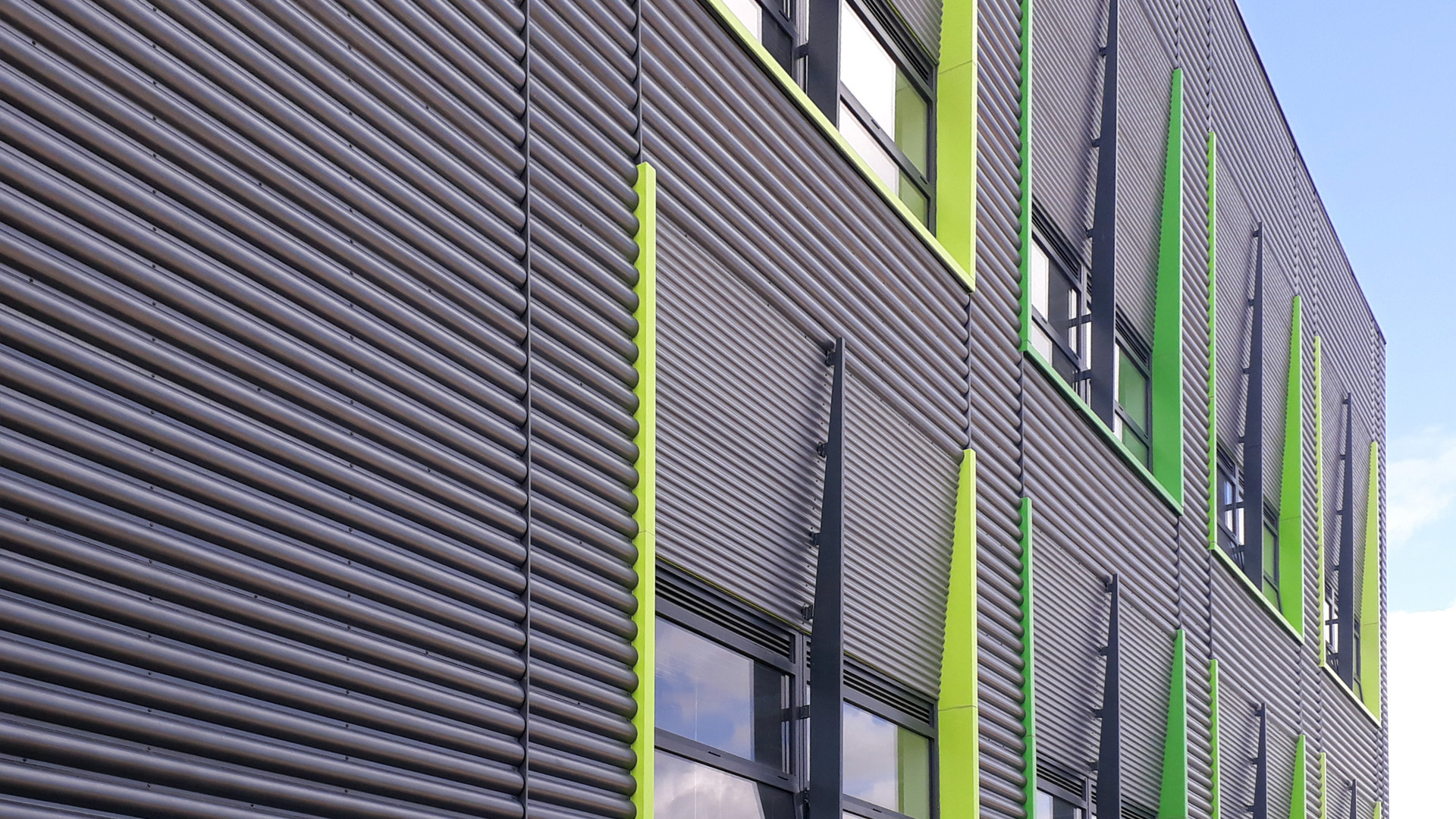
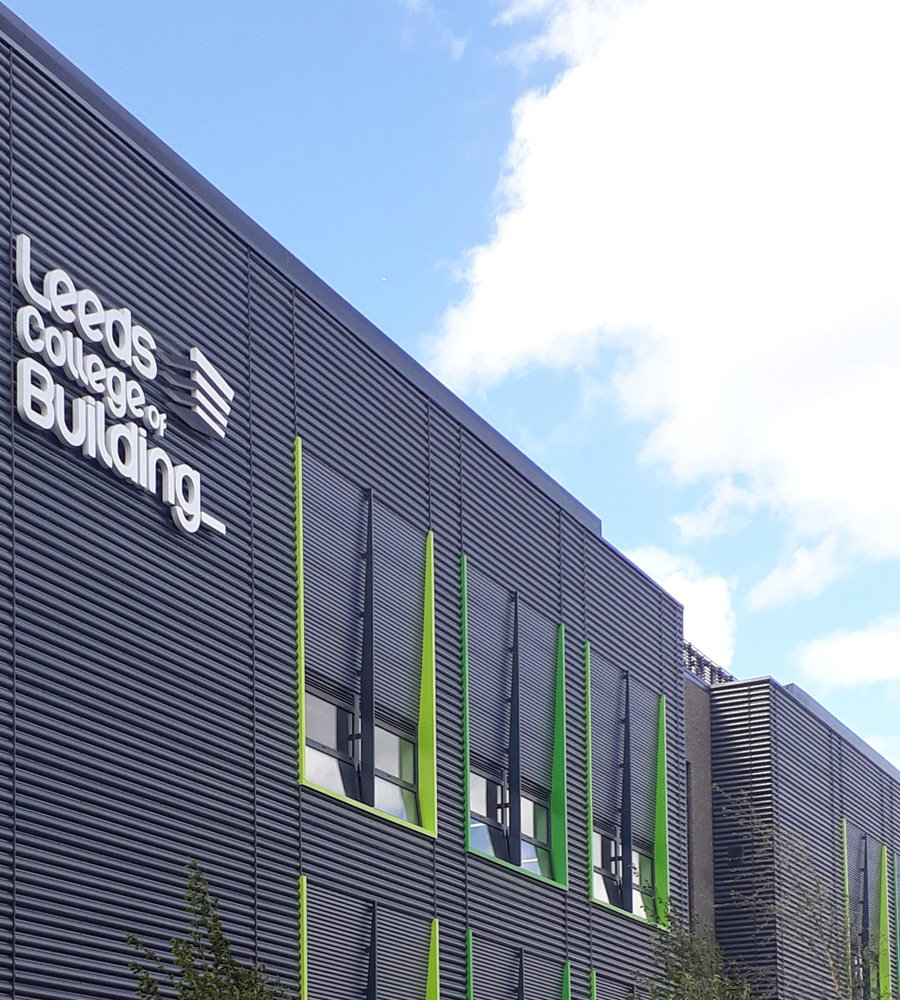
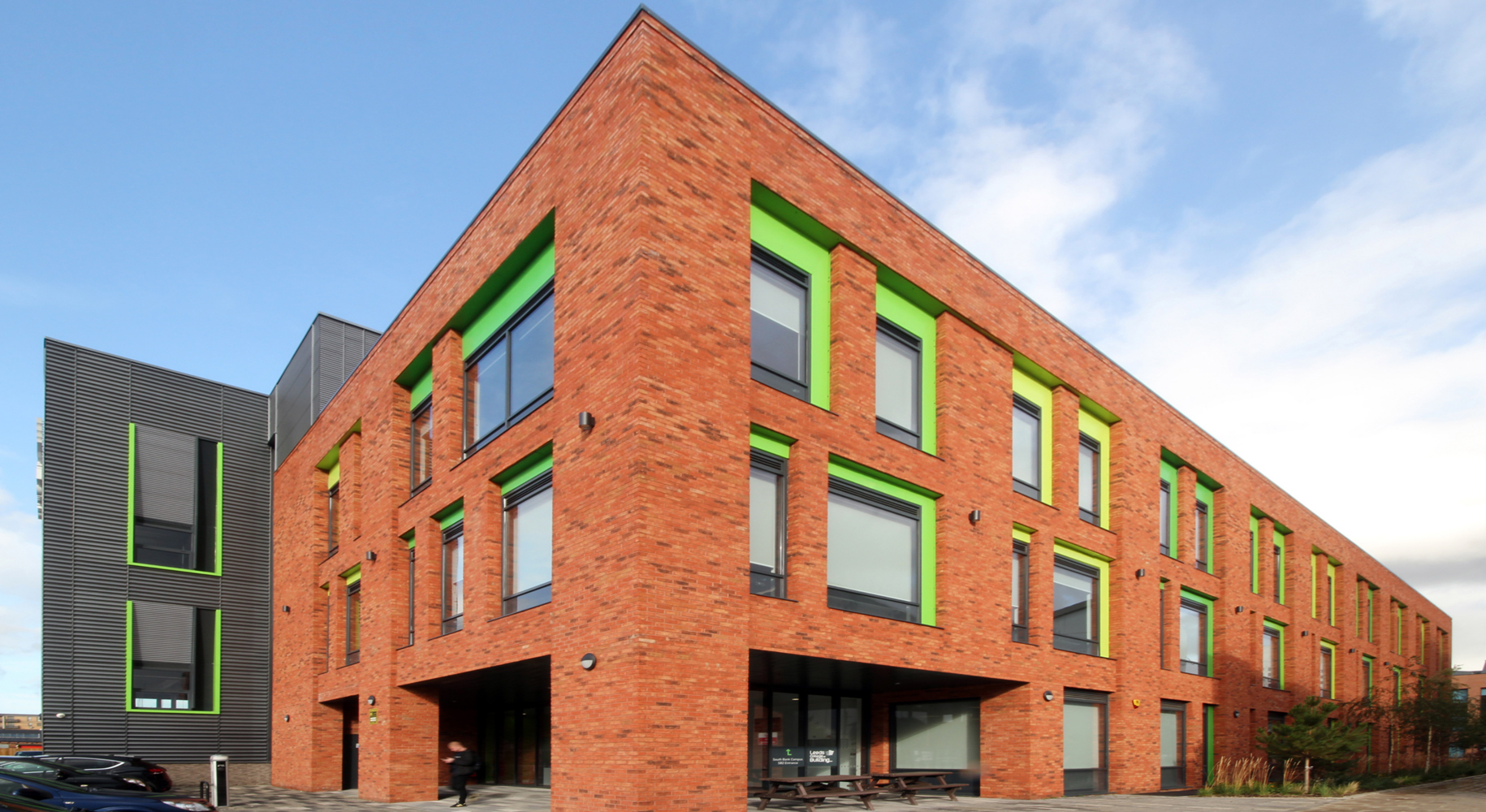
Externally the material palette reflects both the industrial heritage of the area and the activities within the buildings. External cladding materials were selected to complement Phase One so as to create a cohesive campus environment. Again a high quality red facing brick was specified to clad the south facing classroom wing of the building with the window reveals celebrated by strong, vibrant colours, giving the façade a playful nature and hinting at the education use within.
Designing a new building for students of the construction industry demanded that a highly sustainable approach was adopted from the outset of the project, and which successfully achieved a BREEAM rating of “Excellent.”
Client: Leeds College of Building / Sector: Education / Status: Complete / Photography: Fuse Studios


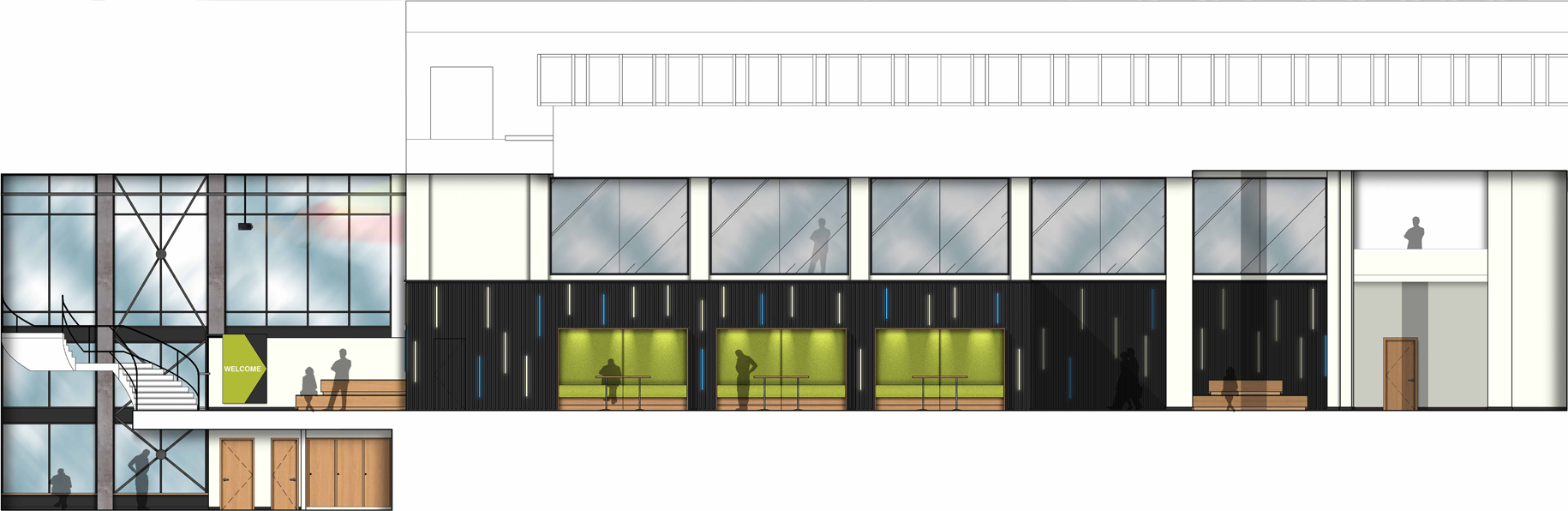
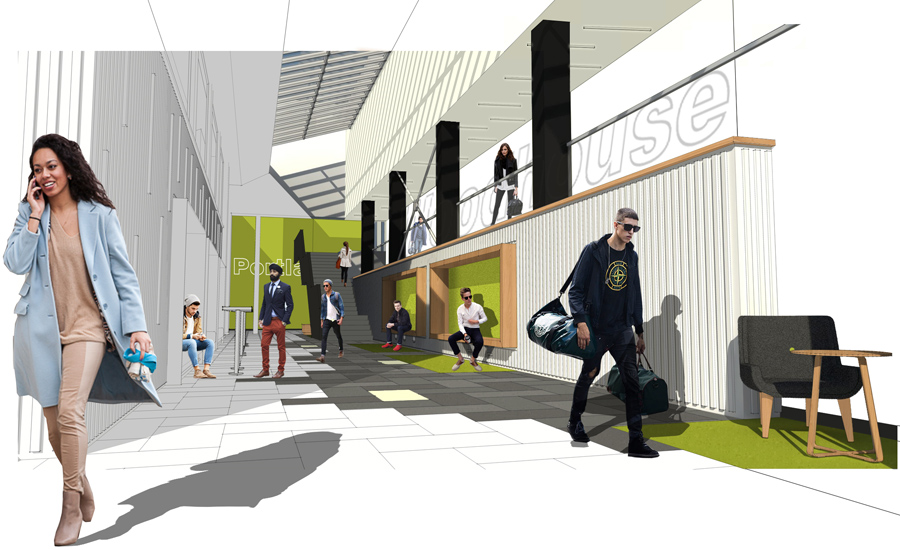
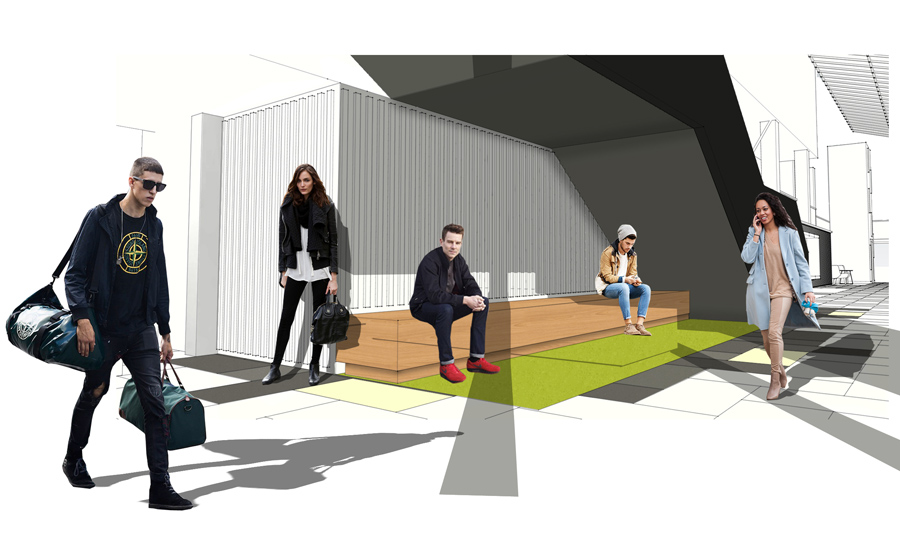
The Portland entrance created a new gateway to the City Campus and enhanced the cohesion of four key locations. As well as providing a principal entrance to the Portland and Calverley buildings – two of the largest teaching spaces in the city – the building now connects the Woodhouse and Leslie Silver buildings, which house the Students’ Union and the library, as well as a range of food and beverage outlets.
Connecting the four buildings has brought everything under one roof for the academic schools based in these locations, creating a greater sense of community and place for the staff and students alike.
The new structure has extended the entrance onto Portland Way, heightening the university’s street presence, whilst the exterior has been designed to blend in with the Portland building’s iconic façade. FUSE were appointed to provide a design concept for the interior allowing the architects to deliver the scheme as a whole through the tender period and onto site. The brief was to work within the architectural design and help bring the creation of smaller collaboration spaces for students to meet and socialise, and undertake informal study within the new entrance.
Client: Leeds Beckett University / Sector: Education, Refurbishment / Status: Complete / Visualizations: Fuse
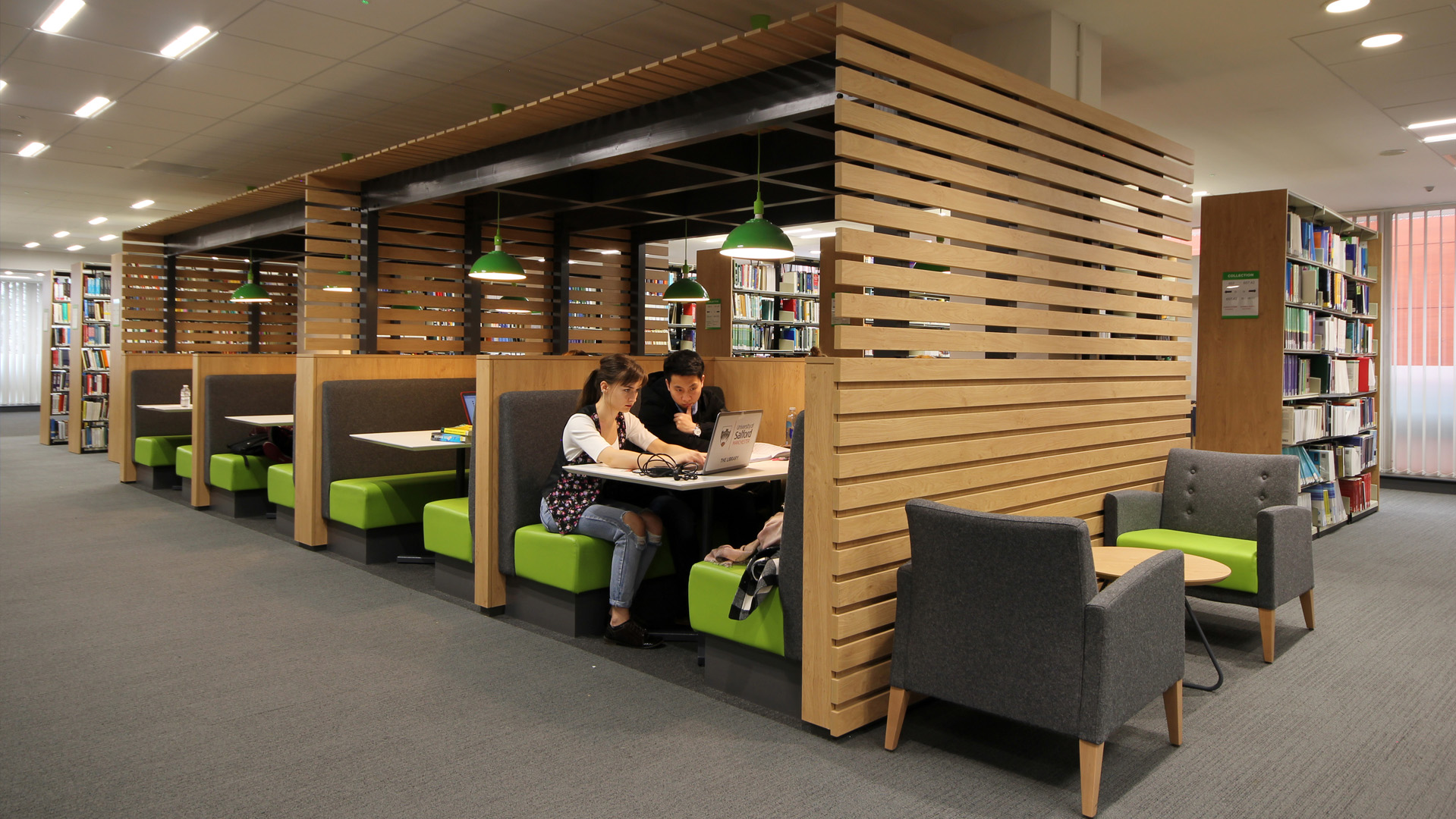
This complicated project was not only the refurbishment of the existing library building but also the consolidation of 2 other campus libraries. The challenge was to create an environment that increased dwell time, enhanced learning whilst delivering access to more books, whilst also taking into account new developments such as the Adelphi building, new student residences at Peel Park, the continuing development of the Cultural Quarter and to change user perceptions of the library by enhancing the overall student experience.
Fuse were appointed to provide a full interior design service from design concept through to on-site delivery, in which the findings of the report would be implemented over a two year period.
Due to the library being a 24 hour provision and to minimise disruption to students during key times of the academic year, the project was delivered in two phases. Phase 1- second and first floors; Phase 2- ground floor.
The design for the library was inspired by the park it overlooks – Peel Park – which was the first municipal park in the UK. This helped coin the phrase ‘the library in the park’ and its design ethos of creating ‘a sense of place’. This theme helped with the selection of colours, materials and artwork in the building, as well as allowing us to create fixed joinery features on each floor based on park pavilions.
The design successfully accommodates just under a linear kilometre of books and an increased seating capacity of 1152 students. The project was and still is regarded as a great success.
Client: University of Salford / Sector: Education, Refurbishment / Status: Complete / Photographer: Fuse Studios
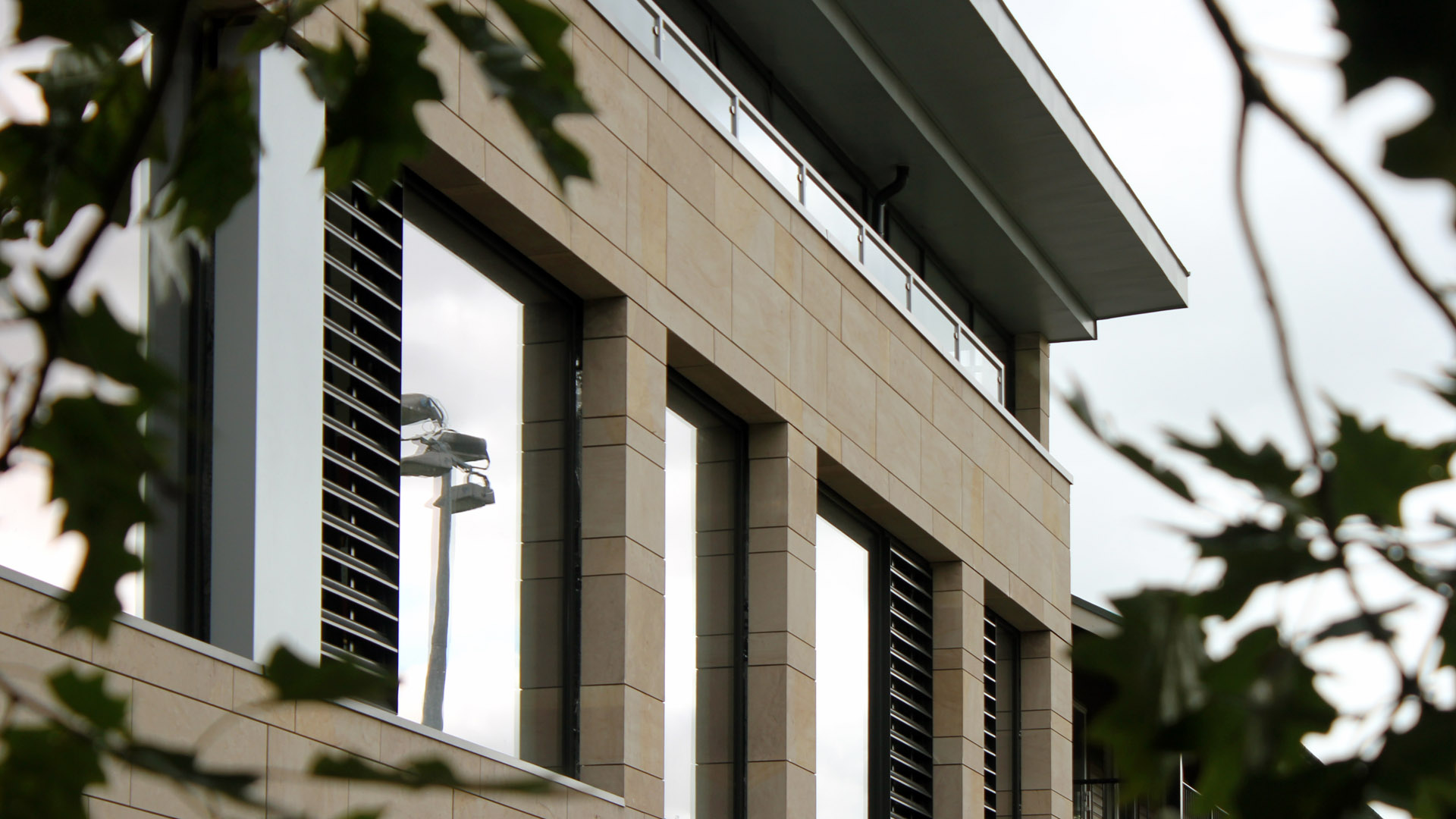
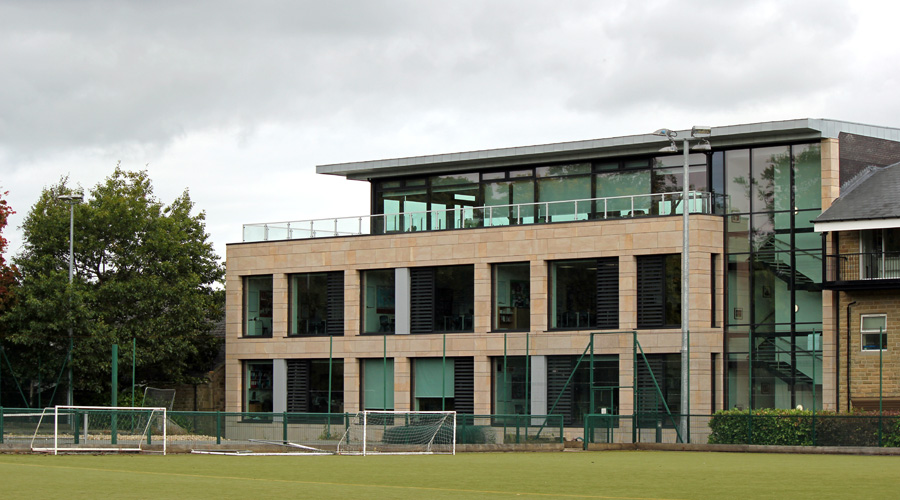
Greenhead College is a sixth form college based in Huddersfield Town Centre and was founded in 1980. It is situated next to Huddersfield’s Greenhead Park and accommodates around 2000 16-19 year-old students.
The project brief called for a design that would be sympathetic to its location, other College buildings and Kirklees Council’s Planning Guidance whilst satisfying the Colleges wish to build a new four storey link building between the existing Arts & Classroom and Dawson building. The new facility provides an IT Suite / Reading area for students at ground level with classrooms and offices to the two upper floors and an exam suite on the fourth floor. Each individual classroom accommodates up to 24 students and are sized between 40 – 50sqm.
The building improves the free flow of students throughout the College by links along 3 boundaries at Ground Floor level – flanked either side by the Dawson and Conway buildings, and to the rear by the existing Main Hall and refectory.
The building’s massing strategy sought to maximise the available development volume and maintain existing natural light and aspect by referencing and respecting the adjacent existing building scales. This resulted in a massing volume which balances the overall elevational impact of the 3 buildings when viewed as a whole, aided by stepping the roof profile of the link building.
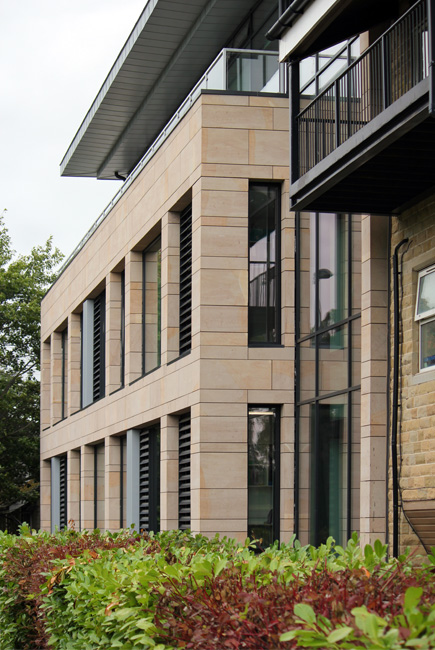
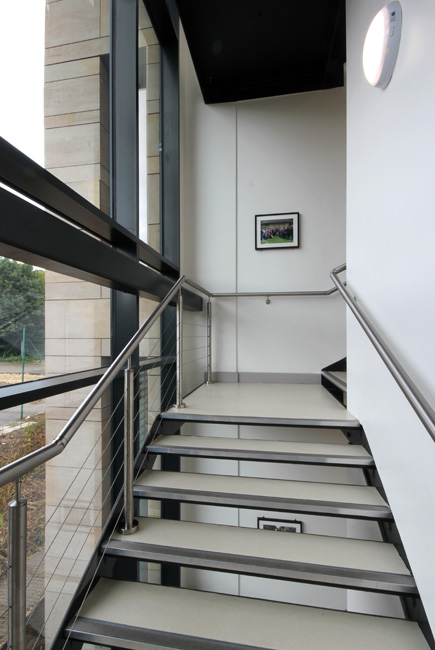
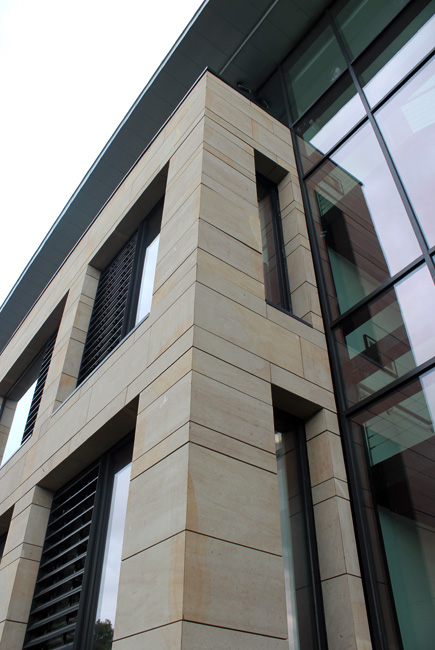
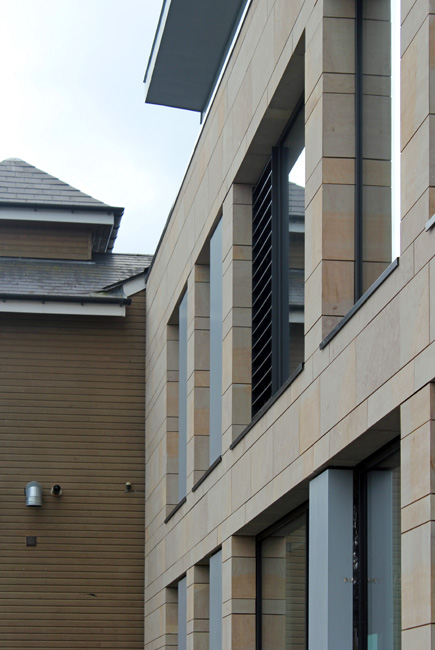
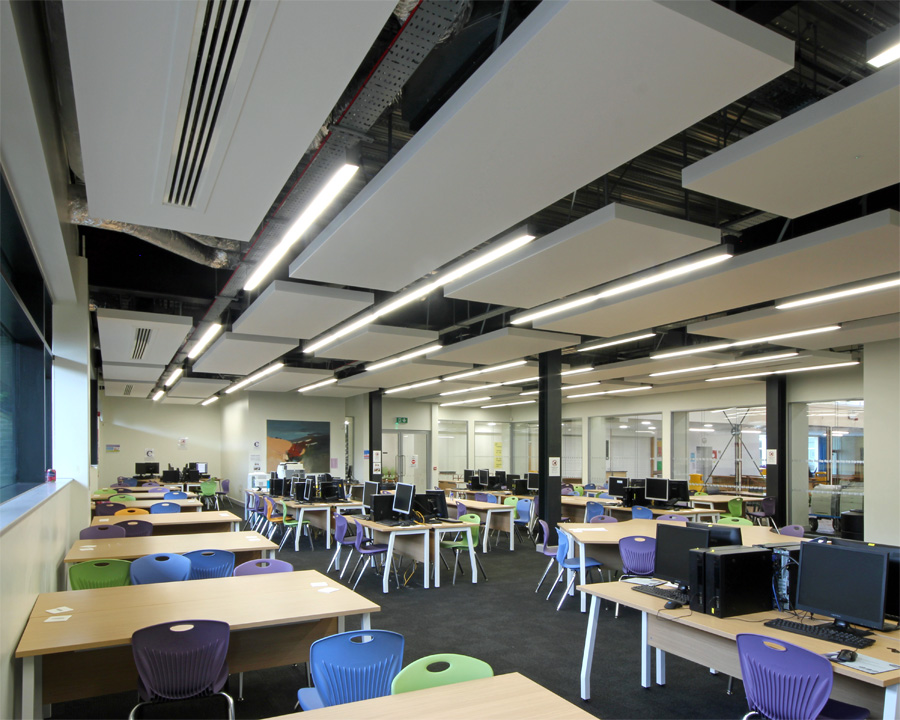
The chosen site presented several challenges due to it’s location between two existing buildings, the main communal hall and the outdoor sports pitches to the East. Due to the historic ad hoc nature of the built forms on the campus, there where numerous level changes for the students to negotiate during their day to day activities. A key design proposal was to lower the height of the existing ground floor within the new building so that it would link to two of the existing buildings as well as the main student common area – thus orghanising all spaces onto one level. This ground floor rationalisation has meant that the main space has now become the central hub for the Campus with clear routes to all of the surrounding buildings / study areas.
The new Reading Room / IT Suite has a full height acoustically treated glazed wall offering the students a clear view through the hub to the learning centre, with auditorium styles steps and seating dealing with the last remaining level change in the hub space.
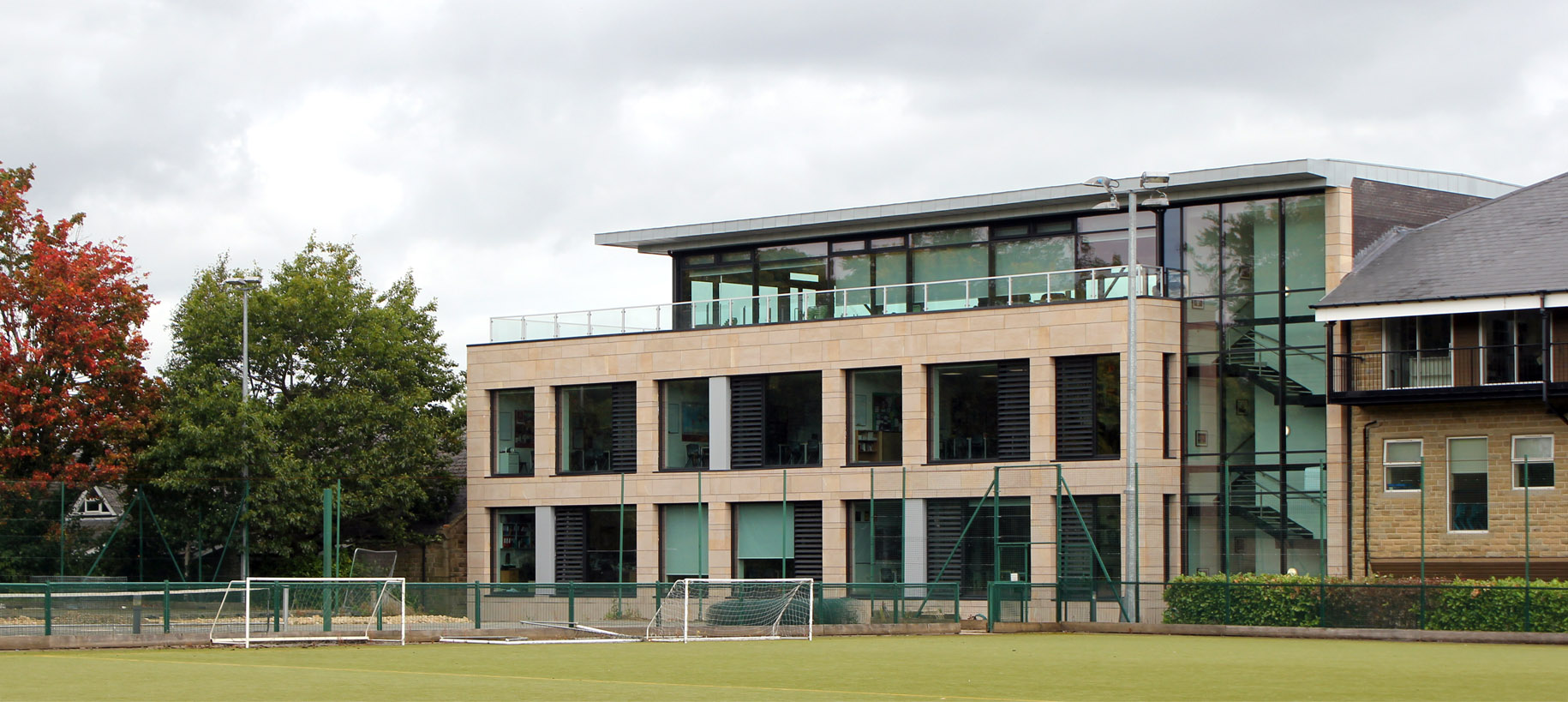
The external design of the building balances the change in height between the two adjacent buildings by reducing the footprint of the fourth floor accommodation which then also allowed for the inclusion of a small roof terrace, which the College utilizes for social events. The exam suite at this level is fully glazed offering the students and lecturers panoramic views across the Huddersfield roof tops and beyond – when they are not busy with their heads down concentrating on their exam papers!
An aluminium-clad roof form floats over and extends beyond the glazed walls to provide natural shading from direct sunlight in the summer whilst allowing it to penetrate deep in to the floor plate during the winter months.
The two classroom levels are designed around the simple concept of maximising natural day light and ventilation into all classrooms and vertical circulation spaces. Finally, the ground floor level of the IT & Library suite has high level windows allowing the students views out and natural daylight in.
Fuse’s elevational philosophy set about expressing the ‘use’ of each floor level through the proportion of solid wall to glazing, and the choice of façade material. The intention was to achieve a bold elevational design utilising a contemporary material palette, and incorporating floor to ceiling glazing to maximise the buildings use of natural day lighting and ventilation through opening lights. As the development sits within the Greenhead Park Conservation Area, the material palette was selected to respect the existing local architectural vernacular – using natural Yorkshire stone and brickwork. At the same time, the elevational strategy and material palette seek to deliver a bold, contemporary building design, whilst avoiding becoming a pastiche of existing local building examples.
July 2017 saw the successful handover of the Canham Turner Building (formerly known as Staff House) at the University of Hull following a major refurbishment of the entire building over two phases. The £7-million redevelopment is part of a £200-million investment by the university that will significantly improve student and staff services and facilities across the campus.
The renaming of Staff House to Canham Turner is the first time that one of the University’s buildings has been named after a woman and the name change recognised a generous £3.5 million donation from alumna Barbara Canham Turner, who sadly passed away in 2015.
Canham Turner is one of the oldest University buildings dating back to 1948 and it houses the main kitchen for the university, along with a large conference/wedding venue with stage, servery area with dining space, conference and meeting rooms, bar, private dining facilities and full staff, back of house, office, support and welfare facilities.
Due to the complex nature of the kitchen refurbishment, the overall project was split into 2 main phases spread across 13 months of on-site fit-out/ refurbishment.
Phase 1 ran from July to October 2016 with contractor Sewell Group appointed to complete the works. This involved the relocation of the main kitchen into temporary facilities, whilst the fit out took place in what was still a live environment. These works upgraded the old and tired kitchen with new modern finishes and new industrial-scale catering facilities. The works included the re-plastering of existing walls, installing hygienic wall cladding and the installation of new floor finishes with modifications made to the existing drainage. As part of this phase, we also installed new ceilings with supporting M&E coordination alongside toilet and shower facilities and upgrades to the existing roof and roof lights.
Whilst Phase 1 was on site, Phase 2 was successfully tendered and another Hull-based contractor, Houlton & Sons Ltd, were appointed. The kitchen was brought on-line and the works started the following day on what was a 9 month program.
Phase 2 ran from October 2016 to June 2017 and tackled the upgrade of the remaining building whilst the kitchen was fully operational. This final phase was again broken down into 4 separate mini-projects so that the conferencing facilities on the first floor and the large conference suite at ground floor could still be used by internal and external visitors, especially during Hull’s tenure as UK ‘City of Culture’.
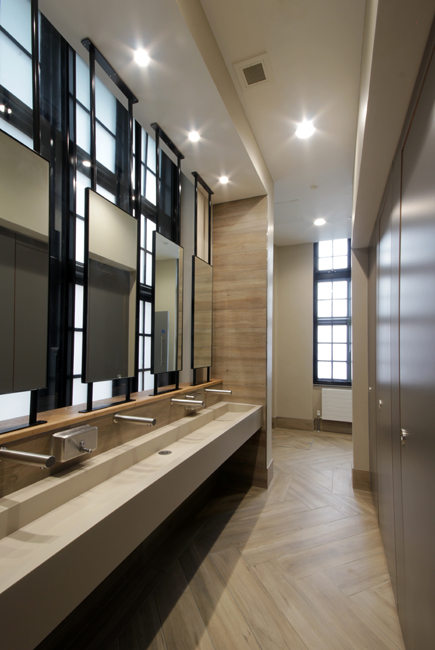
The refurbishment was designed to be sympathetic to the building’s original features, maintaining original details where possible, including aspects of the ceilings, cornice work and mouldings, windows, doors and even the fireplace.
The design also added a contemporary range of modern finishes to further enhance the original features providing a hotel-like quality of finish throughout. In addition to the new finishes, each facility was further enhanced through the use of state of the art audio-visual facilities, fibre wi-fi connectivity and theatre/ stage lighting in the Kingsley suite.
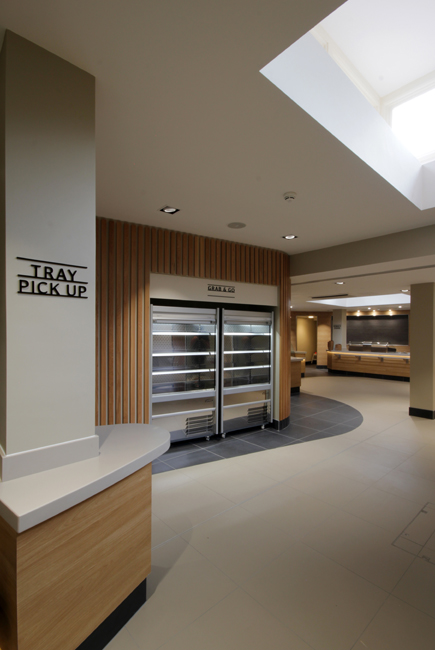
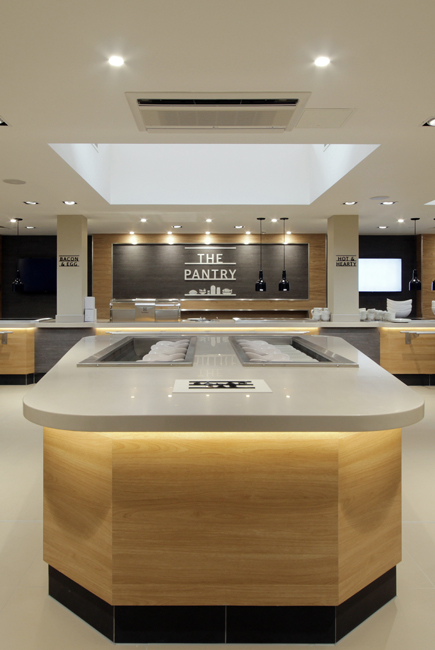
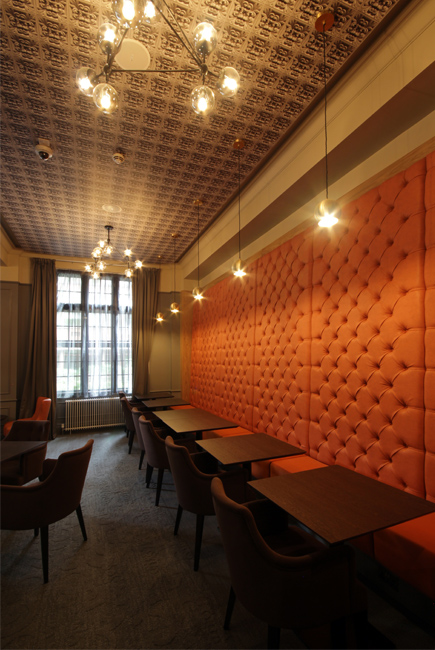
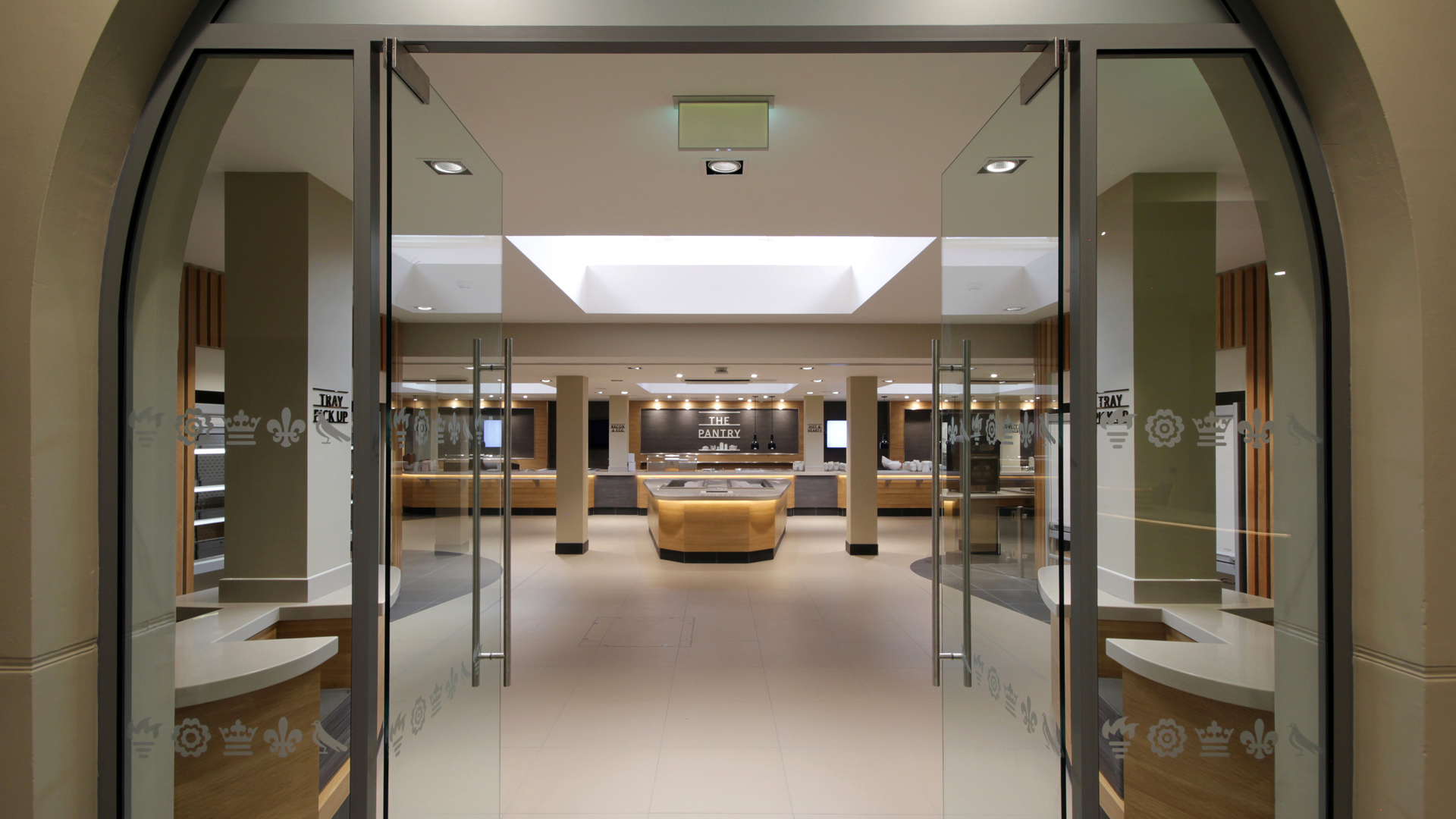
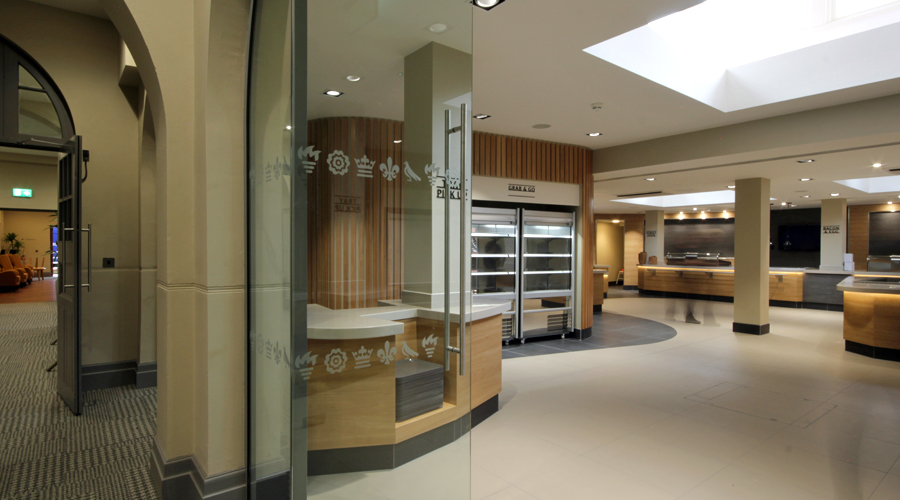
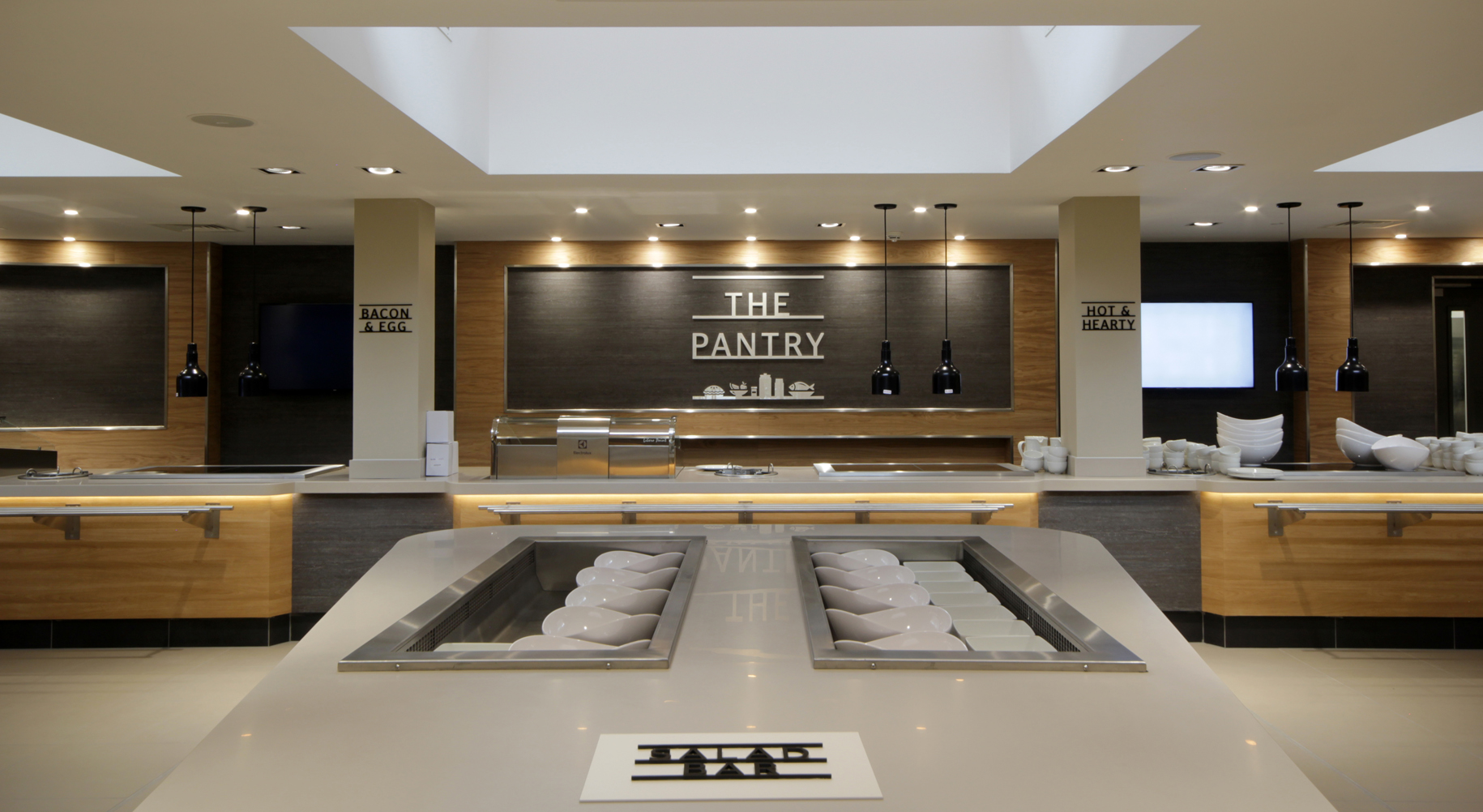
The servery – now known as The Pantry – has been extensively remodelled, removing walls and opening up this and adjoining spaces, creating far-reaching sight lines throughout. This has successfully created a diverse food court with a spacious, modern dining room – The Rossetti – that provides a central hub where staff and students can eat, drink and socialise with friends.
The Rossetti is both visually and physically linked to a brand new café – Wilde’s Café. The café benefits from adjacent breakout areas, a private dining facility and new bar; catering for a diverse range of uses from business lunches, staff meetings, weddings and external events. All these spaces are also linked via a new external terrace, providing a truly flexible and versatile space both internally and externally
The 1st Floor, now called ‘The Barbara Canham Turner Conference Suite’ is predominantly for external users providing them with a wide range of flexible conferencing facilities and meeting rooms accommodating from 10 to 300. This is all supported by new toilet facilities and break-out areas with integrated catering to support any number of uses.
This floor is also the new home of the Campus & Accommodation Services department who manage this building and all the other catering and accommodation outlets across the campus.
Our thanks go to Trudi Vout and Mark Mullaney from the University of Hull along with the University’s project manager, Ian Longhorn. External project managers were Steve Clarke, Wayne Cummins and Jack Kettlewell of Cushman and Wakefield.
The Fuse team was David Eastwood, Tracy Heywood and David Matthews during the design stage, with Steve Bell, supported by Tracy Heywood, Mandy Wright and Scott Ryalls doing a fantastic job of the delivery.
M&E design was by Tony McWilliams of McWilliams Associates and structural design was by Andy Thompson and Laura McCubbin of Mason Clark Associates.
Phase 1 contractors, Sewell Group, were led by Geoff Smith, Chris Soper and Danny Walker; phase 2 was Houltons led by Jon Jones, Sean Hunter, Dave Angus and Gareth Copnell. M&E Contractors for all phases was Valletric, led by Pete Flintoft and Paul Holroyd. Marshall Catering looked after the kitchens under the watchful eye of Simon Dibbs.
Joinery works were by Batty Joinery of Hull and SWJ Solutions from Osset. Loose furniture was supplied by Broadstock and internal and external signage was by Premier Signs.
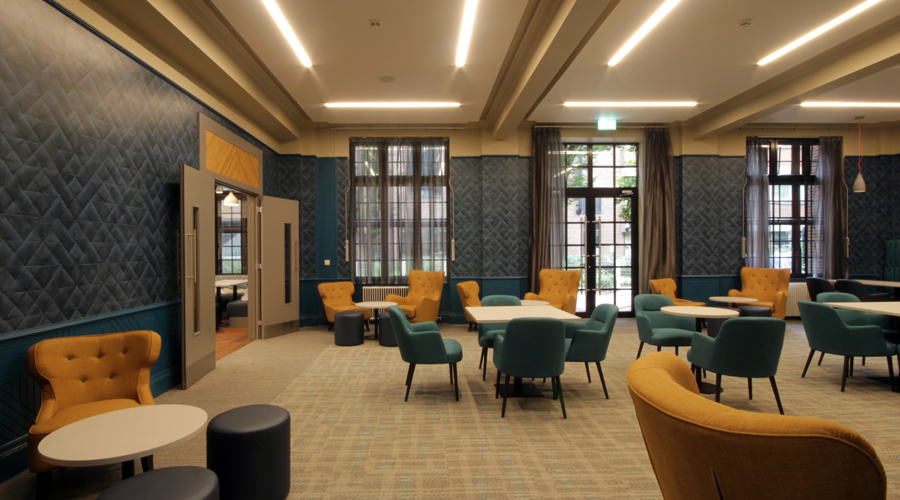
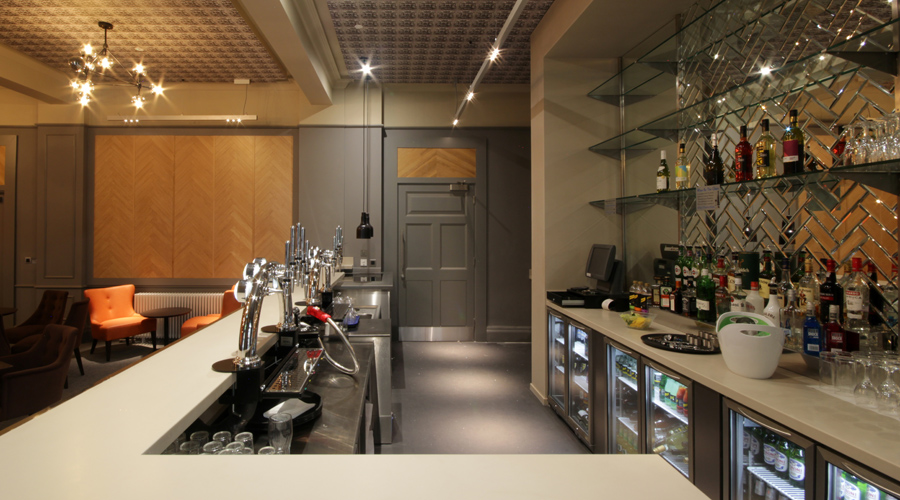
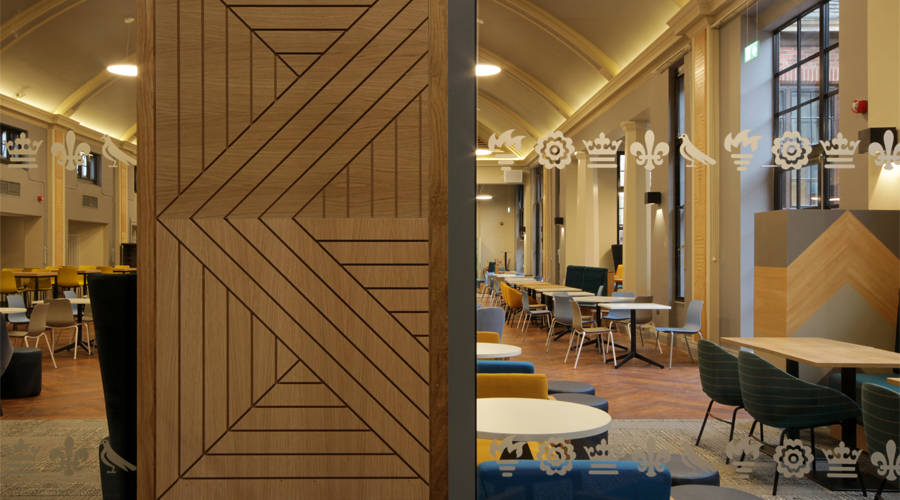
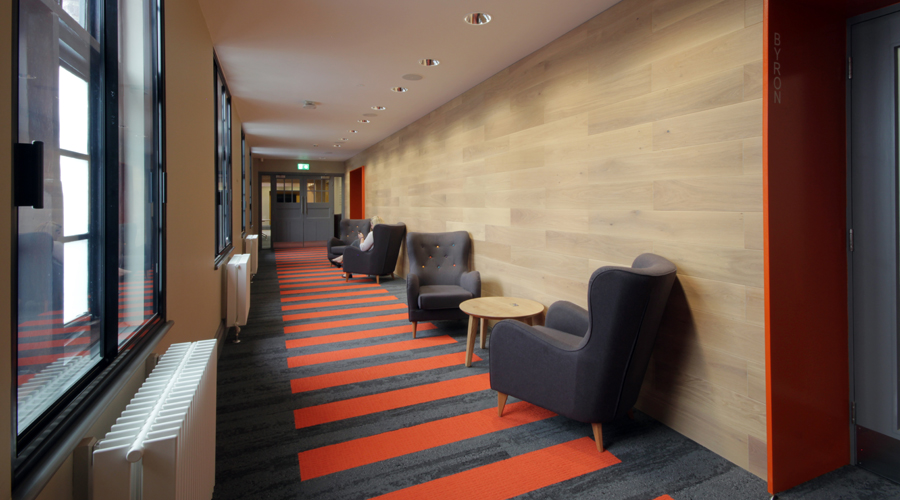

Originally designed in 1915 by Paul Waterhouse (the son of Alfred Waterhouse, the architect of several of the earliest buildings at the University in the late 19th Century and most famous for Manchester Town Hall and the Natural History Museum in London) as an Agriculture Sciences building for Leeds University, this elegant building was eventually completed in 1927. It was adapted over time to include an annexe to rear, a new passenger lift, a 1960s timber-clad rooftop extension and escape stairs. It remained with the Agriculture faculty until 1993 when it was converted for the Geography department. (which Fuse recently relocated to elsewhere on campus). The classical revivalist building was Grade 2 Listed in 1996.
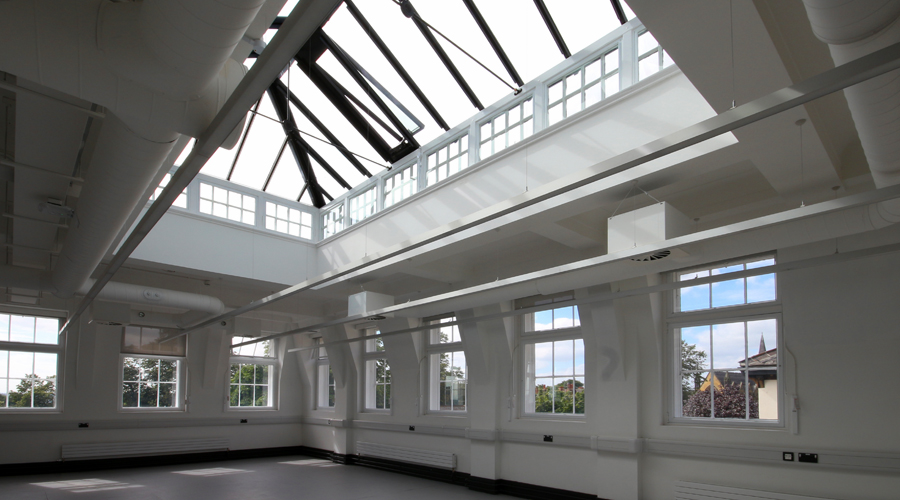
This new chapter in the building’s history included the demolition of the rear annexe, improvements in accessibility and environmental performance (including new building services and secondary glazing throughout), the removal of contemporary partitions to restore the original grand room sizes and the re-cladding of the rooftop extension from timber to zinc.
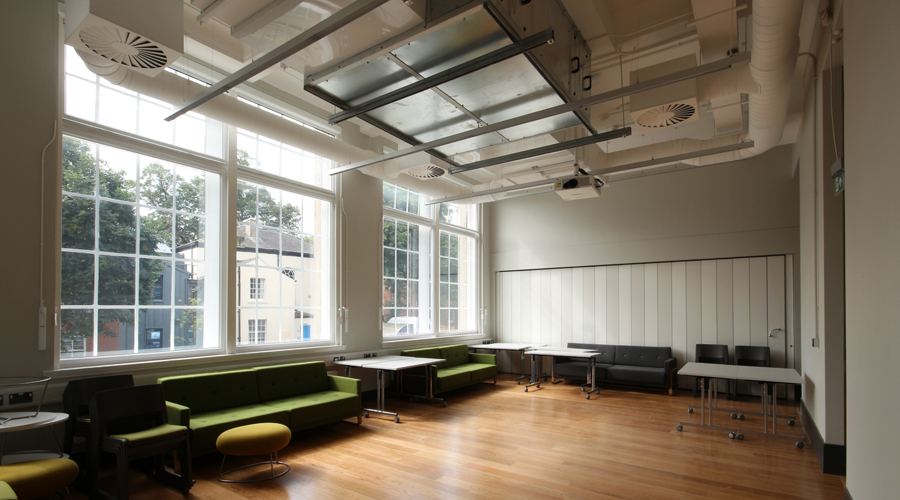
Architects ADP prepared the initial designs for the University working alongside M&E Consultant, Arup; Project Managers, Arcadis and quantity surveyors, Gardiner & Theobald and structural engineers, Curtins. Fuse worked alongside the contractor, the Sewell Group, to deliver the project, supported by M&E Consultants, G&H Building Services and Structural Engineers, Morgan Tucker. Work commenced on site in July 2015 and was completed in September 2016.
It was an extremely complicated project with enormous attention to detail required. One of the many challenges was the addition of a sympathetic secondary glazing system (barely detectable in the photographs) which not only had to maintain the existing appearance of the huge windows, but also allow their original opening lights to remain functional. Specialist sub-contractor, Granada Glazing, did a magnificent job of an almost impossible task.
Another was the introduction of modern building services into a building not designed for them. The plant, originally to be located on the roof, was relocated to the area behind the building due to the significant weight. Internally, the decision was made to leave the services interventions exposed for the most part, rather than attempting to conceal them in inappropriate boxings and suspended ceilings which would have severely compromised the character of the listed building.
For Fuse, the project was led by architects David Bradshaw and Lee Wren supported by technologist Iain McDonald, who worked very closely with the Leeds City Council Planning Department. Thanks are due to Senior Planning Officer Sarah McMahon and Conservation Officer Keith Williams for their valuable guidance.
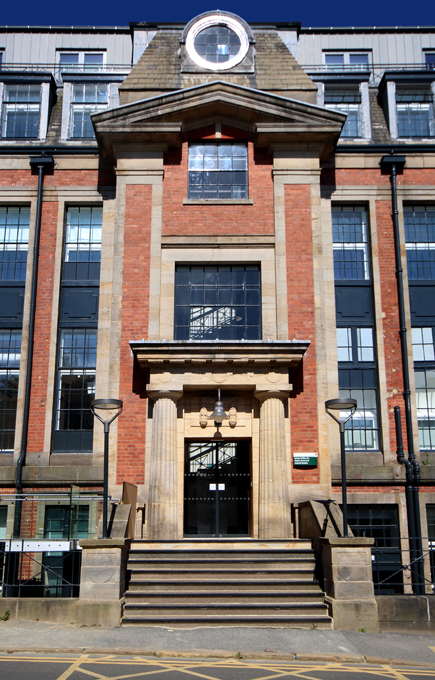
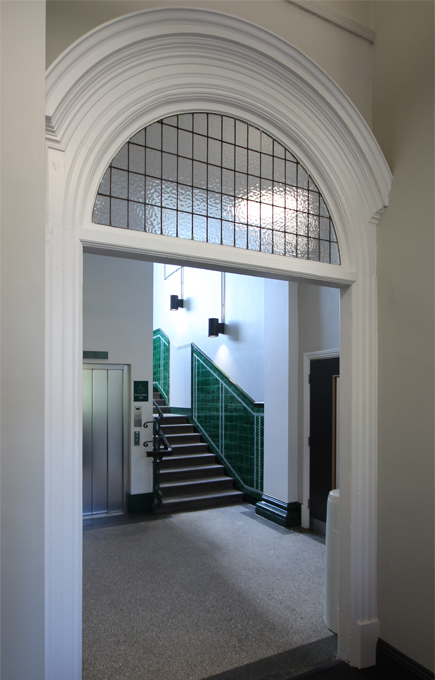
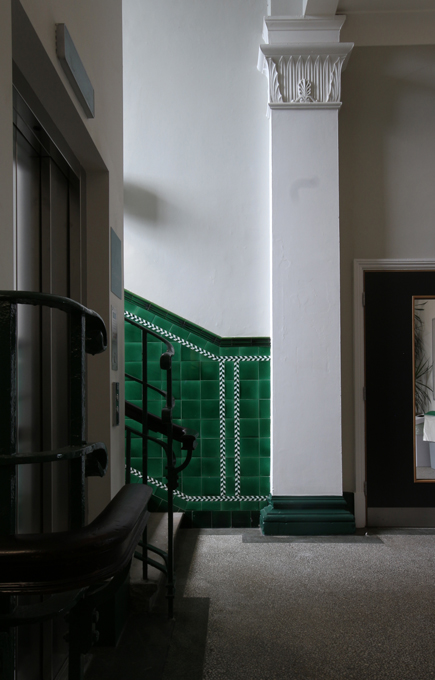
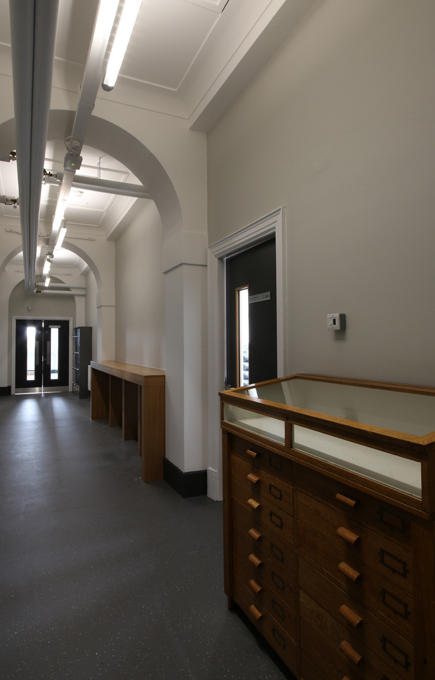
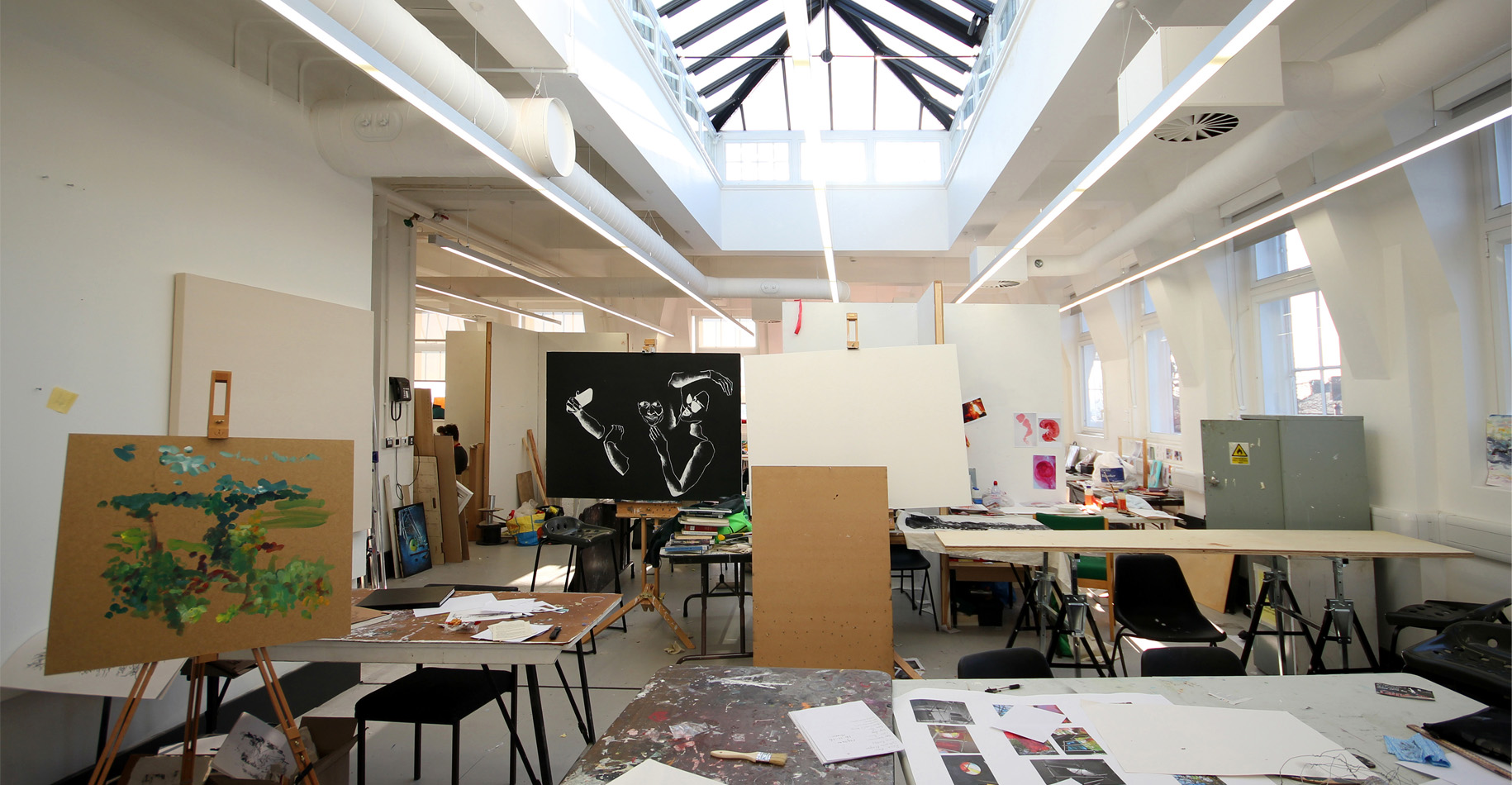
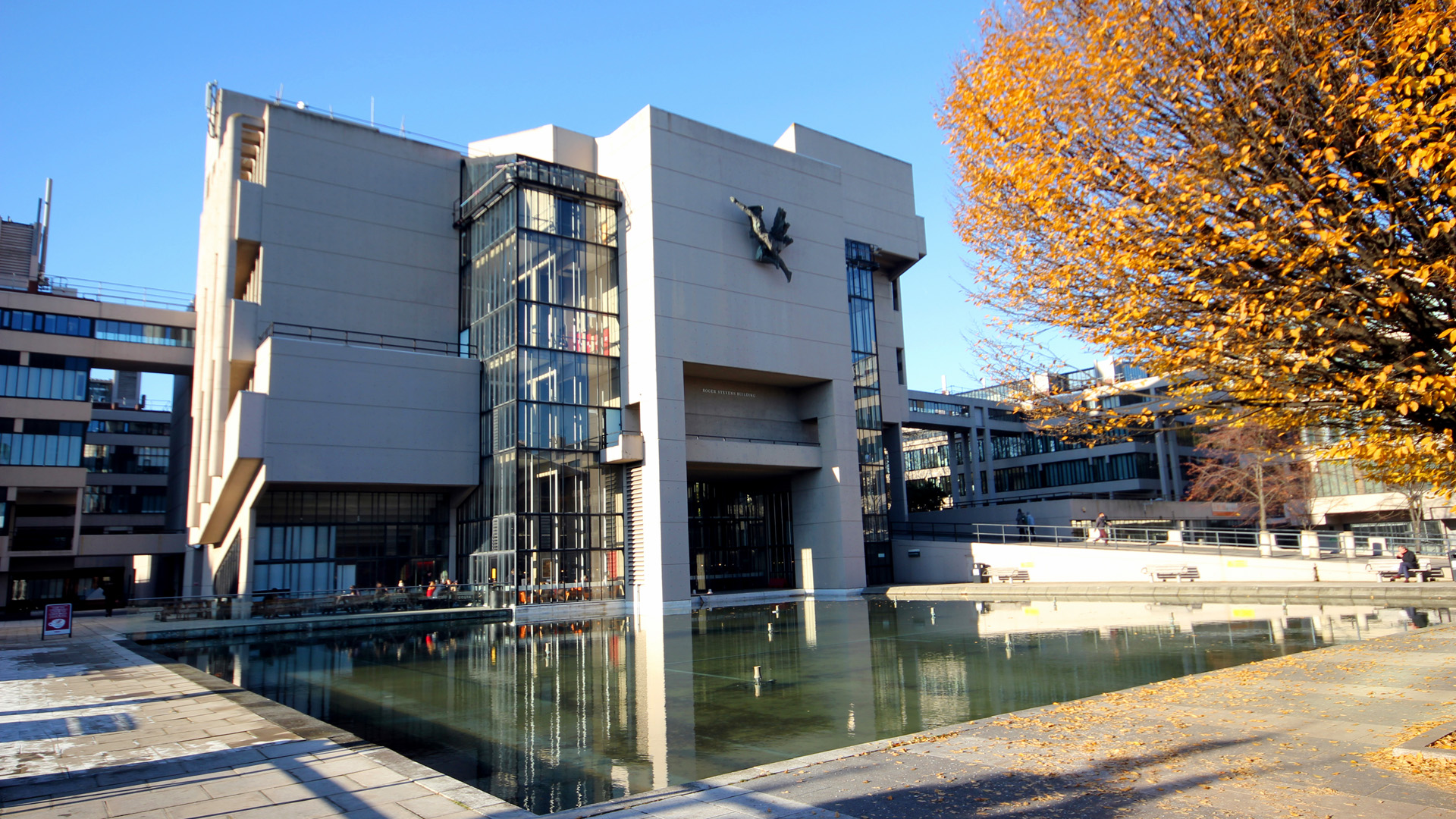
September 2012 saw the handover of the refurbished Roger Stevens Building at the University of Leeds after a major Fuse-designed refurbishment. The project also saw the re-modeling of the Worsley Lounge, on level 7 of the adjacent Worsley Building. The brief given to Fuse was to improve the student experience of both environments.
The Roger Stevens Building is one of a number of buildings designed by Chamberlin Powell & Bon at the University of Leeds. The practice was first appointed by the University in 1958 to design a comprehensive new Development Plan for the University which would help shape the University’s post-War growth. It is remarkable to think that at the time, the plan was to accommodate about 5,500 students. Today, there are approximately 32,000 full and part time students at the University!
The Roger Stevens Building was conceived in 1963 as a centralised lecture theatre block that would serve a number of the University’s Faculties. It was therefore placed at the heart of the University precinct, to be accessible to all and also to “express and symbolise its role as the visible centre of the knowledge exchange process” within the University. The building is therefore not immediately obvious outside of this part of the University campus but its unique form is instantly recognisable once seen. The building is set on the eastern side of the University’s Chancellor’s Court and can be approached from four directions and on a number of levels: it is deliberately placed at the heart of the University’s movement system and when conceived it was approximately less than 10 minutes walk from most parts of the campus.
Given the function, pivotal position and highly distinctive architectural character of the building, it was recently listed as Grade 2*, giving a high level of protection to not only the building envelope but also the interior. Part of Fuse’s role within the project was to ensure the refurbishment proposals were sensitive to the building’s existing fabric, yet responded to feedback received from the University’s students and staff in terms of improving the internal environment.
In terms therefore of informing the Project Brief, some of the more radical ideas offered by users of the building were “out of bounds” but there were a numbering of recurring themes. In no particular order, they were as follows:
Improve the general lighting levels
Simplify and rationalise the signage and way finding
Add colour/art
Improve level of information provided
Refurbish the toilets
Reduce clutter and rationalise recycle/refuse facilitiesSign post the building/improve entrance experience
Provide additional seating/waiting areas
Re-cover entrance, circulation and Lecture Theatre doors
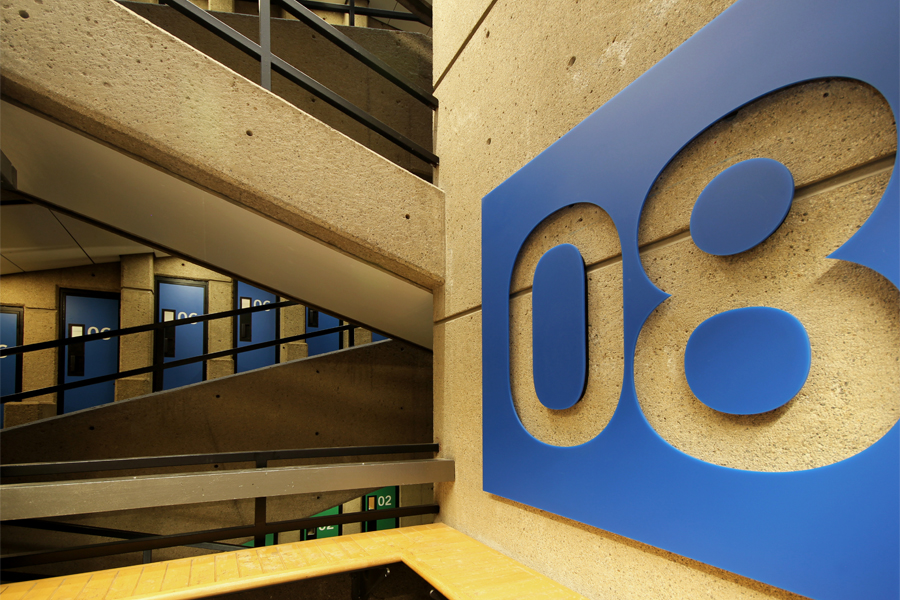
The signage in the building was in desperate need of an overhaul. Being such an unusual building, finding your way around the place for the first time or infrequent visitor was challenging to say the least. Whilst established students and staff eventually became familiar with the building’s layout, for new students, conference goers and other visitors understanding the logic behind the theatre numbering and locations used to take some time. Previous attempts to improve the situation had tended to add to the clutter and to the confusion. A ‘start gain’ approach was required and an ideal solution to the problem was found during our research into the history of the site and the original building design.
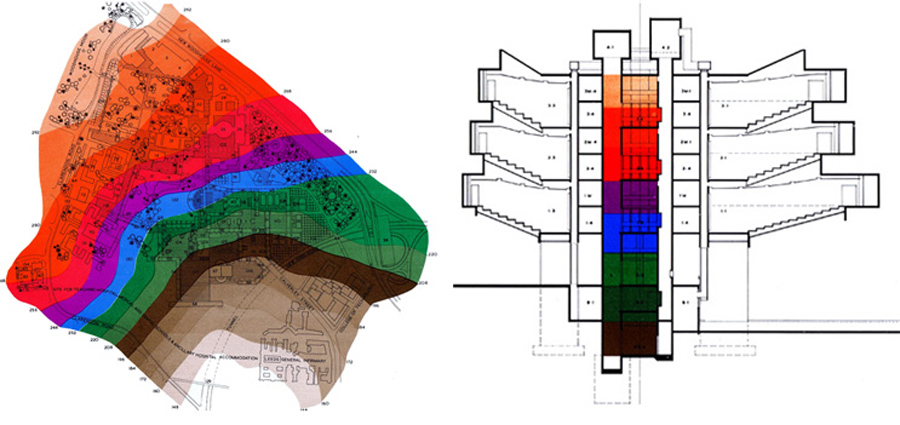
The images above are taken from the 1963 Development Plan Review prepared by Chamberlin Powell & Bon which illustrate the colour-coding device for the campus’s proposed new building levels which was based upon the existing university campus topography. This original thinking regarding colour coding the various levels became central to our proposals for the refurbishment.
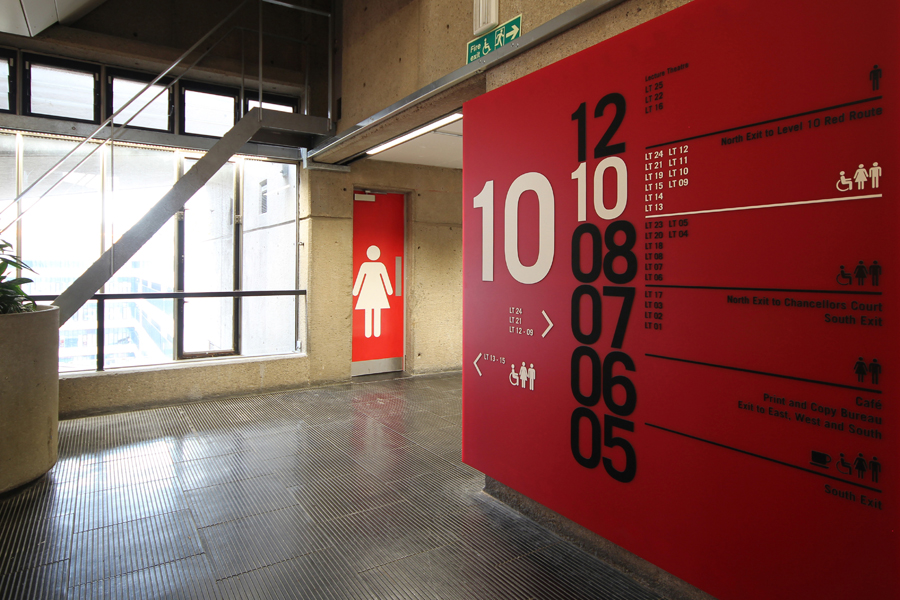
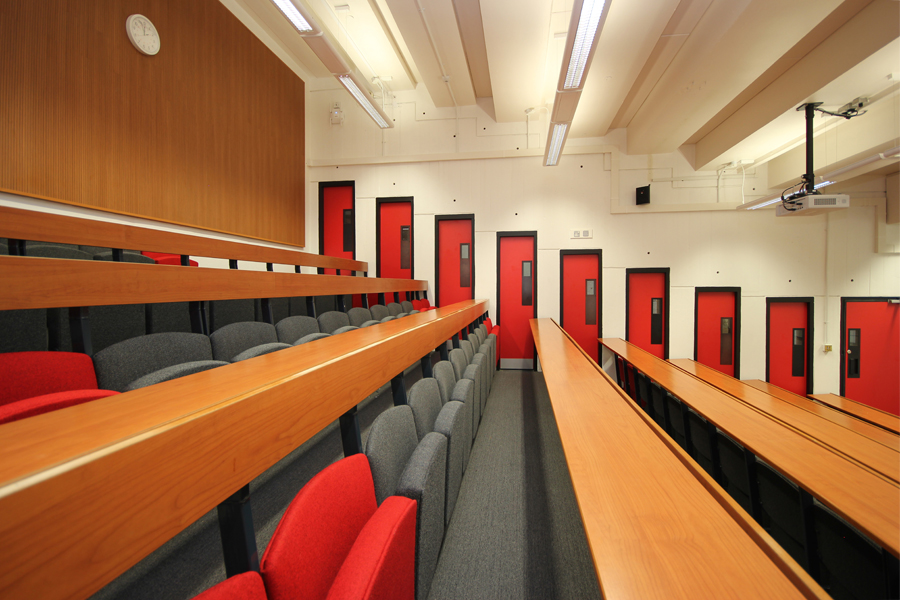
As can be seen from the photographs below, we used the colour coding to identify the levels within the building and the individual lecture theatres and to improve the legibility of the new signage and way-finding package. Graphics are large and clear containing no superfluous information. Upholstery used within the lecture theatres matches the colour of the doors and signage deployed externally. What was terribly complicated is now terribly simple.
The University of Leeds has a rolling programme of continual improvement of its internal student environment and on this occasion, half of the building’s lecture theatres were refurbished as part of the project. It is anticipated that this refurbishment will be mirrored in the remaining lecture theatres in the next few years.
The works undertaken within the theatres included the upgrading of the AV facilities, installation of new acoustic paneling, re-upholstering the seating, redecoration and new carpets throughout.
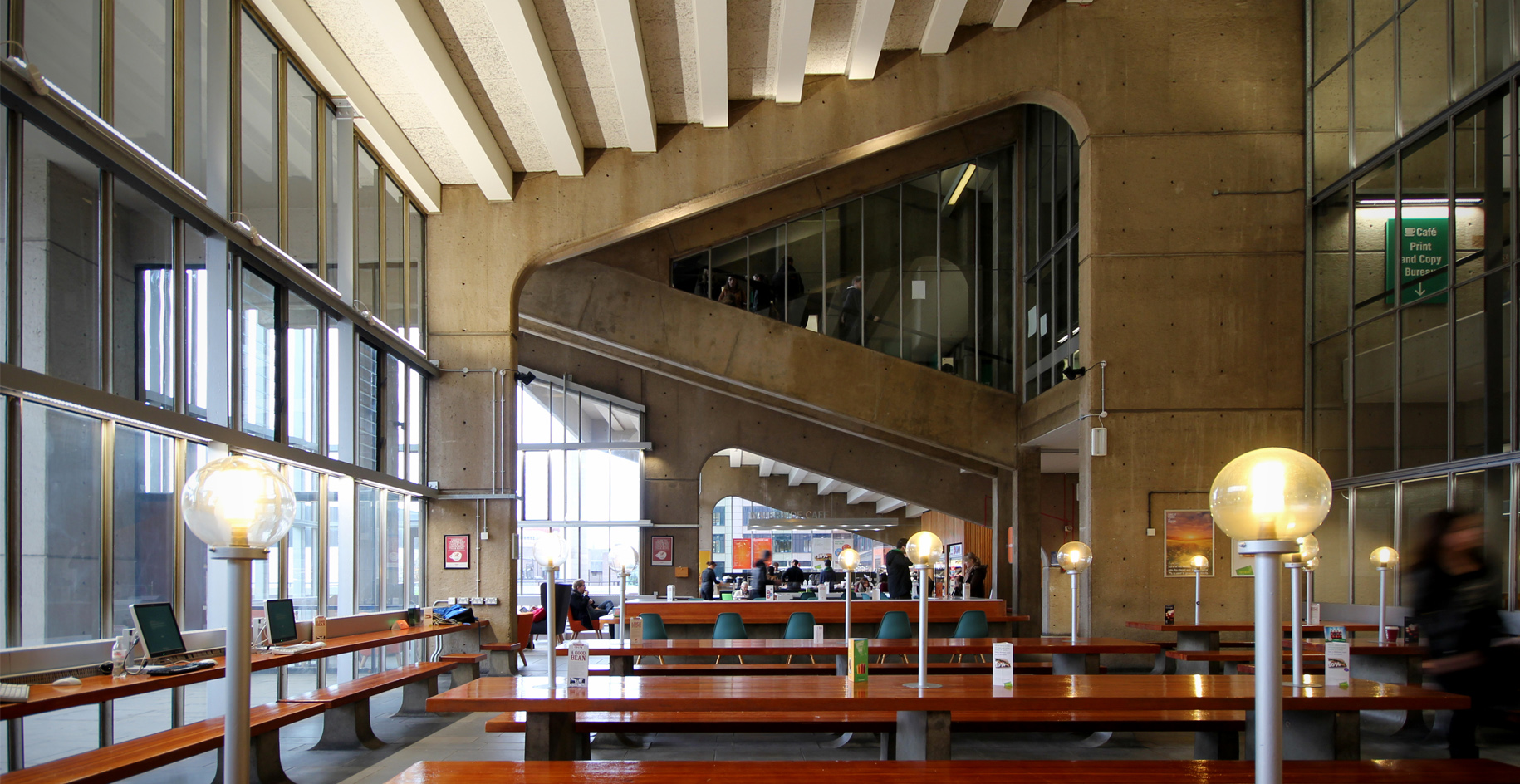
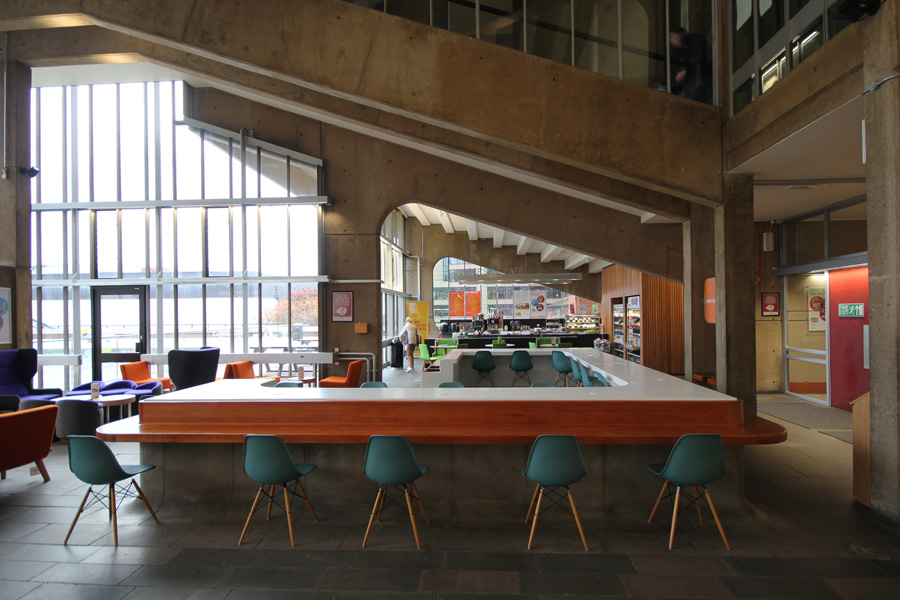
Perhaps the most significant intervention made within the Roger Stevens Building can be seen in the re-working of the building’s cafe at level 6 (lower ground floor level – see below) The cafe inhabits a wonderfully dramatic, double-height volume beneath the one of the main lecture theatres and benefits from continuous, full height glass walls on all sides. The existing cafe had however become extremely cluttered over time, with an unsympathetic central counter housing and smoking room enclosure watering-down the original design concept of a very clear space.
Following dialogue with the University team and Conservation/Planning Officers at Leeds City Council, Fuse proposed re-opening the cafe’s volume by removing the non-original smoking room glazed screen and re-locating the cafe counter facility. The effect has been profound, with a far greater proportion of the space now being used by visitors to the cafe.
Students and staff now benefit from a variety of seating/gathering spaces, in a more contemporary coffee shop environment. As a consequence since its completion, the University has seen a dramatic increase in the newly named Waterside Cafe’s patronage: the cafe again acting as a destination in its own right and extended learning space. Significantly, the cafe’s opening hours have been extended to cater for this demand.
There are always lots of people to acknowledge and thank and the following played a significant part in shaping the final scheme:
University of Leeds, Estates Services: Lisa Tyler (Project Manager and principal Client contact), Brian Ford (Head of Capital Projects) and Harry Birch (Clerk of Works)
University of Leeds, Commercial Services: Stewart Ross and Bev Kenny (Head of Catering & Conferencing)
Colin S Charlesworth: Tim Charlesworth (Quantity Surveyor & Employer’s Agent)
Redworth Associates: David Parker, Chris Adams (Building Services Engineers)
Multibuild: Main Contractor
And last but by no means least – the Fuse team: Steve Bell (The Main Man) who was ably supported by Scott Ryalls, David Eastwood, David Bradshaw and Rick Cartwright. Mr Harris got in the way on occasions too!

The Leeds College of Building mission statement is to ‘deliver a comprehensive range of high quality learning opportunities related to construction and the built environment’. The College’s Property Strategy, completed back in June 2009 identified a unique opportunity to deliver that vision by consolidating several of the existing leasehold sites to form a new, second campus in an area of Leeds that would be subject to major regeneration but which was also close enough to the city centre to access all available amenities and the local transport network.
It was not until January 2012 however that funding was in place and an architectural competition was announced to select a partner to help evaluate potential sites and design the new Leeds College of Building campus. Nearly 100 practices entered the first stage of the process and Fuse was one of six practices shortlisted and invited to submit outline proposals based on one of the potential new sites. At the time, Fuse had only recently celebrated its first birthday. The competition offered a unique opportunity to secure a landmark project on our doorstep and so we threw all our energy into winning the competition.
And win the competition we did!
This new campus will shape the lives of thousands of young people, as well as helping to further the careers of large numbers of existing construction workers, over the coming years. It has also created a landmark building in the South Bank area of Leeds, so it’s great to be part of this.”
Ian Billyard
Principal and Chief Executive
Leeds College of Building
I have to say that the new campus provides students with excellent facilities in which they take extra pride and care when working in. The workshops are large and spacious and the whole building offers incredible natural light wherever you are at any time of the day. At open events we have had so many comments about the innovative design of the building from the outside and the potential new students and parents are literally ‘blown away’ when walking around the inside of the building. ”
Paul Guise
Curriculum Manager for Apprenticeships
Leeds College of Building

Following selection, we spent several months carrying out plot tests in consultation with planning officers for a number of potential sites within the city centre. We also tested varied briefs for different scales of development as well as studying alternative phasing options and assisting with financial appraisals.
Early in 2013, the Leeds College of Building selected its preferred site at the corner of Hunslet Lane and Black Bull Street (known locally as the former Yorkshire Chemicals site) for a new campus to be developed in two phases. It is the first phase which has now been completed and design of the second phase is underway. Secured Skills Funding Agency (SFA) funding was secured – conditional upon achieving a BREEAM excellent rating – and the design was developed during the first half of 2013 in consultation with the Planning Department, Leeds Civic Trust and adjacent landowners. The Planning application was submitted in June 2013, incorporating amendments to address comments from members following an earlier Plans Panel presentation. Approval was granted in November 2013 and construction on site commenced just weeks later in January 2014
The saw-tooth form was generated as a direct response to the historic industrial roofscape of the surrounding area.
We also saw this as an ideal opportunity to integrate photo-voltaic panels (to be installed soon) on the south-facing roof pitches as a key component towards achieving the BREEAM excellent rating, whilst providing natural daylight to the workshops below via glazed North lights. Indeed, consistent with the original competition-winning design was an aspiration to introduce further daylight into the deep plan spaces so in addition to the North lights, the classrooms, library and refectory were arranged around a glazed atrium.
We also wanted to deliver a largely naturally-lit teaching environment without generating excessive solar heat gains. As the college had expressed a concern that too much glazing might create a distraction for students, we felt that the use of translucent Kalwall panels would provide an ideal solution by limiting views out whilst allowing excellent levels of daylight in. We also felt that the consistent diffused nature of the natural illumination was ideal for educational use.
We chose the Verti-Kal format (left and below) as it allowed us to continue the verticality and rhythm that we had sought to generate through the repetitive workshop bays along the Black Bull Street frontage. We felt that this integration of the traditional industrial roof form blended with modern technologies could become a distinctive and recognisable signature of the building and one that also had a synergy with both the construction education use of the building and the local area’s rich industrial heritage.


The Hunslet Road frontage called for a different treatment. This faced the three-storey Victorian frontage of the Printworks building (which coincidentally was recently converted into an extension to the Leeds City College campus – another Fuse project). Here, the glazed openings diminish in size at each floor level and so the new building responds in a similar fashion (below). The stone ornament which surrounds the Victorian openings of the Printworks is replaced with a more playful and contemporary interpretation in the form of brightly coloured reveals. The result is that the new building is starkly different to, yet is respectful of its historic neighbour.
Students began to move into the new campus in May 2015 and the building is now fully occupied.
Mike Harris, who led the Fuse design team, says:
“This building is designed to inspire the future talent of the construction industry. Over half the floor space consists of state of the art specialist workshops, there’s an impressive atrium entrance piazza, a stunning library area and a fantastic range of classrooms. All this creates a superb learning environment in a highly sustainable building that successfully prioritises all the modern building values of the 21st century.
“Moreover, this is the first major new building in Leeds that Fuse has designed and delivered and we are extremely proud of the result. Winning the initial competition was a major milestone in the Fuse story and the completion of the Leeds College of Building campus is yet another. ”

The Fuse Leeds College of Building design team was led by director Mike Harris. During the competition, pre-planning and tender stages, architectural design was by David Bradshaw and David Hall with interior design input from Scott Ryalls, with valued contributions from Steven Bell, Tracy Heywood, Carlton Campbell and Nathan Curtis. For the delivery and construction phases, project architect David Bradshaw was joined by James Smith, Iain McDonald, Tom Smith, Steven Bell and Susie Entwistle.
Project management and quantity surveying services were by Aecom (Rob Hardy and Josh Donnelly); M&E and structural engineers during the pre-planning stages were Buro Happold. Post-planning, the structural and civil engineer was 3E (Alan Liddell and John Mitchell) and M&E design was by Rotary (Ian Nunns). Landscape consultants were Re-form Landscape Architecture (John Simpson); highways consultancy was provided by Fore Consulting (Paul Irwin); CDM services were by WSP Safety (David Linnell) and the BREEAM consultant was GWP Project Services (Barry Rankin).
Main contractors were GB Building Solutions (Project Manager – Anthony Judge, Design Coordinator – Tim Hayes, QS – Mark Wright) and key sub-contractors included Highline (Tim Morgan) who were responsible for the cladding and HW Architectural Ltd (Mark Ramsden) who looked after the glazing package.
The project benefited from enormous support from Leeds City Council, notably from planning officer Chris Briggs and building control officer Basil Parylo.
Last but certainly not least, our client, Leeds College of Building, especially Derek Whitehead, Ros Scanlan and College Principal, Ian Billyard.

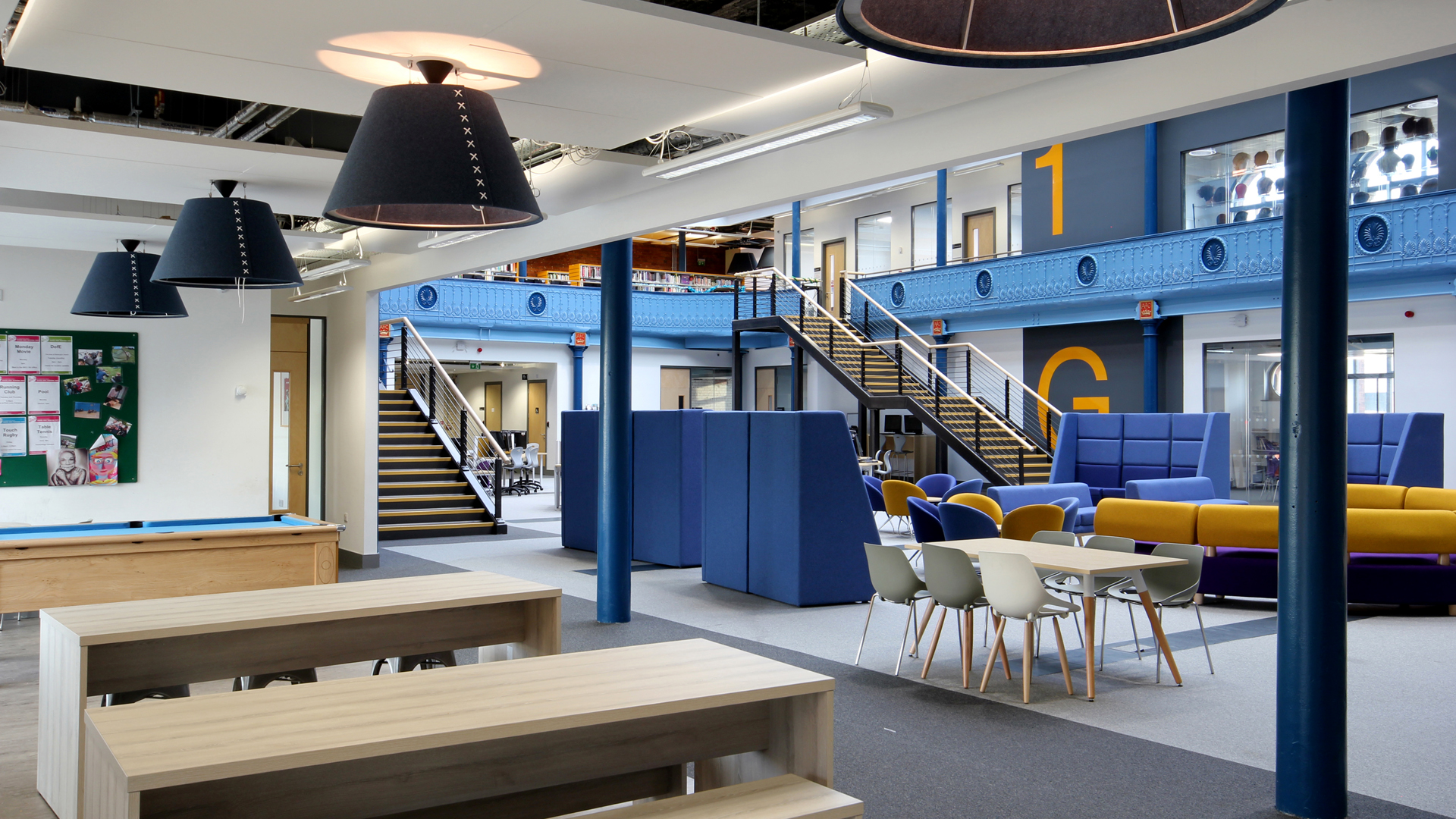
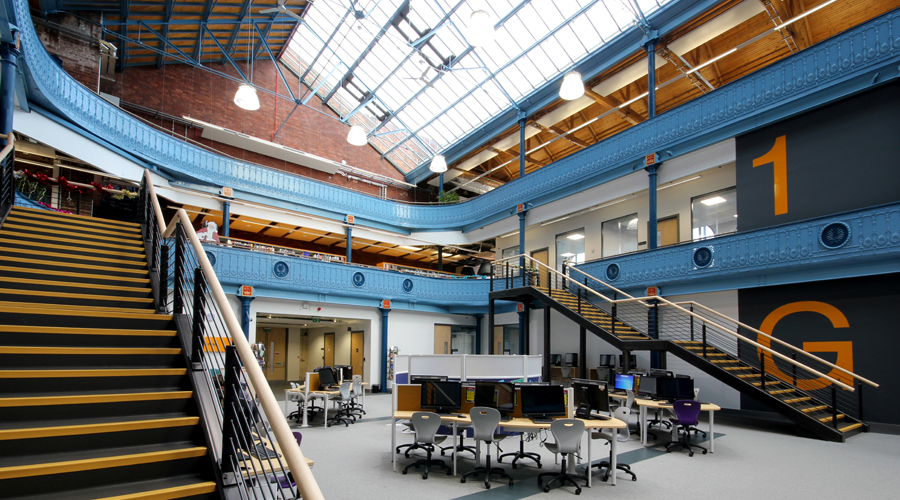
The latest phase of the Leeds City College Printworks Campus was completed in June 2015. The restored Print Hall 1A, part of the old Alf Cooke Printworks, has been given a completely new lease of life and now provides stunning informal teaching areas, staff offices and social spaces for the growing college. The project has won the Committed to Construction Award for Heritage and Refurbishment and the RICS Award for Building Conservation. It has also been nominated for the Leeds Award for Architecture under the Altered Building category.
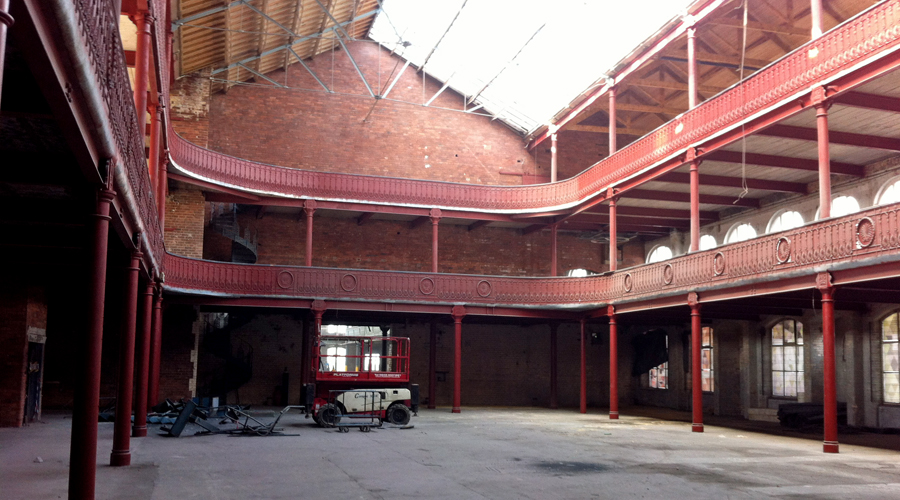
Originally built in 1894 to designs by Thomas Ambler, the Alf Cooke Printworks gradually developed over a duration of more than 100 years into a large industrial complex until its final closure in 2006. Schemes were initially brought forward to covert it into offices but but it was announced in 2011 that the site would become part of Leeds City College. The College’s Printworks Campus opened in September 2013, at a cost of £25 million for the renovation of the print halls and the construction of new buildings adjacent. This latest phase adds Hall 1A (pictured right before conversion) to the campus.
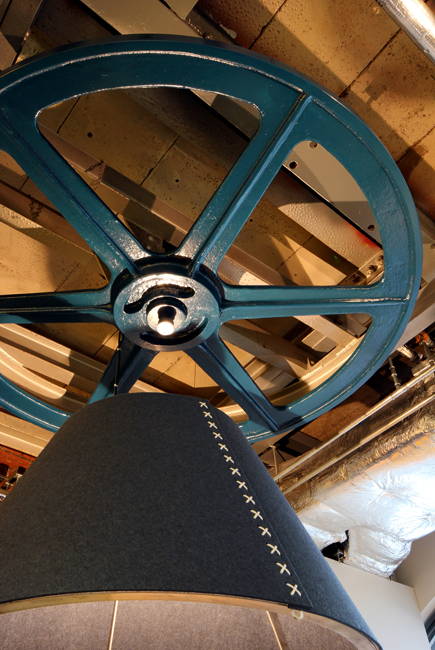
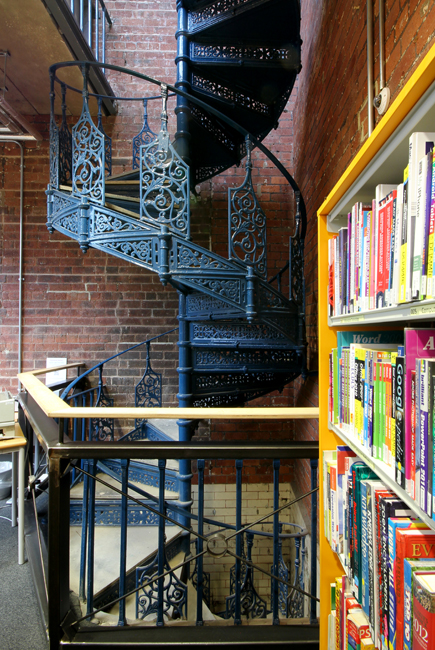
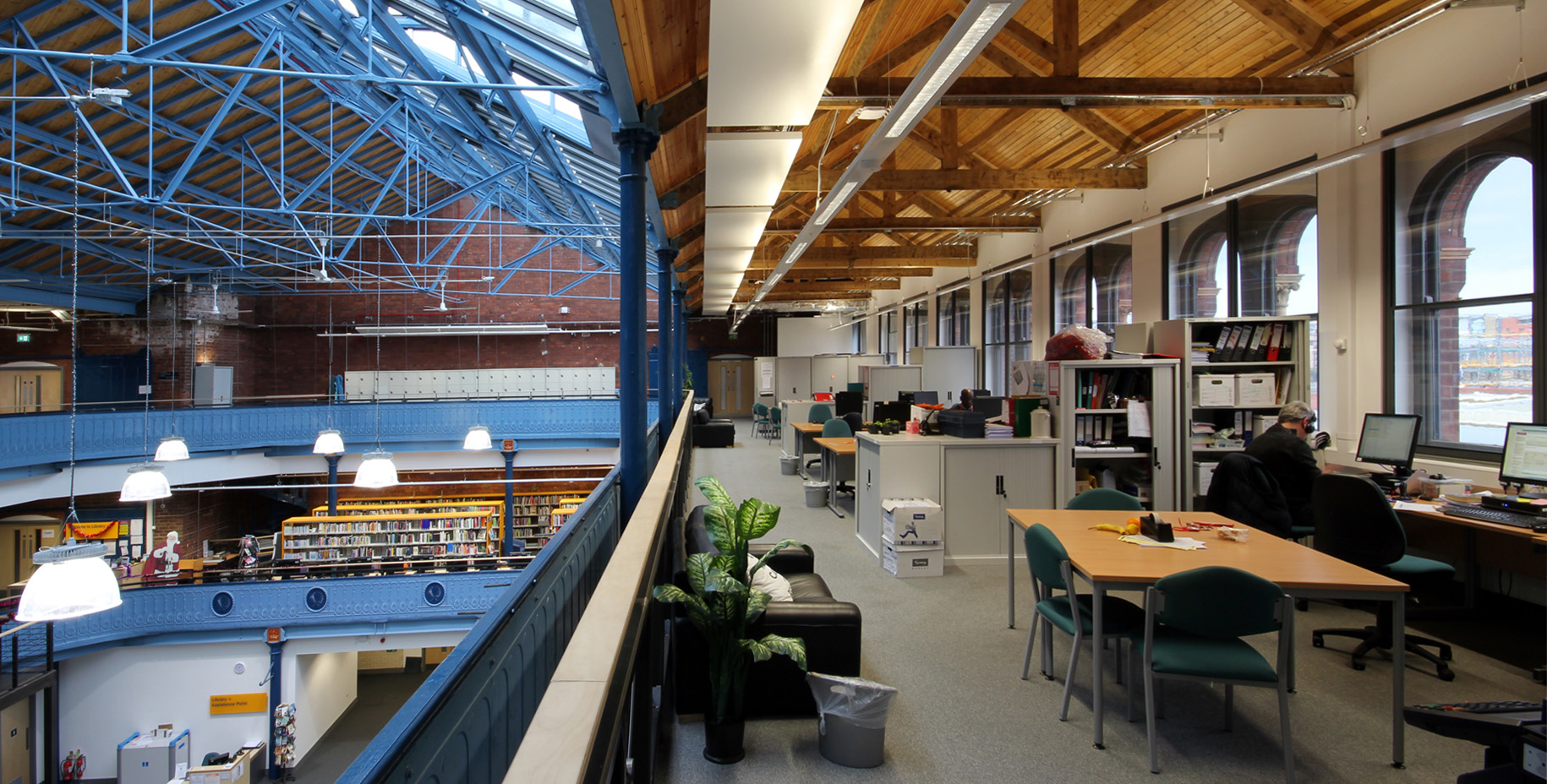
Certain existing features, including the decorative spiral staircase (below right) were identified as a key architectural features during initial conversations with the planning department and interests groups such as the Victorian Society and Leeds Civic Trust. Others included large industrial doors which have been retained and refurbished in-situ and the timber roof trusses which have been cleaned and exposed to retain as much as possible of the original character of the building.
In accordance with the ‘light touch’ approach, existing surfaces have undergone minimum repairs. Original features and protrusions have been left in-situ. The texture of existing materials, such as the brickwork, has been celebrated being left exposed, reinforcing the industrial character of the Print Hall. Existing cast iron columns have remained expsoed, with the required fire resistance achieved with intumescent paint finishes.
Externally both the Large & Small Print Hall elevations have been completely refurbished, including the landmark clock tower, stone details & embellishments. Most important of all, the volume of the print hall was maintained, still day-lit from the north light roof – which was completely replaced to improve the environmental performance of the building.
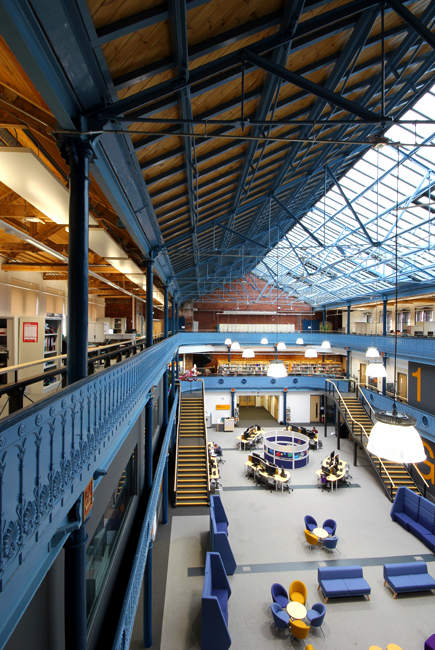
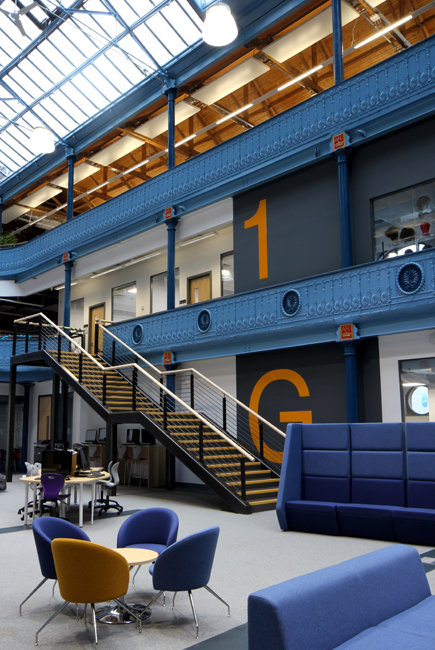
The completed project now provides a multi-purpose informal learning space (at ground floor in the atrium), a coffee bar with pool table etc, a large meeting room/ board room, IT office, staff offices (at the top floor beneath the exposed trusses) and plenty of enclosed formal teaching space. There is a strong focus on student ‘well-being’, with the oasis room , quiet rooms, hygiene room, prayer room as well as the library & quiet reading area, hair & beauty studio space and a number of help points.
The Leeds City College client team for the project were Jason Challender, director of physical resources, Louise Child, project manager and Corina Billing, assistant project manager.
The Fuse team was under the direction of Scott Ryalls, featuring project architect Stephen ‘Sketch’ Brewer working alongside project interior designer Andrew ‘Thurminator’ Thurman.
Main contractor for the works was Sewell Group (Ian Yeo, design coordinator, Mark Dodgson, project manager and Peter North, site manager). M&E installations were by G&H Group (Paul Cuss).Project managers for the college were AECOM (Rob Hardy, project director and Josh Donnelly, senior project manager). The client QS was Turner and Townsend (Alex Hargreaves, senior cost manager and Phil Naylor, cost manager).
M&E design was also by AECOM (John Pickering and Vince Grimley, principal engineers) as was structural design (Matthew de Renzy-Jones, regional director and Steve Seddon, associate director). Fire Consultancy was from Design Fire Consultants (Jonny Joinson, director) and finally, acoustic design was by Acoustic Design Technology (Andy Pagett).

Fuse Studios Limited, info@fuse-studios.com